It is an ordinary Friday evening in Rongjiang, a county in the mountains of Guizhou in southwest China. The floodlights flick on one bank at a time, and the sky above the stands turns the color of a struck match. A whistle sounds. The players jog onto the pitch, and if you watched them arrive an hour earlier you would not have picked them out of the crowd. One of them spent the day in a rice field. One drives a delivery truck. One sells vegetables at the morning market, one teaches at a primary school, one carries parcels up and down apartment stairwells. Tonight they wear numbers. Tomorrow they go back to work.
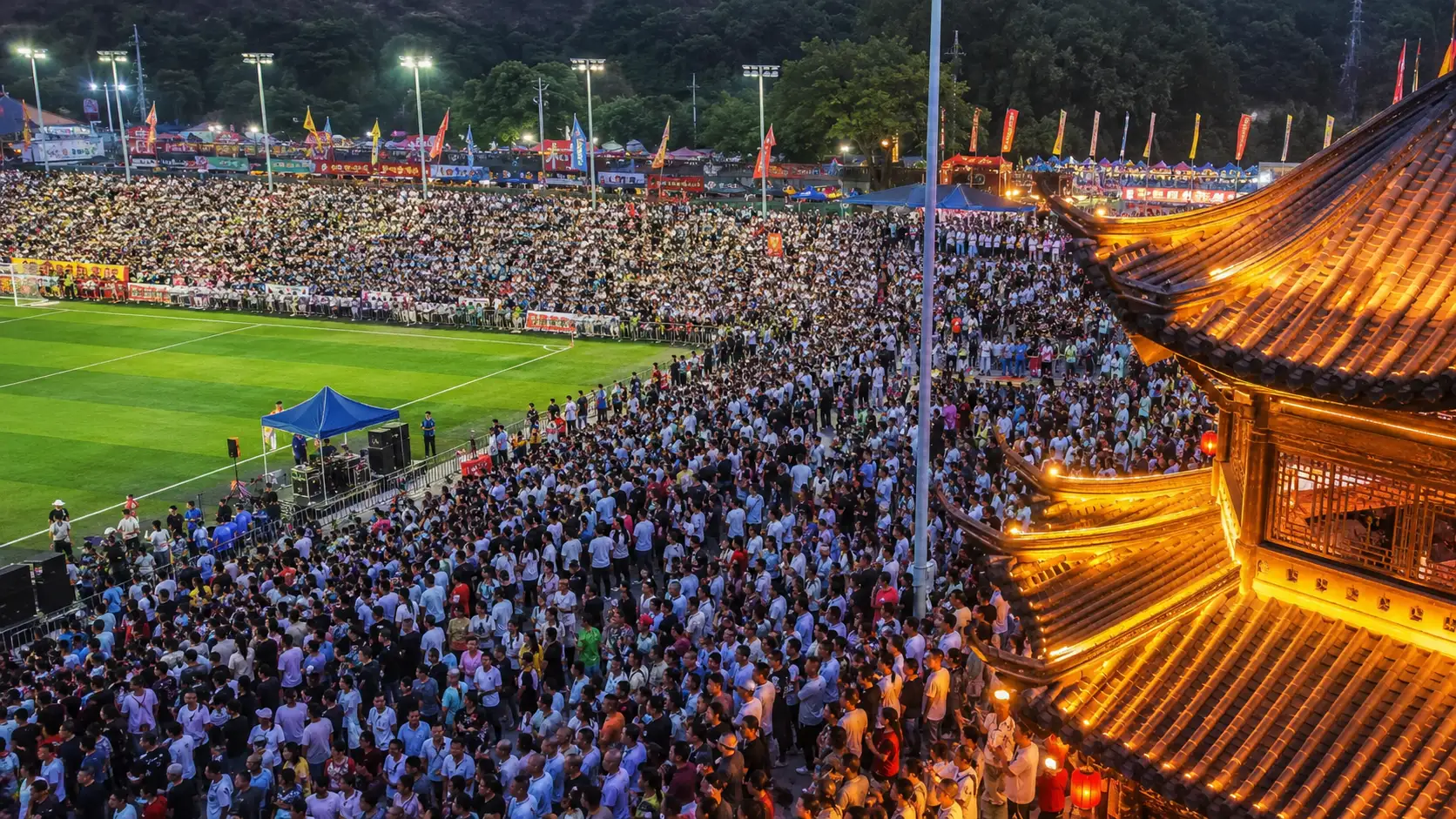
China may not be at the World Cup, but in Rongjiang, Guizhou, football still fills a county stadium on a Friday night. The stands hold tens of thousands. The gate costs almost nothing. And the question a lot of visitors bring with them, the polite version of "why is China not in the World Cup," starts to feel like the wrong question the moment the noise hits you.
What Cun Chao Is and Where It Came From
The locals call it Cun Chao, which is usually translated as China's Village Super League. It is a rural football league in Rongjiang County, in the Qiandongnan Miao and Dong Autonomous Prefecture of Guizhou. The rule that makes it what it is sounds almost too simple: the players have to be ordinary local residents, not professional signings. Cun Chao is the reason a lot of Chinese fans say the country already has a World Cup of its own, even in a year when the national team is nowhere near the real one.
It was not born as a polished professional product. Rongjiang had been kicking a ball around for decades, with dozens of registered village teams and a stubborn local football habit long before anyone outside the county had heard of it. In the summer of 2023, that habit turned into a proper league. The people who built it were not executives. One of the early organizers, Yang Yajiang, was a 49-year-old primary school headmaster who ended up acting as director of performances, event coordinator, and a player for his own village side, all at once. He said the work exhausted him and made him feel twenty years younger at the same time.
The division of labor is worth understanding, because it is easy to get wrong. This was not a top-down showpiece, and it was not pure spontaneity either. Villagers organized the teams, the fixtures, the rules, and the prizes. The local government handled the unglamorous parts: the venue, the electricity, security, sanitation. As Yang put it, it was a pure football competition with no financial interest attached. The prizes tell you everything about the spirit of it. Winners went home with pork, lamb, chicken, and local rice.
The Sound and Heat of the Stadium
A Cun Chao match is not only a football game. It is a county festival that happens to have a ball in the middle of it.
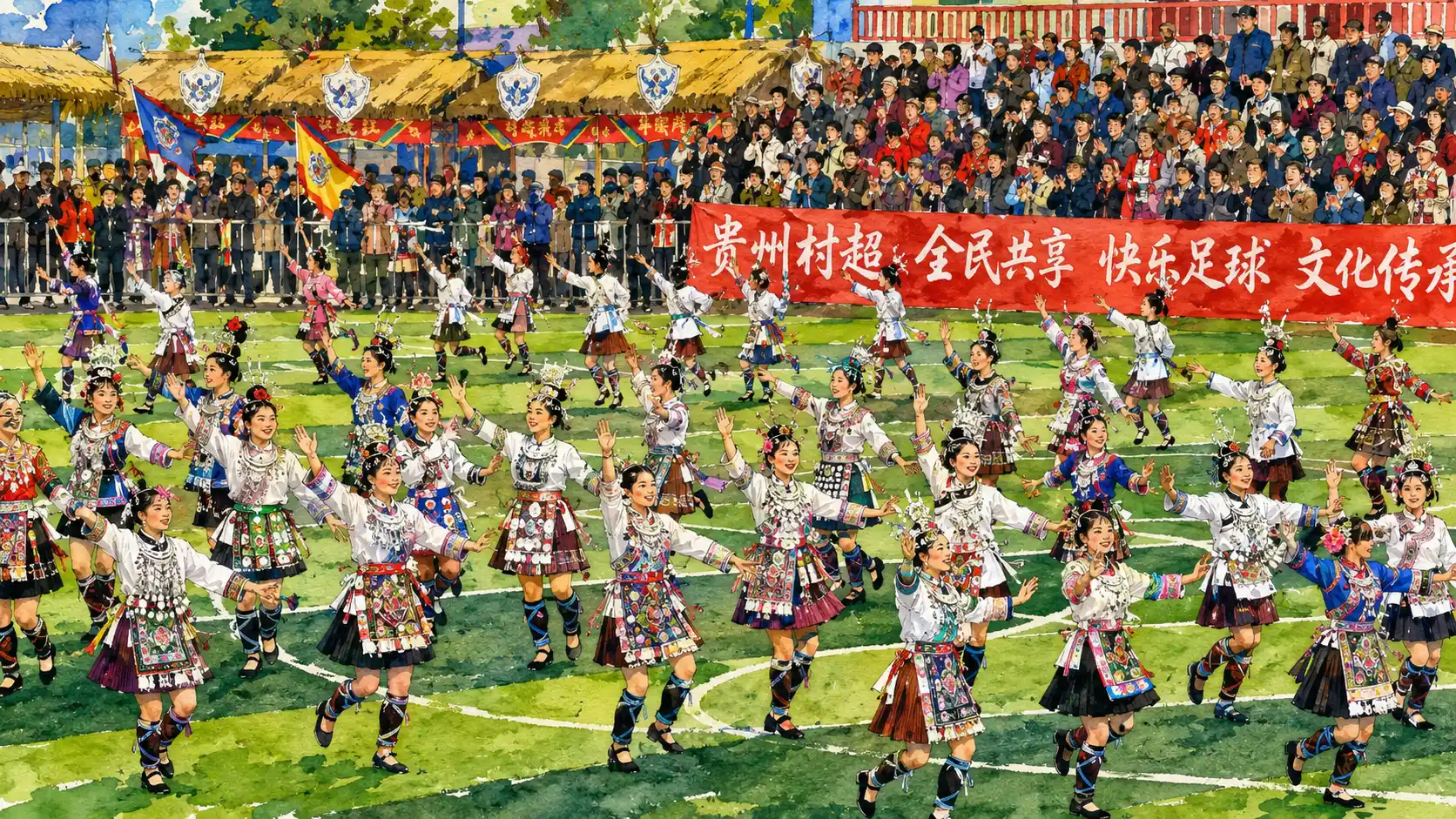
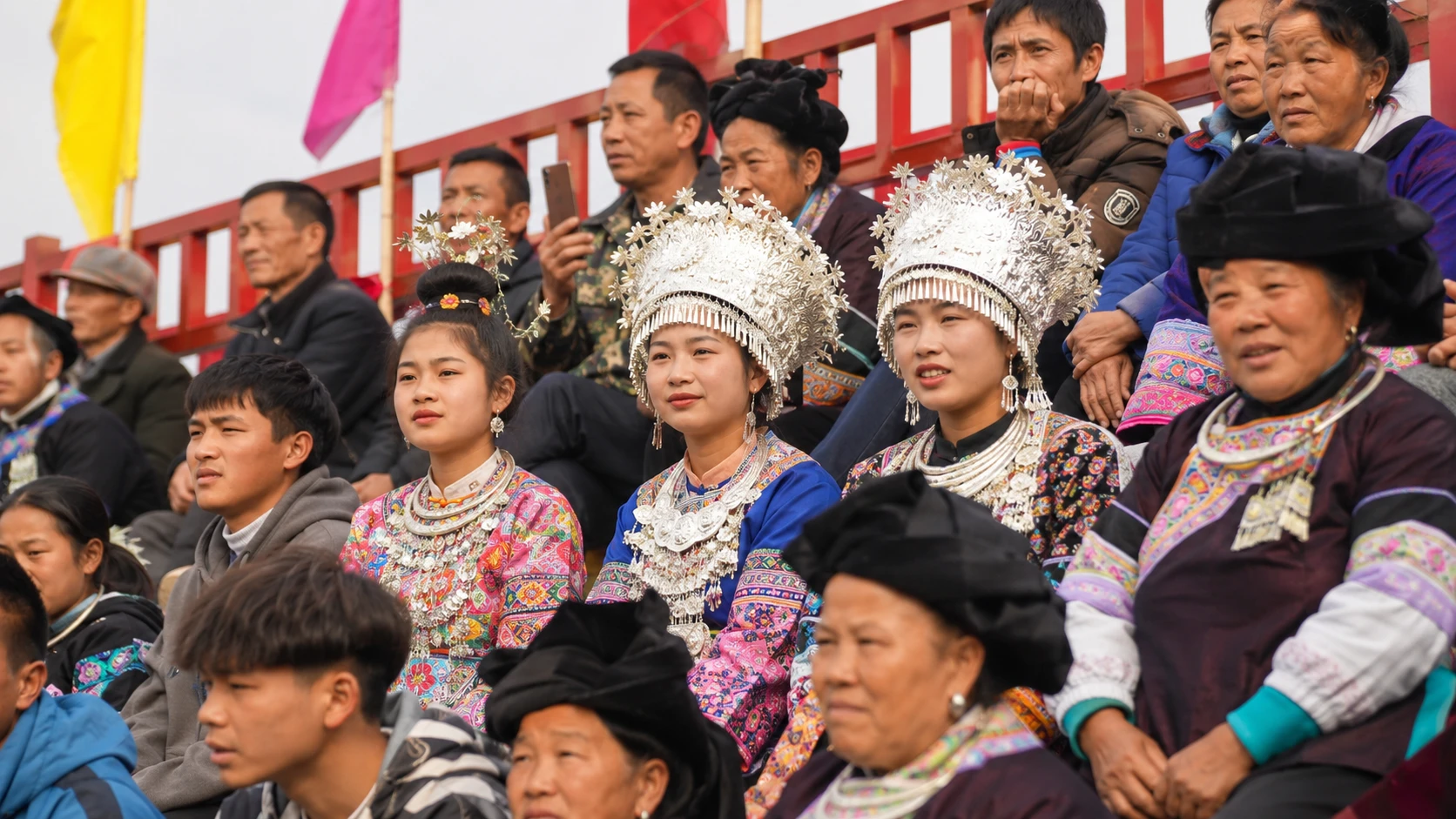
There are no hired cheerleaders. When the teams walk out, they are led by their own villages, people in traditional Miao and Dong dress carrying glutinous rice, cured fish, and other local goods on their shoulders. At half time the pitch fills with folk performance instead of advertising. You hear the Dong Grand Song, the polyphonic choral singing that UNESCO recognizes as intangible cultural heritage, and the reedy swell of the Miao lusheng, a bamboo mouth organ played in ranks. Rongjiang is home to fifteen ethnic groups and eleven national intangible cultural heritages, and on match night it puts them all on the grass.
Then there is the sheer heat of the crowd. Rongjiang football fans do not sit politely. The stands are full past capacity, with people standing along the walls and squatting on the ground where the seats run out, and the overflow gathers at big outdoor screens set up around town. Average attendance passed ten thousand a match, roughly the same as China's professional top flight. Every goal lands like a public holiday. Neighbors bring their own food and press it on strangers. Free water and snacks get passed down the rows. The whole county behaves, for one night a week, like a single loud family.
The Neighbors on the Field
The strongest thing about Chinese amateur football is not that the players look like stars. It is that they look like the people you passed on the street this morning.
Cun Chao squads are stacked with vendors, farmers, tilers, butchers, drivers, students, and factory workers. They come from Miao, Dong, Shui, Han, and Yao backgrounds. On the pitch they are the ones the whole stand is screaming for. The next morning they open the shop, climb back into the excavator, or stand behind the market stall again. That double identity is the emotional engine of the whole thing. When a man who laid tiles all week curls one into the top corner, the roar is not only for the goal. It is for the recognition that the hero and the neighbor are the same person.
This is China grassroots football without the varnish. No transfer fees, no imported names, no VIP box. Just people playing for the honor of the place they are from, which is exactly the thing professional football keeps promising and pricing out of reach.
Why It Suddenly Became a National Sensation
So why did a county league in the Guizhou mountains become a national obsession, and then an international curiosity that pulled congratulations out of former England striker Michael Owen?
Part of it is the phone in everyone's hand. Short clips of Cun Chao goals spread across Douyin, the Chinese sister app of TikTok, and across Weibo, and the county's Friday nights suddenly played on screens two thousand kilometers away. Within a single summer the tournament racked up tens of billions of online views. One man in a wheelchair traveled more than two thousand kilometers by plane and high-speed train just to sit in that stand in person.
The deeper reason is contrast. After years of expensive, disappointing professional football, people were hungry for something cheaper, warmer, and easier to believe in. Cun Chao went viral because it made Chinese football feel local again, and local is a thing money cannot fake. It is worth being honest here, the way careful reporting has been: these village leagues are a genuine wave of enthusiasm, not a finished ladder that carries village players up into the professional game. What they proved is smaller and more human. The appetite for football in China was never missing. It was just waiting for a version that felt like it belonged to ordinary people.
From One County to One Country as Su Chao Takes Over
If Cun Chao showed that a single county could love football like a festival, the next summer showed that an entire province could do the same thing at a much larger scale.
In 2025, Jiangsu, the wealthy province north of Shanghai, launched the Jiangsu Football City League. Everyone calls it Su Chao. It runs from May to November with thirteen teams, one for each city in the province, and the fans immediately turned it into a running joke about regional pride, complete with food-based nicknames for every derby. The scale is the part that stops you. On August 17, 2025, the Nanjing Olympic Sports Center drew 60,633 spectators for a single Su Chao match, setting a Chinese amateur football attendance record, and by the later rounds the league had pulled in more than 1.3 million spectators in person according to Chinese media reports. Tickets were cheap or free. This was not the Chinese Super League. This was the Jiangsu people's own World Cup, and Jiangsu official media said so in exactly those words.
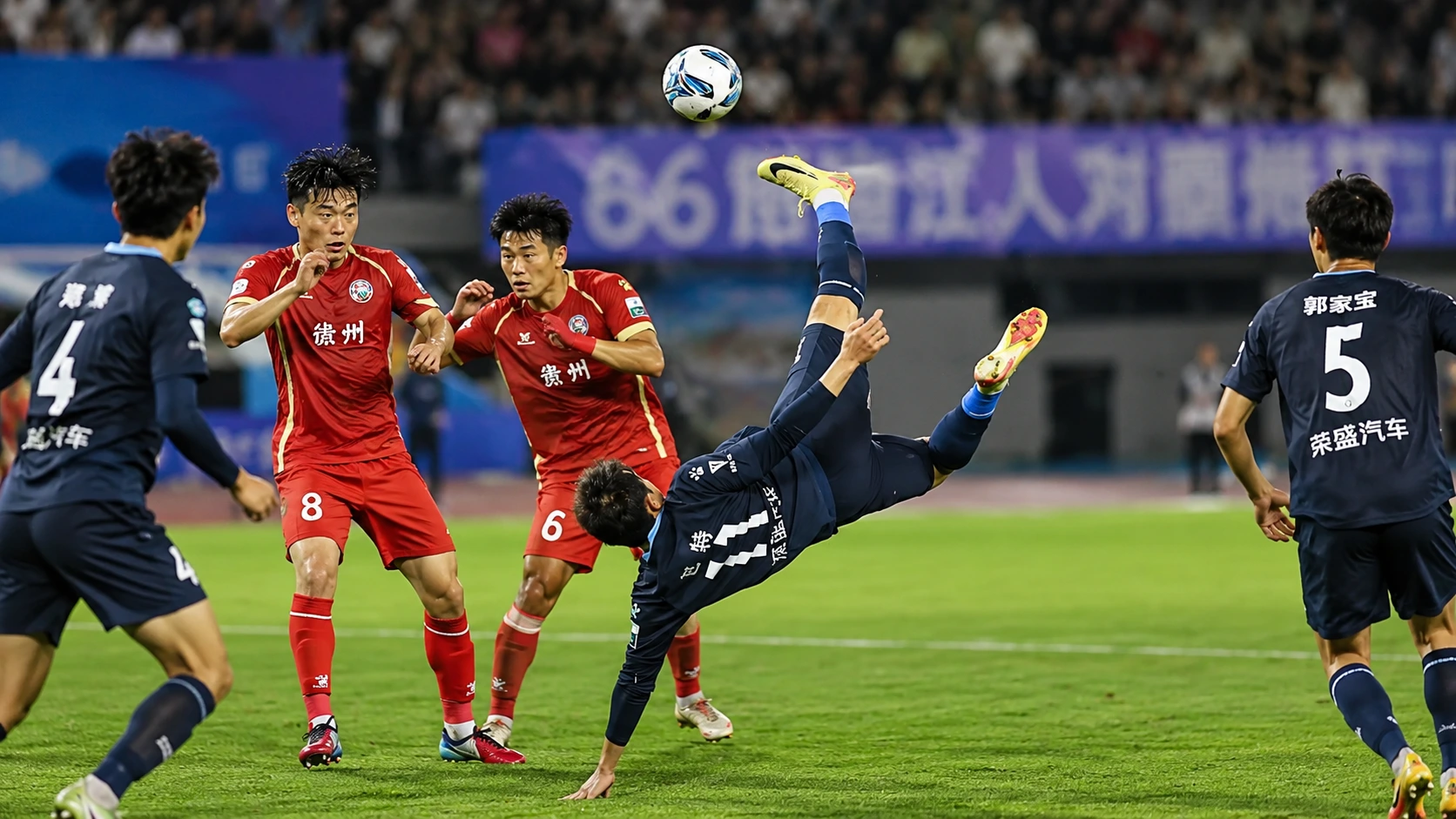
And the football itself refused to stay humble. Kou Cheng, a 17-year-old student, scored 1 minute and 17 seconds into a match for Suzhou against Yangzhou, the fastest goal in the league. Dai Hu, 39 years old and by day the Party branch secretary of a village in Lianshui, drove fifty kilometers to train and then volleyed home the league's 100th goal. Bat, a player for Taizhou, produced a bicycle kick clean enough to belong in a professional highlight reel. Amateur, in Su Chao, stopped meaning ordinary.
Back in Rongjiang, the whistle blows for the second half. Somewhere in the stand a grandmother is on her feet. The delivery driver who scored last week is being marked by a man who fixes air conditioners.
A lot of foreign friends ask the same thing. China is huge, so why does it so rarely appear at the World Cup? Is it because China has no football culture? Watch a night like this and the answer arranges itself. If you want to feel where Chinese football passion actually lives, do not only watch the national team. Go to Rongjiang for Cun Chao. Go to Jiangsu for Su Chao. Sit in a stand that sings its own heritage, eat food a stranger hands you, and cheer for a farmer who plays like the pitch was built for him. China's national team not being good enough does not mean Chinese football is not alive. China's national team may miss the World Cup, but the next Friday night in Rongjiang, the lights will come on again, the whistle will sound, and China will still have a World Cup of its own.
FAQ
When is Cun Chao held?
Cun Chao is usually a spring and summer event, built around weekend matches in Rongjiang, Guizhou, with the first breakout season running from May to July in 2023. Exact dates shift every year and the league has paused and restarted around local events such as flooding, so check official Rongjiang or Cun Chao announcements before planning a trip.
Where can I watch Cun Chao?
The home of Cun Chao is Rongjiang County in the Qiandongnan Miao and Dong Autonomous Prefecture of Guizhou, in southwest China. Admission has often been free or very low cost depending on the match and the season, but access rules change, so confirm current arrangements before you travel.
What is Su Chao?
Su Chao is the popular nickname for the Jiangsu Football City League, a provincial competition that began in 2025 with thirteen teams representing the cities of Jiangsu. It runs across the province from May to November and became famous for huge crowds, cheap tickets, and fierce, friendly city rivalries.
Are Cun Chao and Su Chao professional leagues?
No. Both are grassroots, amateur-style tournaments rather than professional club systems. Their appeal comes from ordinary players with everyday jobs, strong local identity, low-cost or free access, and enormous community crowds, not from big transfer budgets or imported stars.
Do I need to understand Chinese football to enjoy it?
Not at all. The experience is easy to read even if you have never followed China football fans before: floodlights, drums, local food, folk performances, packed stands, and players whose ordinary daytime lives are part of the show. You do not need to know the standings to feel why the county is on its feet.