"Yang jie, san que yi - we need one more player."
It is the kind of call that can turn an unfinished table into an afternoon plan. In Chinese, *san que yi* literally means "three are here, one is missing." Around a mahjong table, it is an invitation.
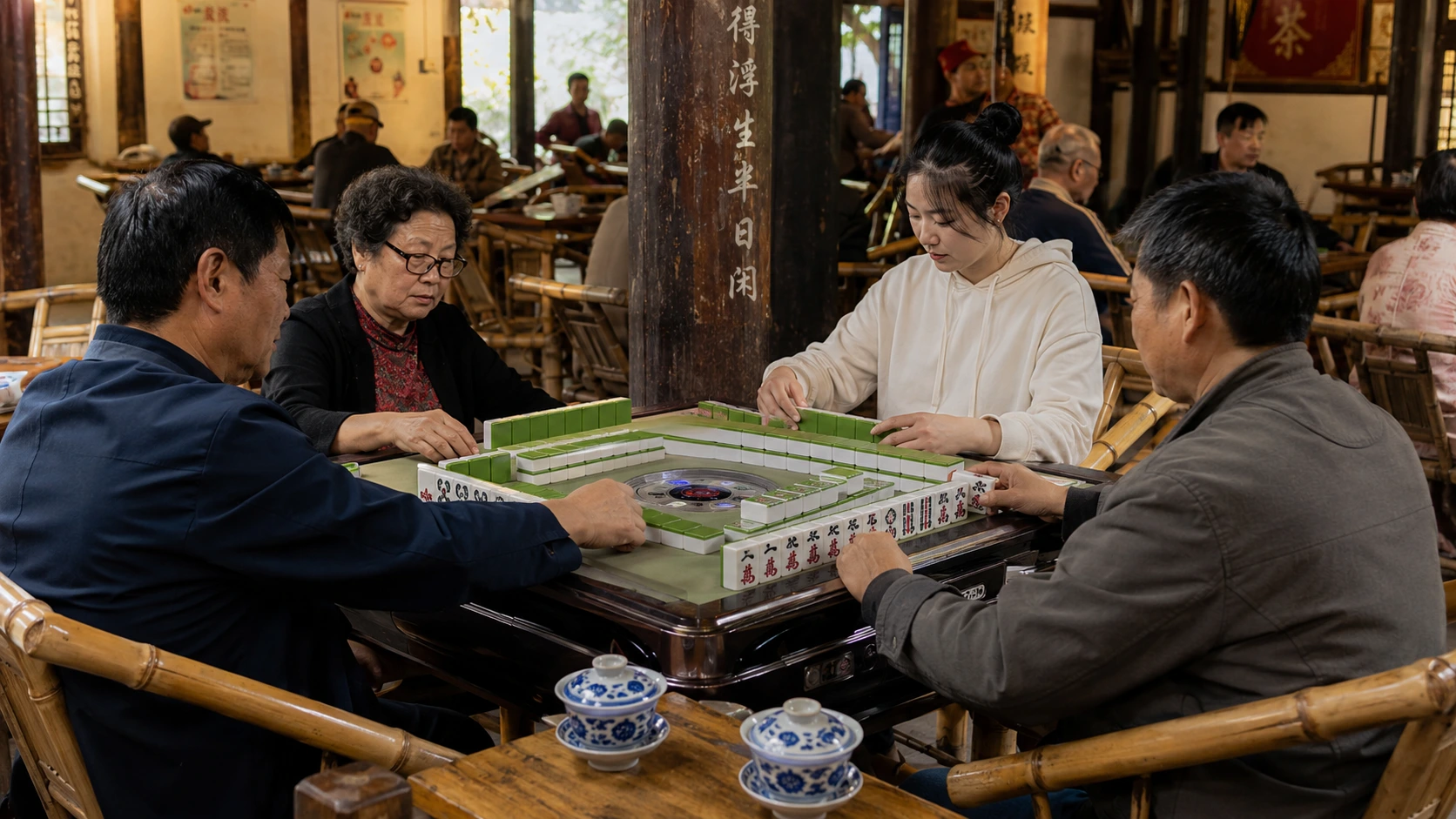
A typical Chengdu scene might begin with three people seated beside an automatic mahjong table. Four covered tea bowls wait within reach, but one chair is still empty. The tiles remain hidden below the tabletop.
Then Yang jie arrives. *Jie*, meaning "older sister," is a familiar and friendly way to address a woman. She takes the fourth seat. The center of the table opens, and a square wall of shuffled tiles rises into view.
To understand Chengdu mahjong culture, begin with that empty chair. Mahjong is played across China, and Chengdu is hardly the only city that loves it. The more interesting question is why this four-player game fits so naturally into everyday life here.
What does mahjong give four people that conversation alone cannot?
In short: Mahjong fits Chengdu because teahouses give people a place to stay for hours, while the four-player rhythm lets friends and families talk, pause, and reconnect without having to carry a conversation continuously. Common Sichuan formats such as xuezhan daodi can keep the table active even after one player wins, reinforcing the city's long, social afternoons.
The Fourth Player Makes an Afternoon Possible
Three people can drink tea together. They can talk, scroll through their phones, or decide to go somewhere else. But a four-player mahjong game cannot properly begin until the last seat is filled.
That small requirement gives the gathering a shape. Once the fourth person arrives, everyone knows what they will do together. Nobody needs to propose an itinerary. Nobody has to turn an ordinary meeting into an occasion.
The players may be relatives, neighbors, old colleagues, or regulars who have spent years meeting at the same place. Some groups arrange their games in advance. Others begin with a message or a call: *san que yi*. Either way, finding the fourth player means more than completing a set. It creates a shared block of time.
Mahjong also answers a quieter social problem. If four people meet only to talk, someone must keep the conversation moving. A pause can feel like the meeting is running out of energy. At the mahjong table, a pause is simply part of the game. There is always a tile to draw, a hand to inspect, or another player's move to watch.
Family members do not need to schedule a serious conversation. Neighbors do not need a fresh subject every time they meet. Friends who have known one another for decades do not need to invent a new activity. The game gives them something to do while everything else - news, complaints, teasing, silence - comes and goes.
The fourth player solves the question of who will join. The turns solve the question of how everyone will stay.
Conversation Moves at the Speed of the Tiles
A mahjong table has its own rhythm: draw, look, discard, wait. A hand reaches for a covered tea bowl. Two players continue a story while the other two study their tiles. Someone calls *peng* and claims a matching tile. The conversation stops, then returns from a slightly different direction.
In Sichuan, this kind of unhurried talk is often called *bai longmenzhen*. The phrase can mean chatting, trading stories, or passing along the ordinary news of family and neighborhood life. It does not require a formal subject or a neat conclusion.
A typical exchange might run like this:
"How did your son's exam go?"
"Don't ask. Math was bad again."
A tile lands on the table.
"Peng."
For several turns, the subject disappears. One player considers her hand. Another pours more tea. Then someone asks whether the boy is still spending every evening on his phone.
At the table, talk does not have to proceed in a straight line. A complaint about school can become a discussion of dinner, work, the price of vegetables, or a neighbor who has not been seen for several days. The game carries the group through every gap.
That makes mahjong different from an activity that demands everyone's full attention and different from a conversation that demands constant speech. It creates room for both. A player can concentrate without withdrawing from the group. Someone can fall silent without making the silence uncomfortable. A story can wait for the next discard.
This rhythm also helps people of different ages share the same table. They do not need identical interests. They only need enough familiarity with the game to follow the turns. The conversation can remain light, become personal, or vanish for a while.
Mahjong does not require four people to keep talking. It gives them a reason to keep sitting together.
Chengdu Gave the Table Somewhere to Stay
The game explains how four people can share an afternoon. Chengdu's teahouses explain where that afternoon can happen.
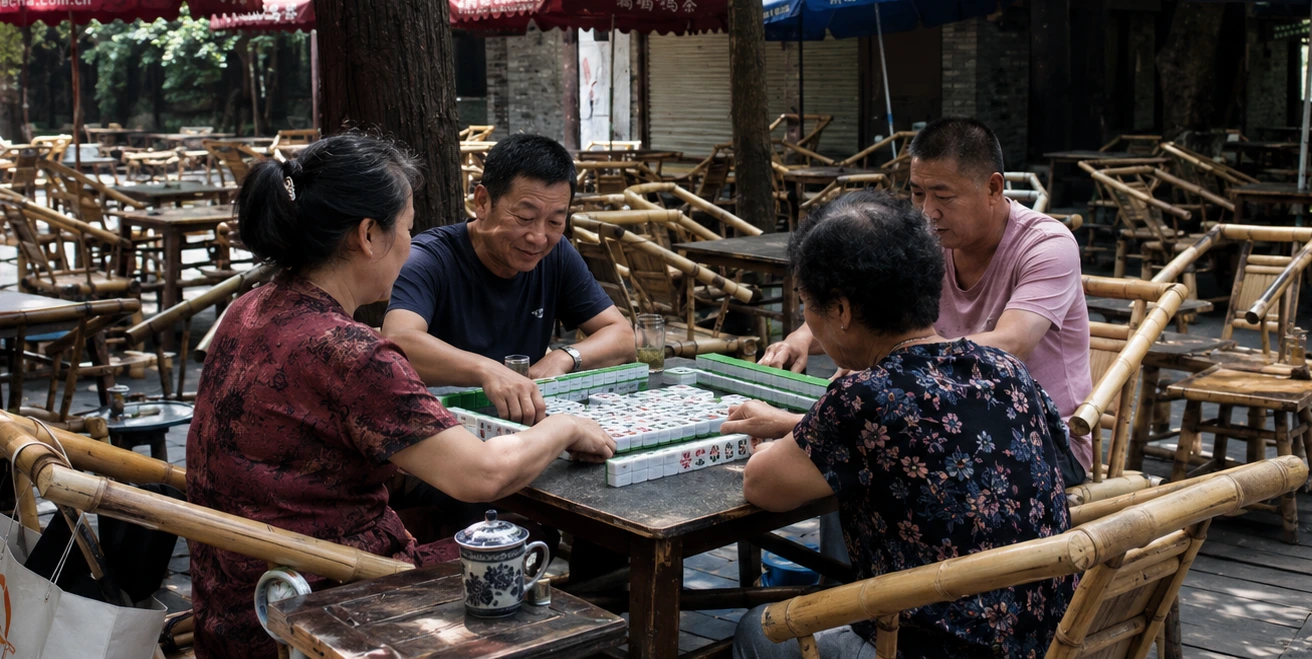
Chengdu's teahouse culture has long made room for more than drinking tea. Street-corner teahouses, park tea gardens, community rooms, and small mahjong parlors offer tables where people can remain without turning every hour into a new purchase or planned activity.
Historian Wang Di, who has studied Chengdu teahouses across the 20th century, describes mahjong as one of the most popular activities in the city's small corner teahouses after public leisure revived in the reform era. These places served people from different social backgrounds. They were commercial spaces, but they also worked as parts of neighborhood life.
The arrangement is simple. The teahouse provides chairs, hot water, and permission to stay. Mahjong fills the time without requiring a performance, a reservation, or a special event.
Local Sichuan rules can help keep that table moving. In a common format called *xuezhan daodi*, often translated as "Blood Battle to the End," the first player to complete a winning hand does not necessarily end the round. The other players can continue until three have won or the available tiles run out. House rules vary, and not every table plays in exactly the same way, but the format gives Sichuan mahjong an unusual sense of continuation.
That continuity is not always peaceful. Tiles striking a table can travel through thin walls. Money can sharpen arguments. In 2000, Wang Di notes, a Chengdu resident took a neighborhood committee to court over the near-constant sound of mahjong in a residents' activity room. A shared leisure space for some had become an intrusion for someone else.
The tension matters because mahjong is not a decorative custom staged for visitors. It occupies real hours and real spaces. People negotiate noise, stakes, time, and boundaries around it, just as they do around other parts of everyday life in China.
The teahouse supplies the table and the time. Mahjong gives four people a way to use both.
Nobody Leaves After the First Game
The first game ends. Someone turns over a winning hand. Someone else points at the tile she should not have discarded. The tea is no longer as hot as it was when Yang jie took the empty seat.
The complaint about a son's mathematics score has already drifted toward a question about dinner. Perhaps it will return. Perhaps nobody will mention it again.
This is where Chengdu's reputation for slow life becomes easier to understand. "Slow" does not have to mean quiet, idle, or alone. A mahjong table can be loud. It requires attention. It produces winners, losers, jokes, irritation, and the occasional argument.
What it makes visible is a willingness to leave several hours open for other people. The game keeps the afternoon from needing a purpose beyond the four chairs. Conversation can continue, stop, and begin again without bringing the gathering to an end.
Someone presses the control beneath the edge of the table. The used tiles disappear into the opening. Inside, they tumble and shuffle.
Then the center rises again.
Four pairs of hands reach forward.