The child is told to stand still before the street sees him.
Not almost still. Not stage still. Completely still.
Behind a temporary curtain near the parade route in Wuchuan, adults work around him with the quiet intensity of people tying a boat before bad weather. A sleeve is adjusted. A painted robe is smoothed across the chest. A belt is tightened over hidden metal. Someone crouches to check the place where the support disappears beneath cloth. The child lifts his chin. His eyes are lined dark enough for the crowd below to read them from a distance.
Outside, drums are already moving toward the corner.
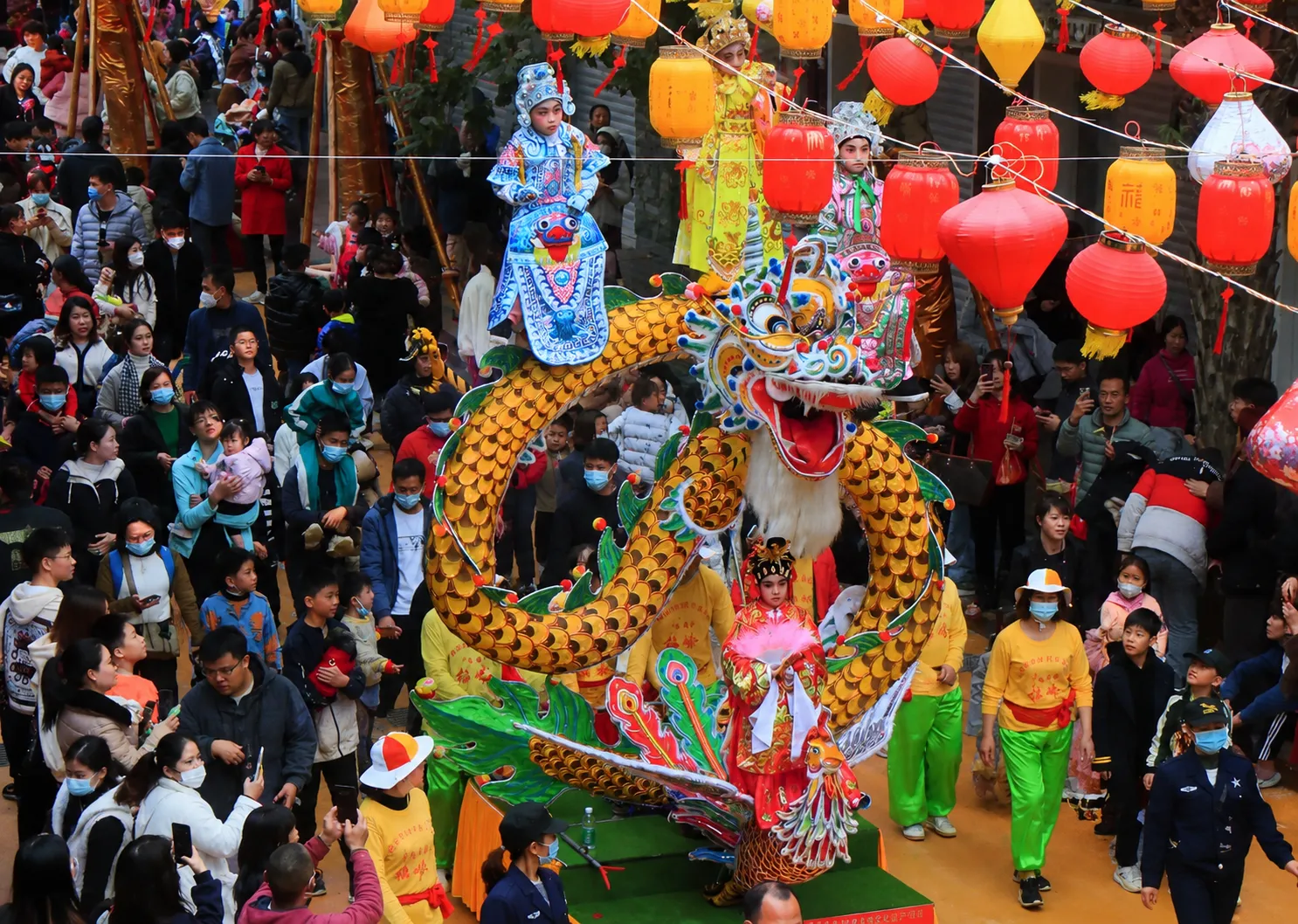
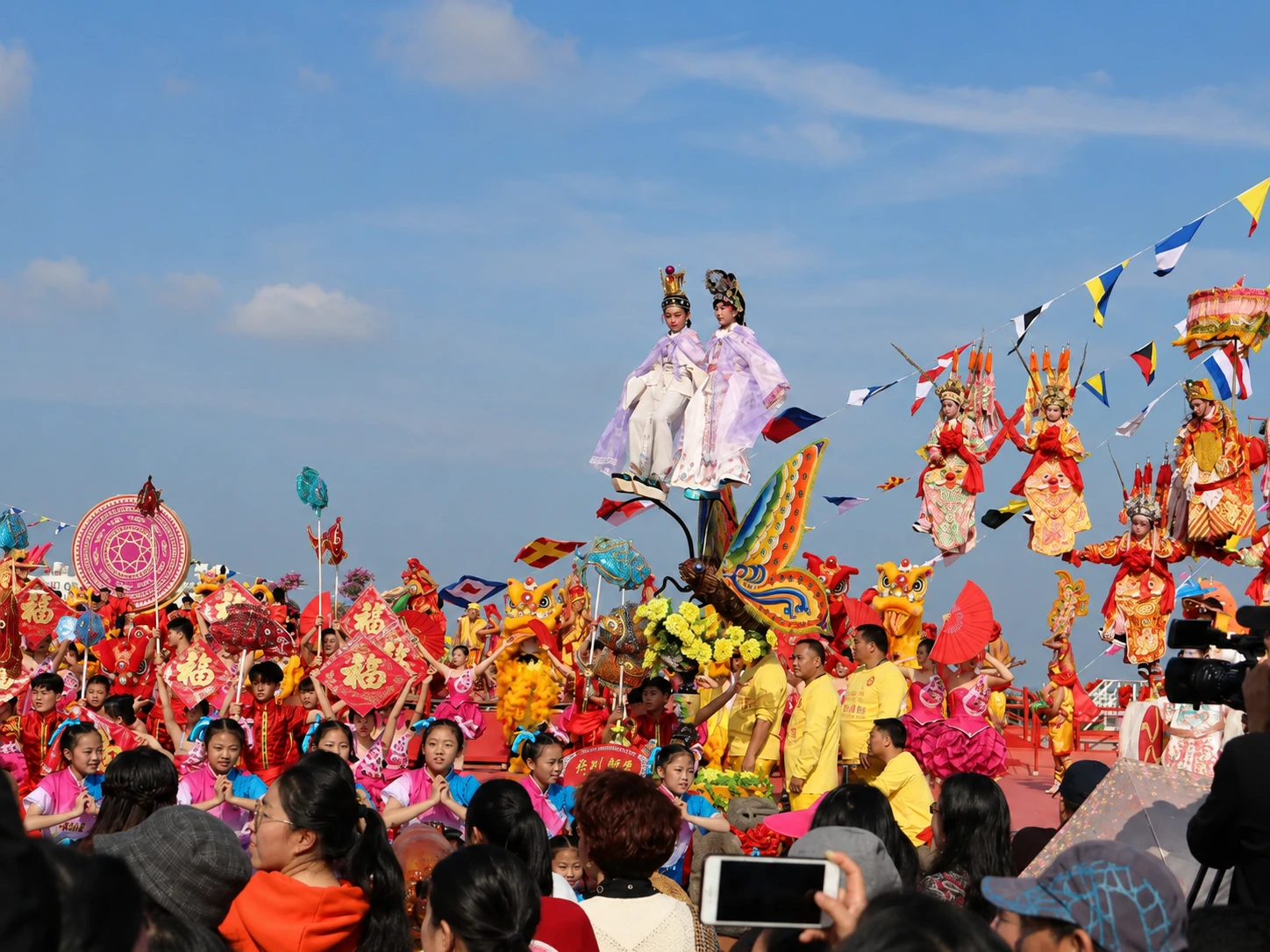
When the platform rolls out, the street changes its breathing. People at the front point upward. A murmur spreads backward through the crowd. Above the carved and painted base, above the musicians and attendants and bright banners, the child appears to stand in open air.
This is Zhanjiang's Wuchuan Piaose, the art of floating color.
The secret is not that the child floats. The secret is that everyone knows he does not, and still the street accepts the sight.
The Iron That Must Disappear
Piaose belongs to a family of festival arts built around a small moving stage. In Guangdong, the form became famous for one visual promise: a performer seems to drift above the platform with no visible support. The word piaose carries that sensation, color suspended in motion.
The mechanism is practical, hidden, and unforgiving.
Inside the float is a rigid support, often described as the se geng, the color stem. It rises from the base, passes through costume and scenery, and holds the performer at a calculated angle. The person below, seated or standing on the platform, is the visible foundation. The child above is the se xin, the heart of the scene. Because weight matters, children often take the floating roles. Their small bodies allow the iron to vanish more convincingly beneath sleeves, banners, flowers, weapons, clouds, or the curve of a robe.
But iron alone does not make Piaose work.
The child must understand stillness. A sudden reach of the hand can reveal the support. A nervous shift of the hip can turn grace into danger. The platform must move smoothly over streets that were never built for theater. The people pushing or carrying it must feel potholes before the child feels them. The costume must hide the structure without trapping the body inside heat and panic.
From below, the crowd sees lightness.
On the platform, lightness is engineered one tightened strap at a time.
A Stage That Refuses to Stay Put
The float begins moving after the drums pass the first bend.
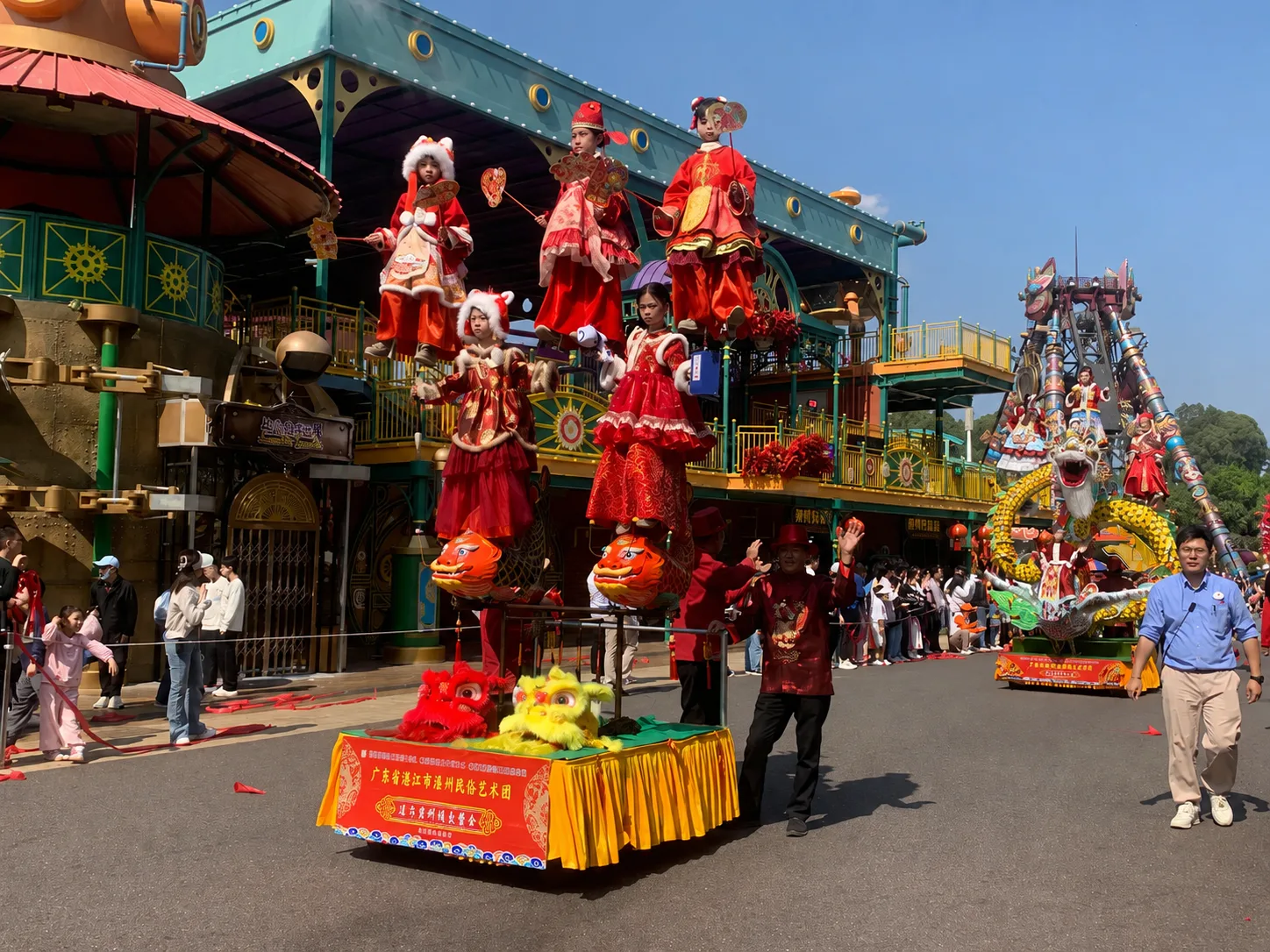
Wuchuan's streets are narrow enough for spectators to feel the platform before it reaches them. Children sit on adults' shoulders. Shopfronts become balconies. A woman leans from an upstairs window with a phone in one hand and a bowl in the other. The float inches forward, not like a vehicle but like a shrine that has learned to perform.
Every Piaose scene is a small theater: opera robes, painted faces, legendary weapons, court sleeves, clouds cut from bright material. Drama, music, visual art, acrobatics, mechanics, and a magician's instinct for misdirection are packed into a few square meters. The story may come from opera, history, or village imagination, but the audience does not need every plot detail. They wait for the impossible arrangement of bodies.
The lower performer may look up with a warrior's glare. The child above may hold a spear, a fan, a ribbon, or a branch of blossoms. Between them, the iron does its silent work. Around them, the float keeps moving, and movement is what makes the illusion breathe.
If the platform stood still in a theater, the eye would have too much time to investigate. On the street, the scene arrives, shines, and passes. The crowd sees it from changing angles, through incense smoke, phone screens, drum vibration, and the push of bodies. The secret is never absent. It is simply always one step ahead.
That is why Piaose has been called a moving stage. It does not ask the village to enter a theater. It brings theater to the road where people buy vegetables, wait for buses, argue over prices, and return home with plastic bags in both hands.
The Child Learns the Crowd
Before a child floats above Wuchuan, he learns the weight of being watched.
The adults can build the frame. They can paint the face, fit the costume, tighten the hidden support, and choose the safest route through the street. They cannot lend the child a calm expression once the crowd begins shouting.
So rehearsal starts with ordinary fear. The child is lifted a little. Then higher. He learns where his feet are allowed to press, where his hands must rest, how to keep the chest open when the belt feels too tight. He learns to breathe through the nose because the painted mouth must keep its shape. He learns that the parade will stop suddenly, that drums can startle the bones, that a gust of wind can catch a sleeve and make the body want to twist.
Older performers do not overexplain. They touch the shoulder. They adjust the wrist. They say, hold it. Again. Hold it.
The lesson is courage, but timing matters just as much. A Piaose child must look alive without moving too much. He must offer the crowd a face, a gesture, a small turn of the eyes. Too little, and the figure becomes a doll. Too much, and the floating breaks.
The most beautiful moments are small. A sleeve trembles but the hand does not. A fan tilts by a few degrees as the platform turns. A painted gaze follows the street corner just long enough for someone below to feel chosen by the floating figure.
Then the float moves on.
Lantern Smoke and Old Mechanics
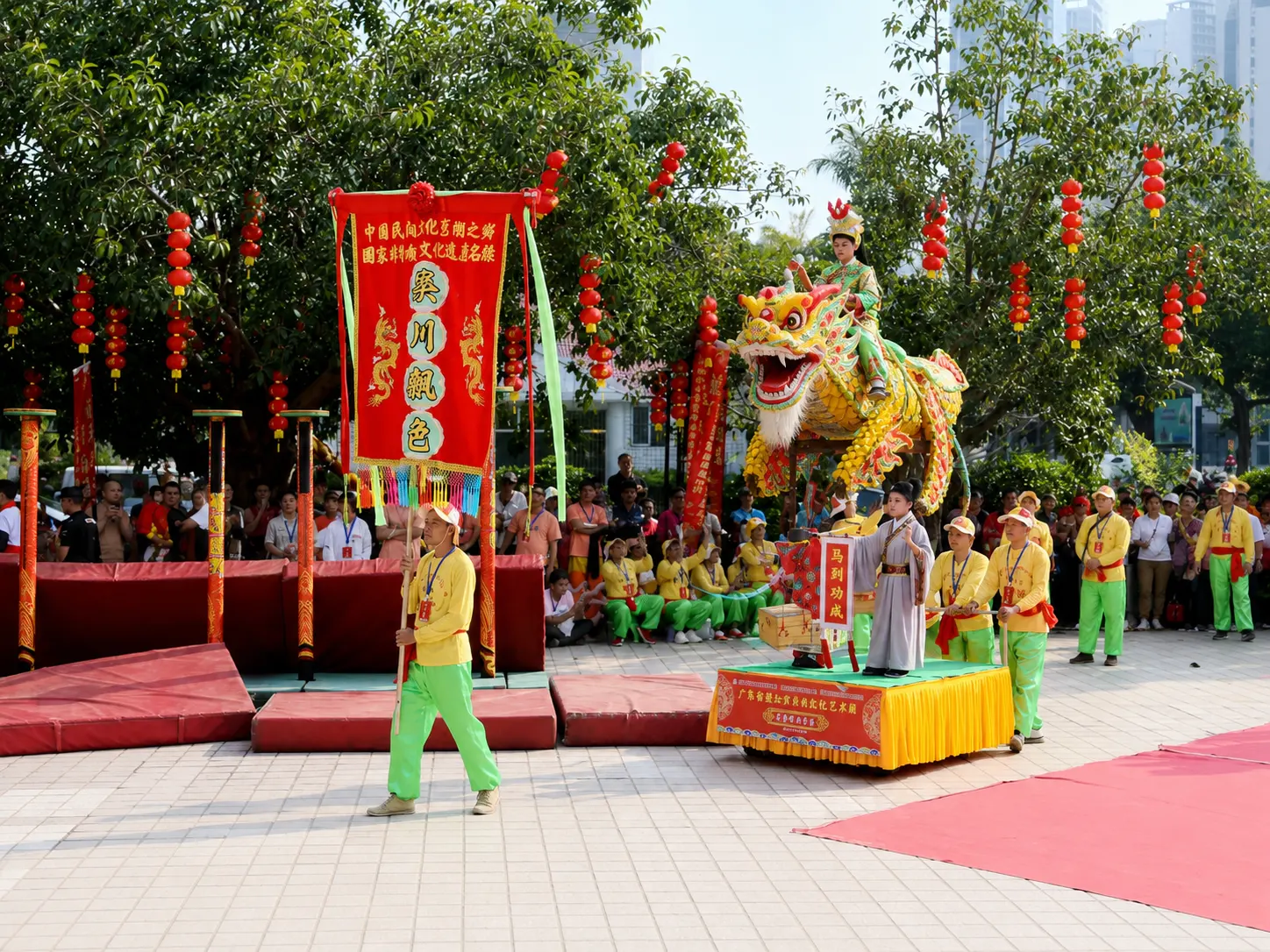
Wuchuan Piaose is often seen during the first lunar month's festival season, especially around the Lantern Festival celebrations. In this part of western Guangdong, festival days do not separate worship, entertainment, family pride, and neighborhood competition as cleanly as outsiders might expect. They arrive together: offerings, drums, food stalls, visiting relatives, children in costume, elders judging the steadiness of a platform with one narrowed eye.
The art is said to have grown from Wuchuan's villages, with Huangpo and Shagang often named in local memory. Its age matters less on the street than its survival does. A Qing-era artisan may have given the form one of its early shapes, but every generation after him had to solve the same practical problems again: how to make iron invisible, how to keep a child safe, how to move a stage through a crowd, how to make people who already know the trick still gasp.
That last problem is the hardest.
Modern spectators have seen cinema, wire work, computer effects, and close-up magic on screens. Piaose uses none of that distance. The child floats a few meters away from them, under daylight or festival lamps, close enough for the crowd to see the powder on his face. The mechanism is hidden, but not by technology. It is hidden by composition: costume, angle, color, timing, and the old agreement between performer and viewer.
The crowd knows there is iron.
The crowd also knows that iron has no expression, no patience, no childhood memory of standing above a street while drums shake the platform beneath the feet. That part belongs to the child.
After the Floating
When the route is finished, the platform disappears behind a gate or into a side lane.
Only then does the floating child become heavy again.
Adults loosen the fastenings in reverse order. The robe opens. The hidden support shows itself in plain daylight: metal, bolts, straps, the honest skeleton of the miracle. Someone lifts the child down carefully. His legs are stiff. A line of makeup has cracked near one eye. He drinks water through a straw so the painted mouth survives a little longer for photographs.
Outside, another float is still moving. The crowd is already calling out. Drums fold into the noise of the street.
But beside the resting platform, the strange truth of Wuchuan Piaose becomes clear. The art does not depend on fooling people completely. It depends on making them care more about the floating than the explanation. For the length of one street, iron becomes cloud, engineering becomes theater, and a child who was told to stand still carries the sky above the crowd.
Then the straps are gathered, the costume is folded, and the metal that held him up lies quiet until the next festival asks it to disappear again.