The old man stands at the river's edge before anyone is awake to see him.
His beard is white. His robes, once the silk of a high minister's court dress, are now loose on his frame, frayed at the hem by years of walking the banks of this river. In his arms he holds a stone —not a pebble, not a token, but a rock heavy enough that his shoulders quiver under its weight. The Miluo River moves past him, dark and unhurried, the same water that has flowed past this bank since before kingdoms learned to name themselves.
He does not hesitate. He has been hesitating for years —in the king's audience hall, on the road into exile, in the margins of the poems he wrote instead of sleeping. The stone is the first thing in his life that has asked for nothing except to be held.
He steps forward. The water swallows his ankles, his knees, his waist. The cold would be unbearable if he were still paying attention to cold. When the river reaches his chest, he leans forward and lets the stone do what stones do. For a moment his white hair floats on the surface like a scattered flower. Then it is gone. The river closes without ceremony. The ripples travel outward, grow wide, grow faint, disappear.
This man was Qu Yuan. He was the chief minister of the kingdom of Chu. He was the greatest poet of his age. He was sixty-two years old. And he had just watched his country die.
The Kingdom's Last Honest Voice
Qu Yuan was not a general. He was the kind of man who believed a well-written memorial could save a kingdom —a minister, a diplomat, a voice in the ear of a king who did not want to hear.
It was the Warring States period. The kingdom of Qin was swallowing its neighbors one by one, and Chu was next. Qu Yuan advised his king to build alliances and resist. The king listened to other voices —voices that told him what he wanted to hear. Qu Yuan was stripped of his rank and exiled. Not once. Twice.
He spent his exile writing. His poems —gathered later into the *Chu Ci*, the Songs of Chu —are unlike anything else in classical Chinese verse. They speak of orchids worn at the waist as emblems of virtue, of celestial journeys on dragon-drawn chariots, of a world where integrity is a physical substance you can hold in your hands and refuse to put down. His most famous lines, from "Encountering Sorrow" (Li Sao), read like a man arguing with heaven and losing, but refusing to stop arguing.
In 278 BCE, news reached him on the banks of the Miluo: Qin troops had taken the Chu capital. The kingdom he had spent his life trying to protect no longer existed. That night, he composed his final poem. He called it "Embracing the Stone" —Huai Sha. The title was not a metaphor.
On the fifth day of the fifth lunar month, Qu Yuan pressed a rock to his chest and walked into the river. He was not running from pain. He was refusing to outlive the only thing he had ever loved.
The people who lived along the Miluo did not accept this. They launched their fishing boats —long, narrow vessels —and rowed into the river, beating drums to scare the fish away from his body, splashing the water with their paddles, throwing packets of rice wrapped in leaves so the fish would eat rice instead of flesh. They rowed until their arms gave out. They did not find him.
They have never stopped searching.
A poet walked into a river holding a stone. Two thousand three hundred years later, the boats are still looking.
The drums that beat on the Miluo that day were trying to protect a dead man from the fish. The drums that beat on the Miluo today are looking for a man who has been gone for two thousand three hundred years.
Drums Across the Water
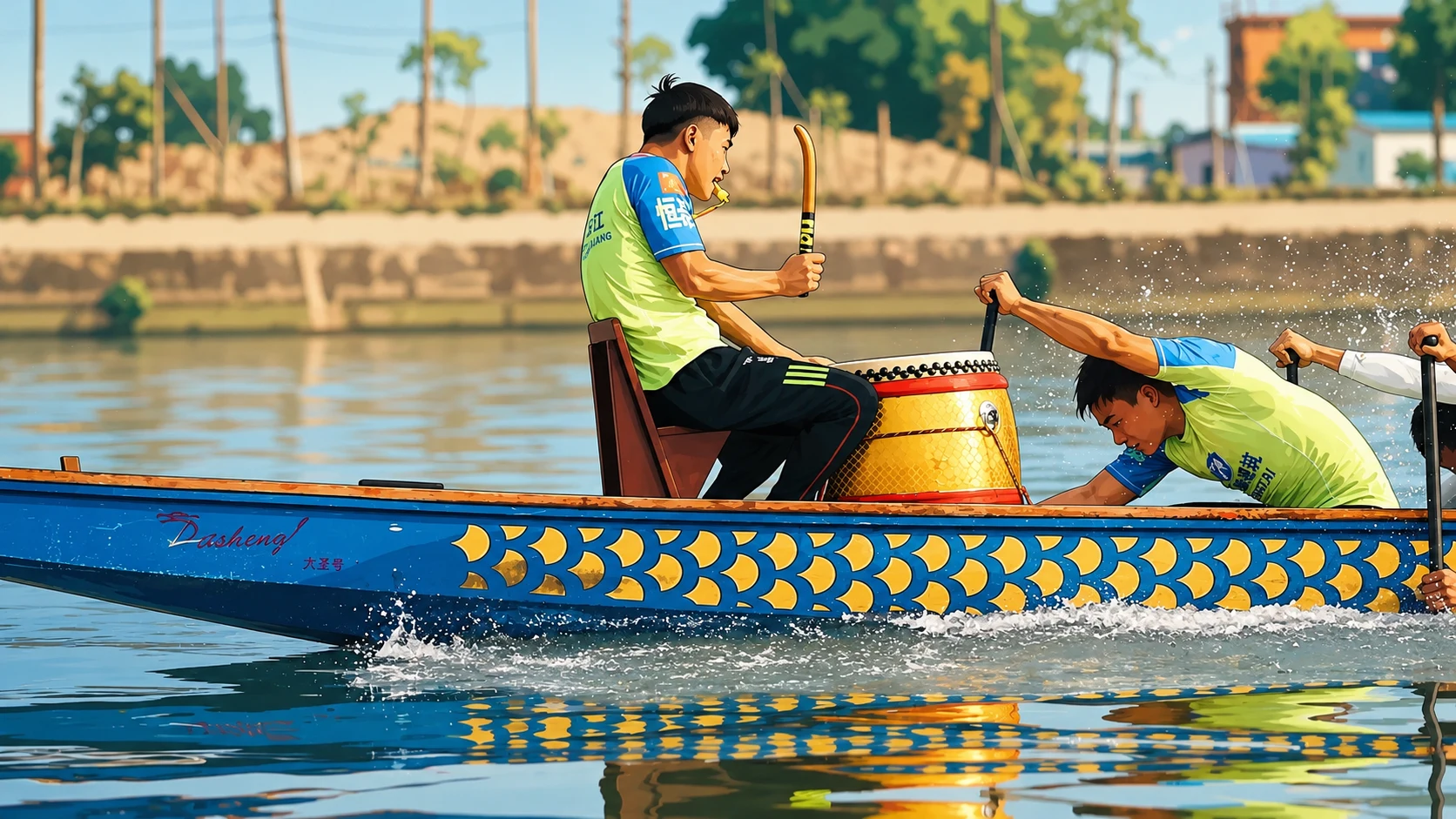
A dragon boat does not move until the drum tells it to.
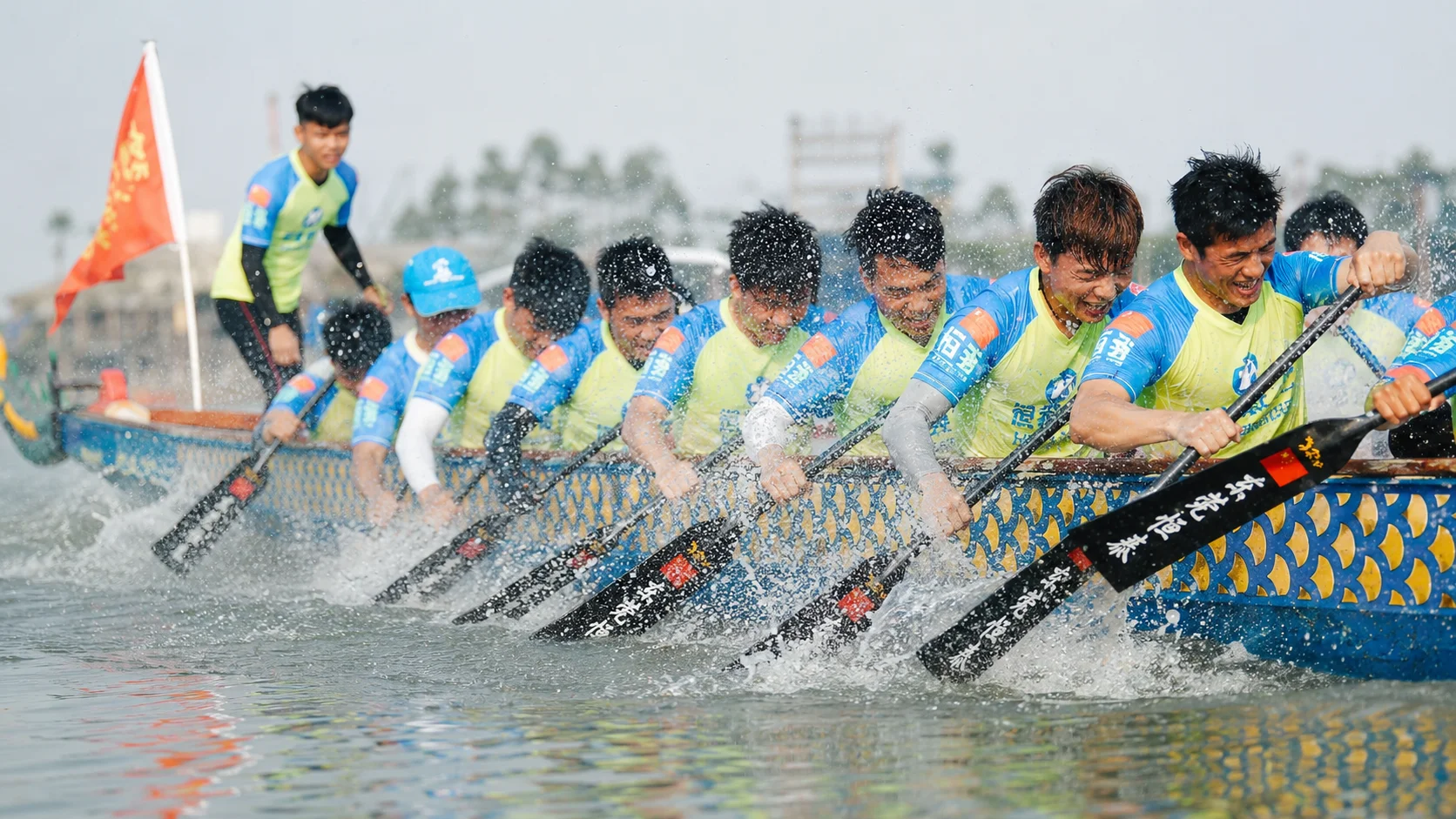
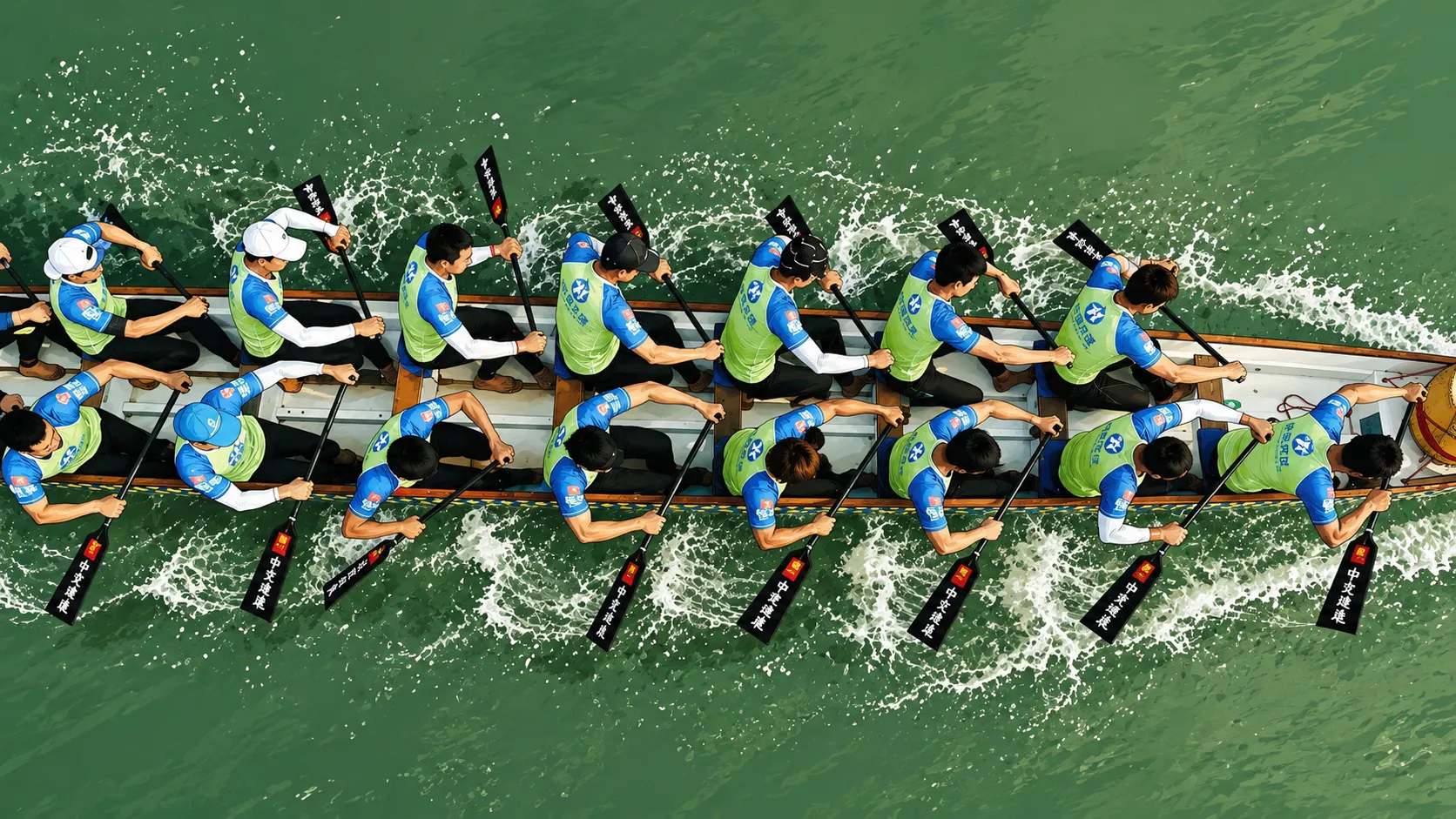
On the Miluo, the drummer at the bow does not simply keep time —he is the boat's pulse. His sticks strike a drumhead of stretched cowhide, and the sound punches through the noise of twenty-two paddles thrashing water. When he speeds up, the boat surges. When he holds a beat, the paddlers hold their breath. The rhythm is a language: three fast beats for attack, a long pause for the turn, a sudden roll that tells the lead paddlers to dig deeper.
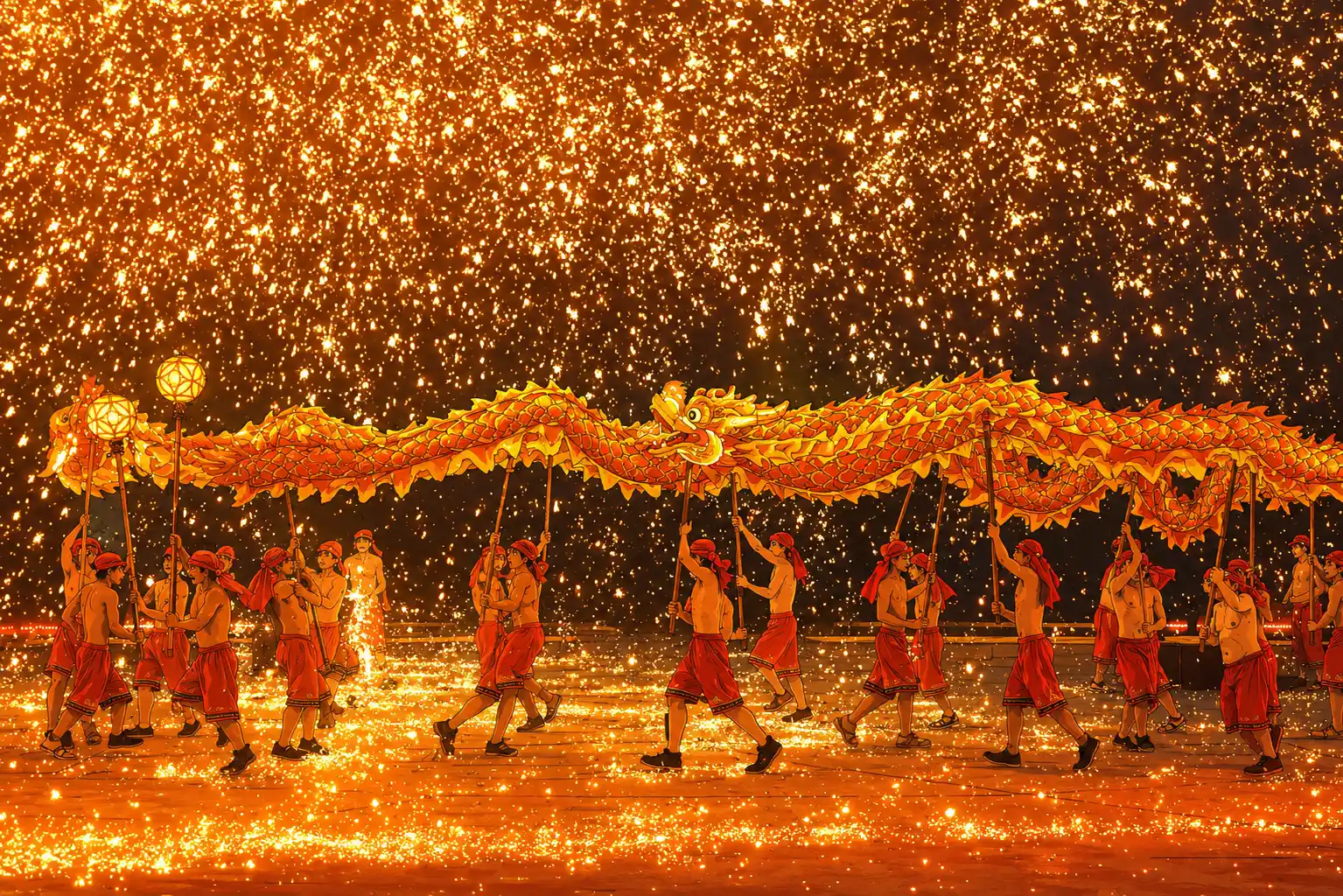
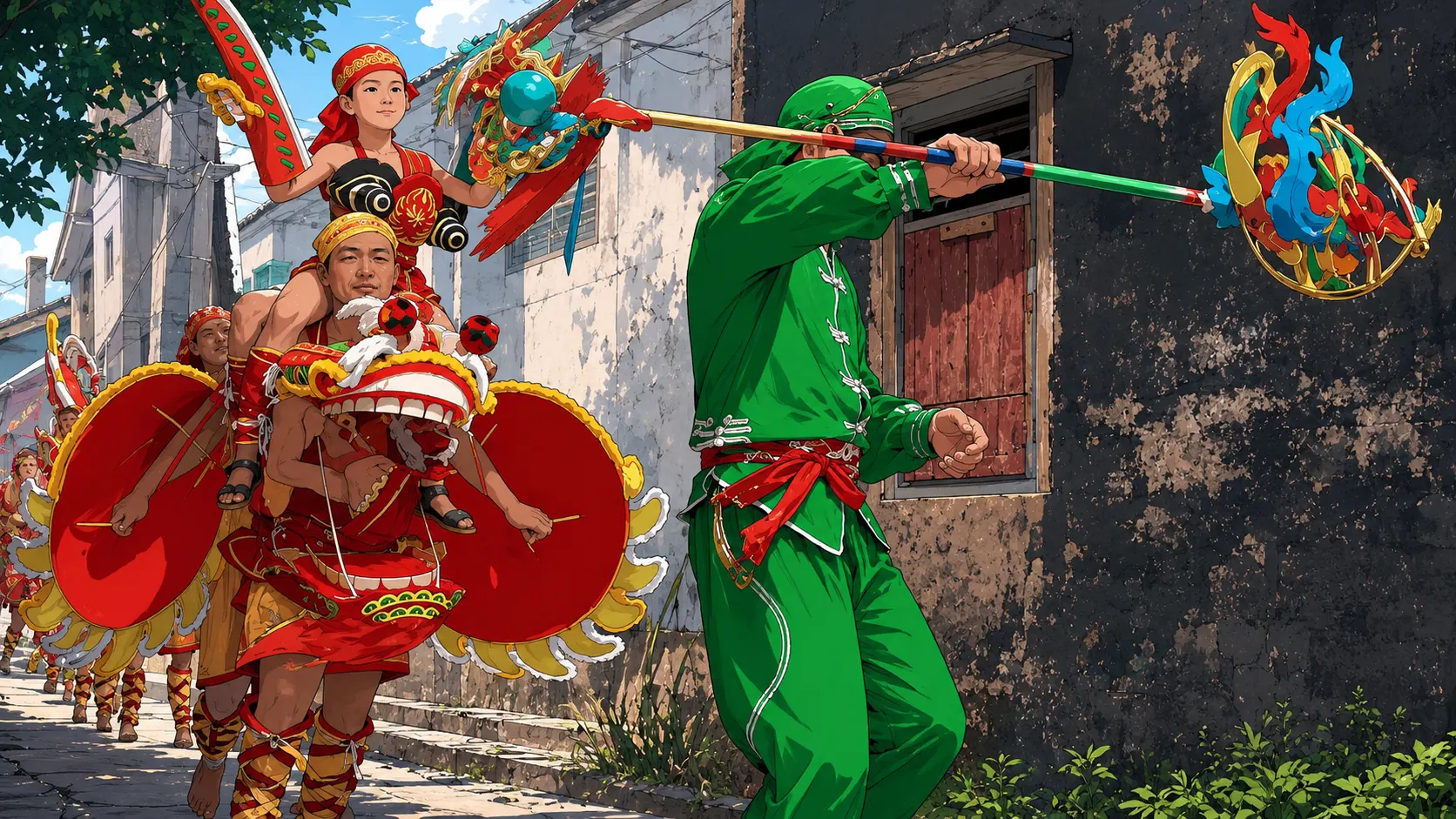
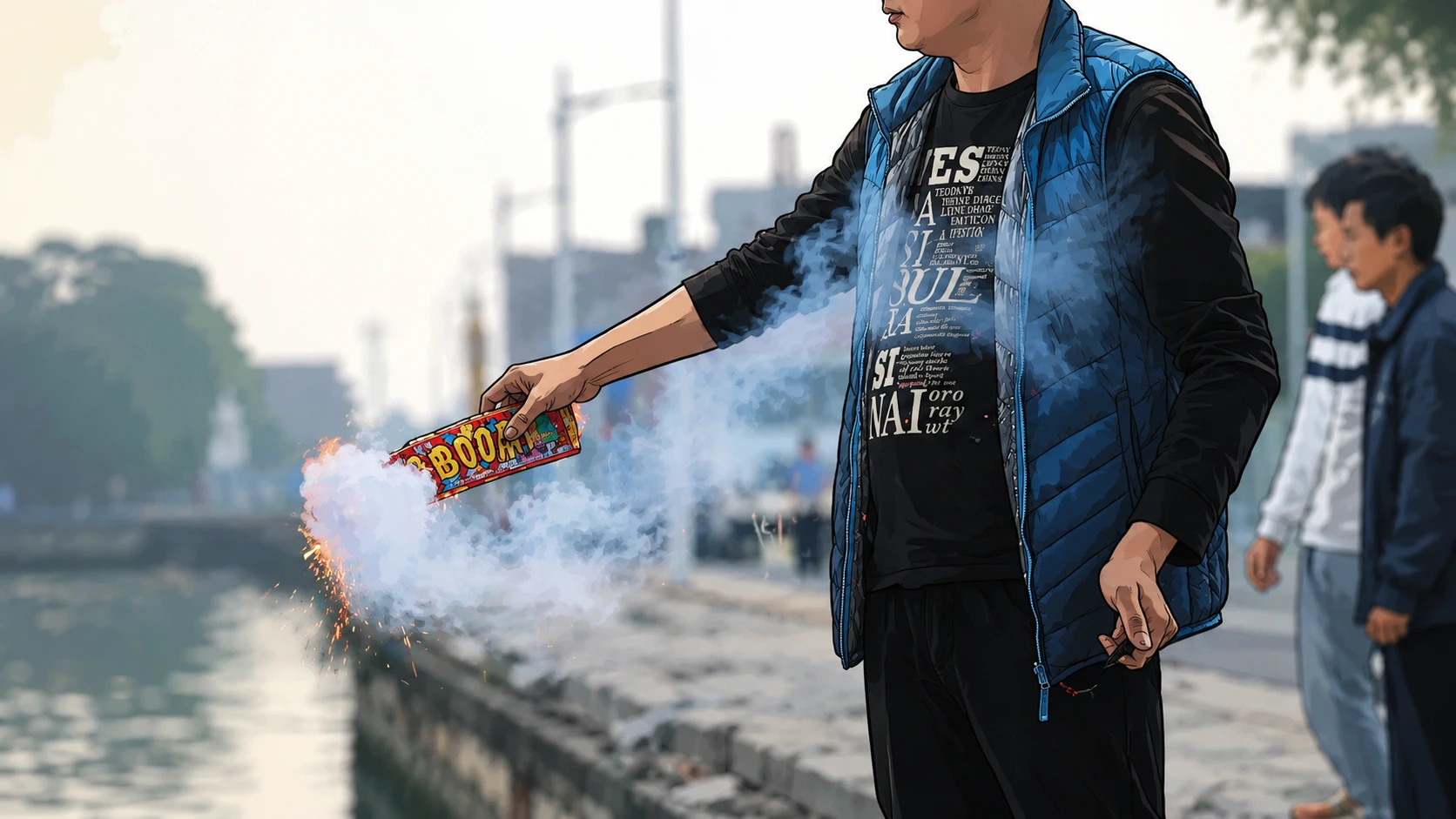
Before any of this can happen, the dragon must be woken. The eye-dotting ceremony, dianjing, follows the same logic as the awakening lion. A respected elder dips a brush in cinnabar-red ink and touches it to the carved eye of the dragon head. Before the dot, the boat is a boat. After the dot, it is alive with an appetite for the finish line. The paddlers bow three times. Firecrackers split the air.
Then the race.
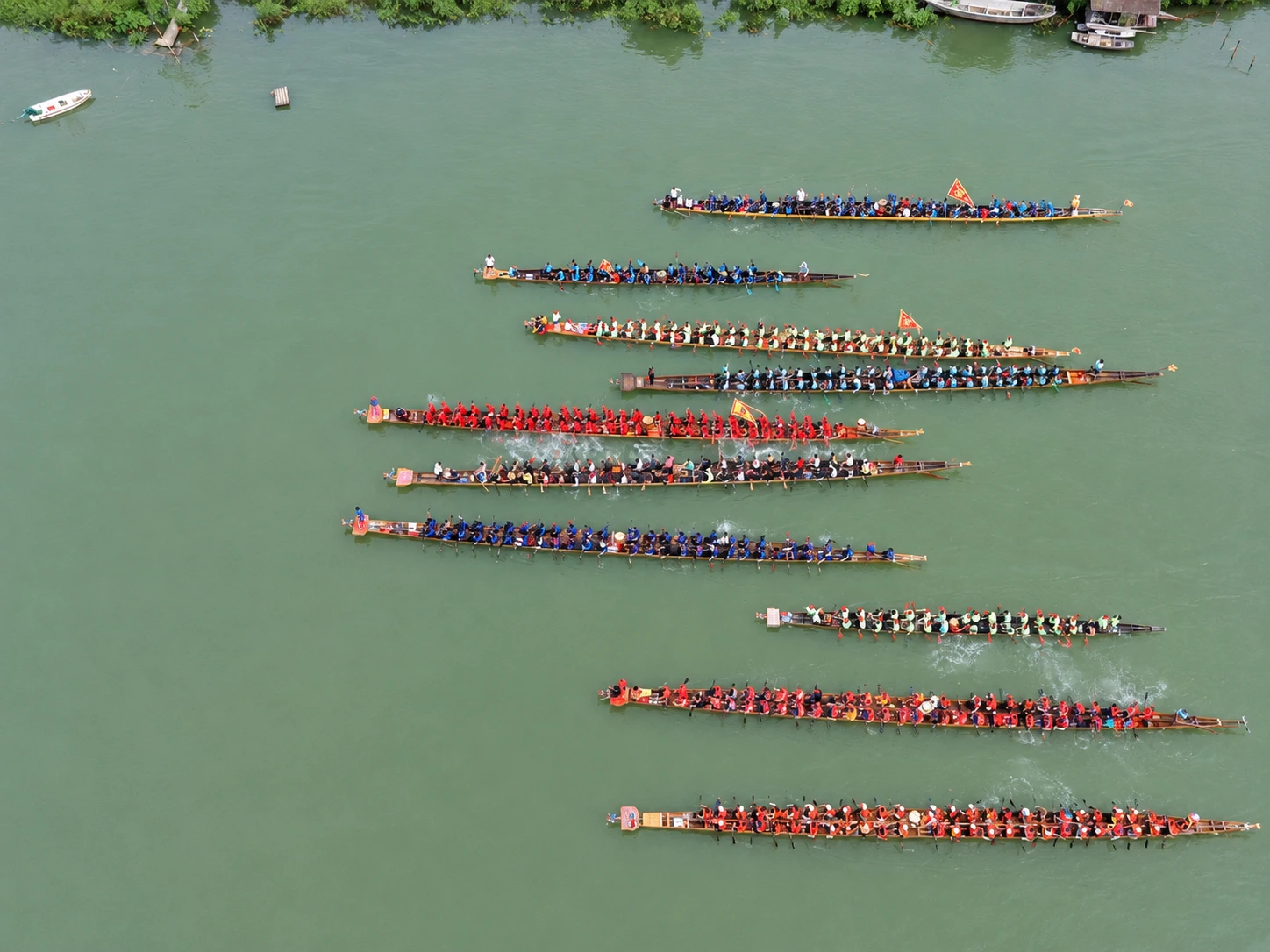
The most riveting moment in a Yichang race comes not from speed but from the turn. Boats must round a buoy marker, and this is where races are won or lost. The helmsperson stands at the stern, balancing on the narrow tail, working a ten-foot steering oar. As the boat banks, the hull tilts so sharply that paddlers on the low side drag their knuckles through the water. One wrong lean and twenty-two people capsize into the Miluo —surfacing laughing, because falling into the river that Qu Yuan entered is, in its own way, a form of participation.
At the far end of the course, a flag hangs from a pole —the prize-grab, qiangbiao. The first boat to reach it claims the honor. The drummer does not stop beating. The paddlers do not stop paddling even after the flag is torn from its mount, because in Yichang it is understood that the race does not end at the finish line. It ends when the river says so.
Leaves That Fold the Map of a Nation
The rice packets thrown into the Miluo two millennia ago have evolved into a food that maps the entire country.
In Beijing, zongzi are modest —plain glutinous rice pressed around a single red date, boiled until translucent, then dipped in white granulated sugar. The pleasure is in the contrast: warm, sticky, neutral rice against the cold crunch of sugar crystals.
In Jiaxing, a canal town south of Shanghai, a slab of soy-braised pork belly is buried in the center of seasoned rice. During hours of simmering, the fat melts into the surrounding grains. You unwrap the leaf and find rice the color of dark caramel, each grain coated in pork-scented oil.
In Sichuan, they add Sichuan peppercorns and chili. In Guangxi, the zongzi are enormous —pillow-shaped parcels the size of a small loaf, sliced and pan-fried the next day. In Hainan, banana leaves replace bamboo. The leaf is a blank page on which every region writes its own hunger.
In Beijing, the zongzi wants sugar. In Jiaxing, it wants pork fat. In Chaoshan, it refuses to choose.
The Sweet and the Salted, Folded Into One
In a Chaoshan kitchen on the morning of the festival, two bowls of glutinous rice sit side by side on the counter. They are the same grain. They will become different things.
The savory rice has been fried in lard infused with scallion, the oil carrying that green-onion scent deep into each grain. Dark soy sauce turns it the color of polished walnut. The sweet rice has been tossed with white sugar and toasted sesame seeds —nothing more, because sweetness in Chaoshan cooking is never loud.
Now the bamboo leaves. They have been soaking since the night before, turning from brittle to pliable. A pair of hands lifts one leaf from the water and folds it along its central vein —not into a simple cone, but into a shape with a divider down the middle. This is the technique that makes shuangpin, the double-combination zongzi, possible: the leaf creates two compartments within a single wrap.
Into the left compartment goes the savory filling: a whole shiitake mushroom, pan-fried until its edges crisp; a chestnut; a lotus seed; a piece of soy-braised pork belly, its layer of fat gleaming white against the dark meat; dried shrimp; and a salted duck egg yolk, orange as a setting sun. The savory rice is packed over it, pressed firm with the heel of the palm.
Into the right compartment goes the sweet filling: a spoonful of red bean paste, another lotus seed, a red date. The sweet rice covers it.
The leaf is folded over both compartments in a single motion, the two fillings snug against each other but separated by the bamboo-leaf wall. Reed string binds the package tight —not too tight, or the rice will have no room to swell; not too loose, or water will seep in and blur the boundary.
It boils for three hours. When the string is cut and the leaf peeled back, steam rises carrying the scent of scallion oil and the faint perfume of sesame. The zongzi sits on the plate with a visible division —on one side, glossy brown rice studded with mushroom and pork; on the other, clean white rice dotted with black sesame. The first bite lands on the sweet half: the red bean paste is grainy, the sugar restrained. The second bite crosses the border into savory: pork fat, soy, the deep fungal note of shiitake. Nothing clashes. The two halves do not fight because they were never asked to.
What the River Still Hears
Back on the Miluo, the races have ended. The dragon boats are pulled onto the bank, their painted heads turned toward the water as if already waiting for next year. The drummers wrap their sticks in cloth. The paddlers stretch their shoulders and pass around bottles of water.
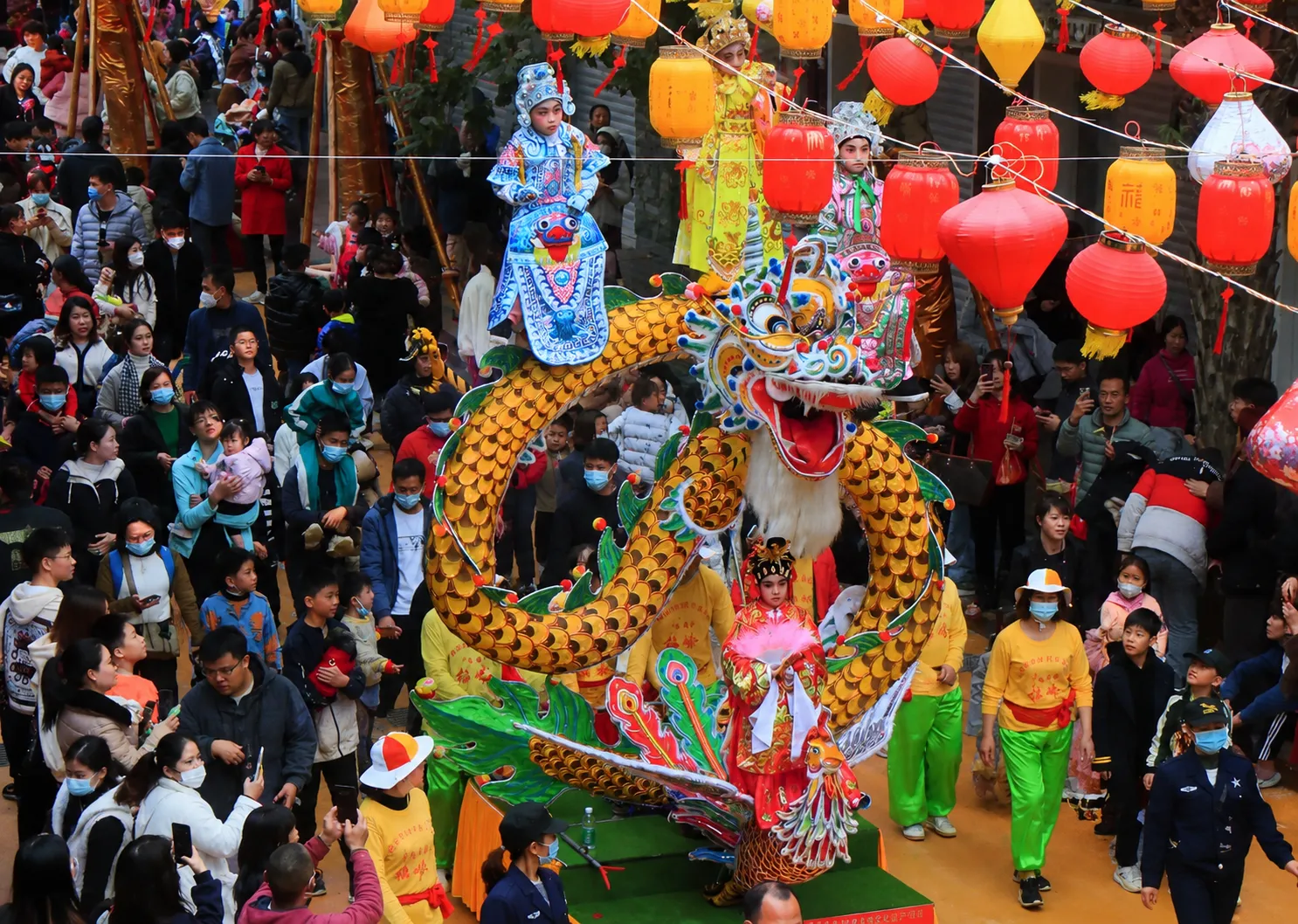
In Yichang, children wear bracelets of five-color silk thread —blue, red, yellow, white, black —tied by their grandmothers before the sun came up. The threads will stay on until the first heavy rain of summer, when they are cut off and thrown into moving water, carrying away whatever misfortune has gathered in the weave. Bundles of mugwort and calamus hang from door frames, their bitter green smell a rebuke to summer insects and summer illnesses alike.
Somewhere in Shantou, five hundred miles south, a zongzi is being unwrapped at a dinner table. The leaf falls open. Sweet and savory, dark and pale —two halves of the world sit side by side in the same triangle of rice. The person holding the chopsticks does not think about Qu Yuan. But the river does not need to be remembered to do its work. It flows. It carries. It receives.
On the Miluo River, the water that closed over a poet two thousand three hundred years ago moves past the bank where the boats are now sleeping. The surface is flat again. The ripples from the last paddle have traveled out, grown wide, grown faint, disappeared. The river does not distinguish between a stone, a paddle, and a leaf-wrapped packet of rice. It takes them all. It remembers them all, in the only way a river can: by continuing to flow.