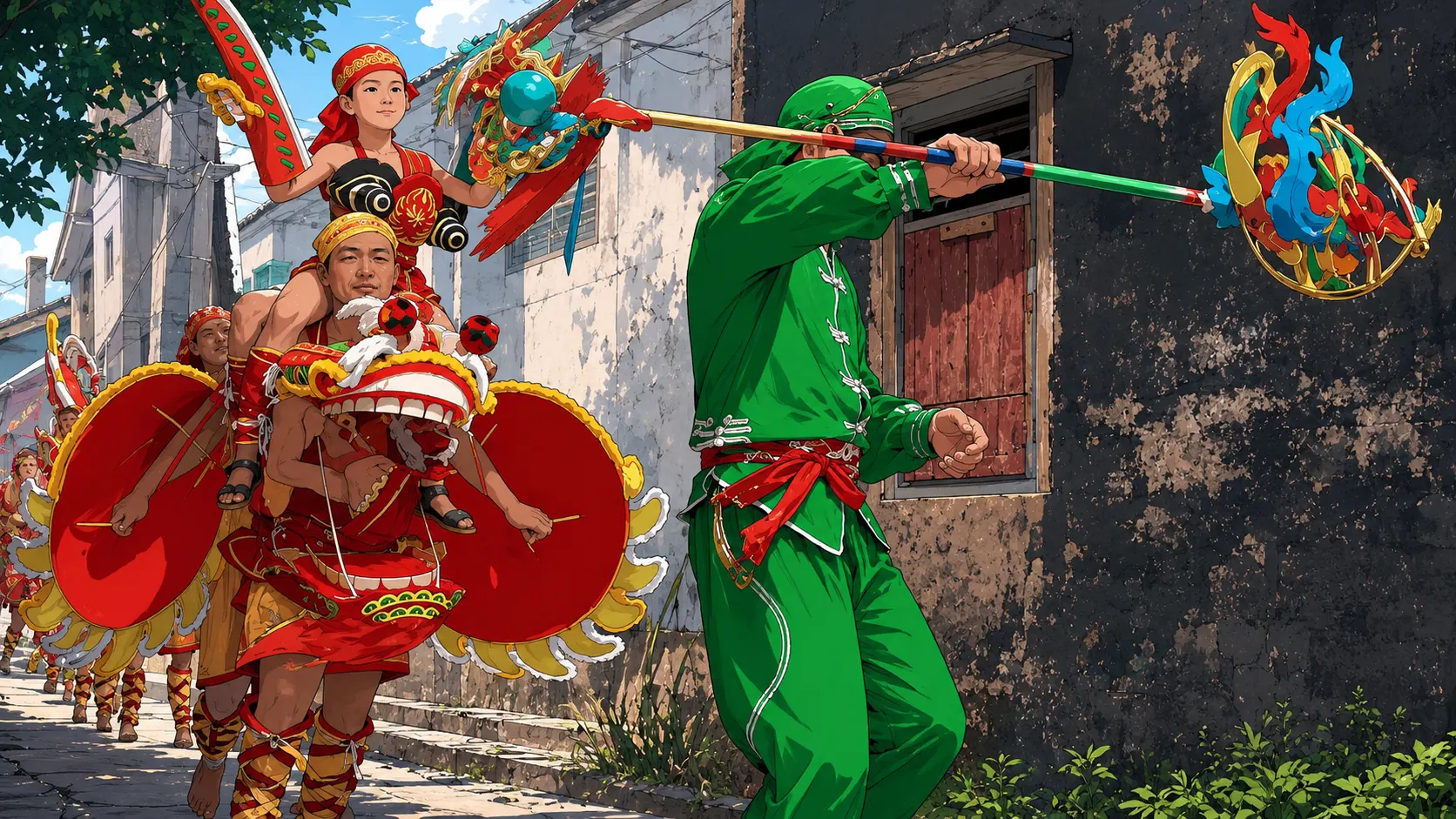
A boy places his bare foot on a man's thigh.
The man does not look back. His palms are already locked around the waist in front of him. The boy climbs once, twice, then settles onto a pair of shoulders as if mounting a moving wall. Around them, other bodies are doing the same: men bending, teenagers stepping up, children tightening their knees around necks, hands reaching for wrists before the drum has given permission to begin.
The square on Donghai Island is still crowded with separate people. In a few minutes, it will not be.
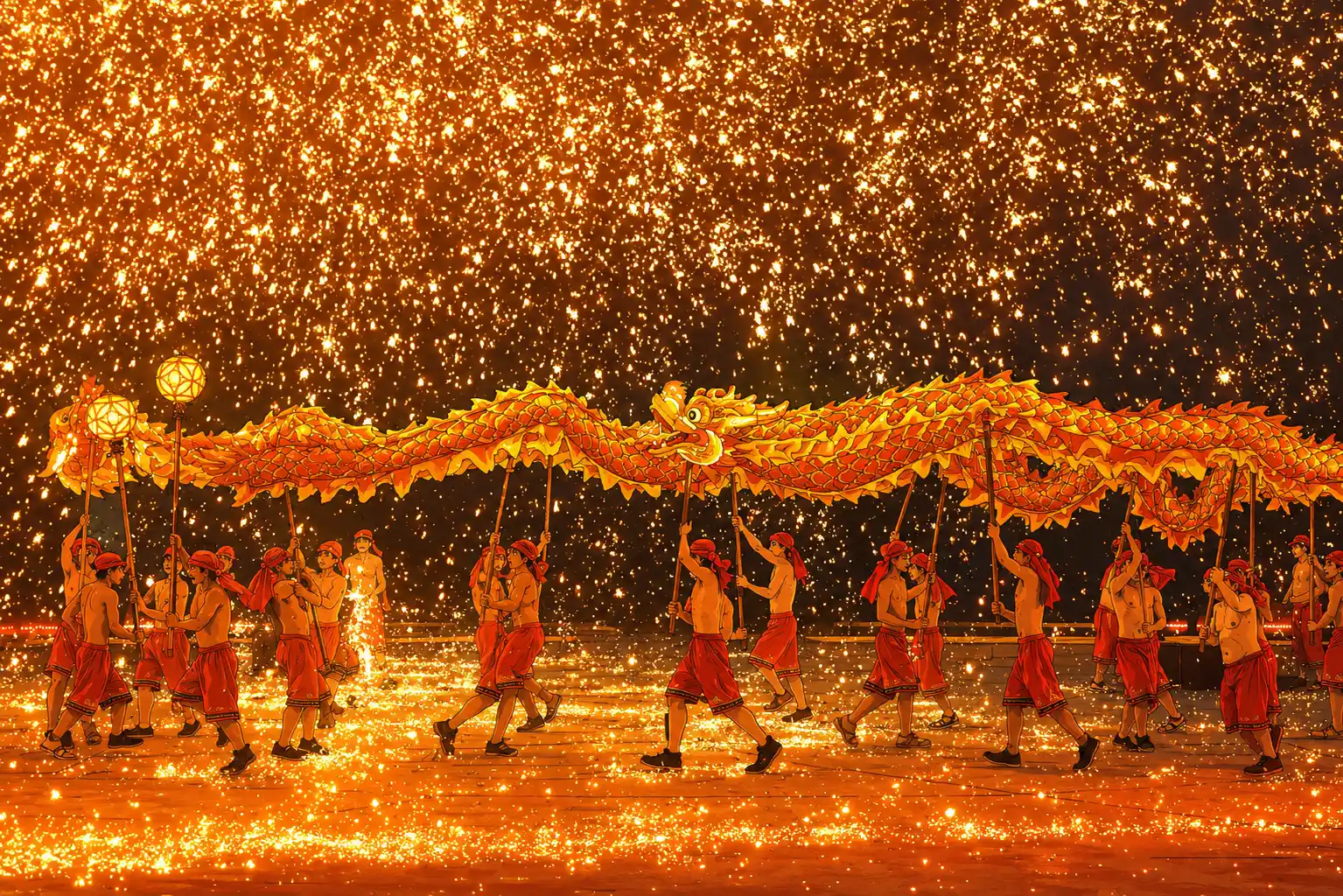
A gong strikes. The first sound is flat and metallic, the kind that makes conversation fall apart. Then the drum answers from the edge of the square, dry and urgent. Under the lamps, red cloth flashes. Ankles dig into the ground. Backs rise. A line of bodies bends into another line, and the children above them lift their chins toward the night air.
The dragon has no bamboo frame. No silk body. No poles spaced along a painted spine.
It is being assembled from human weight.
A Dragon Without a Prop
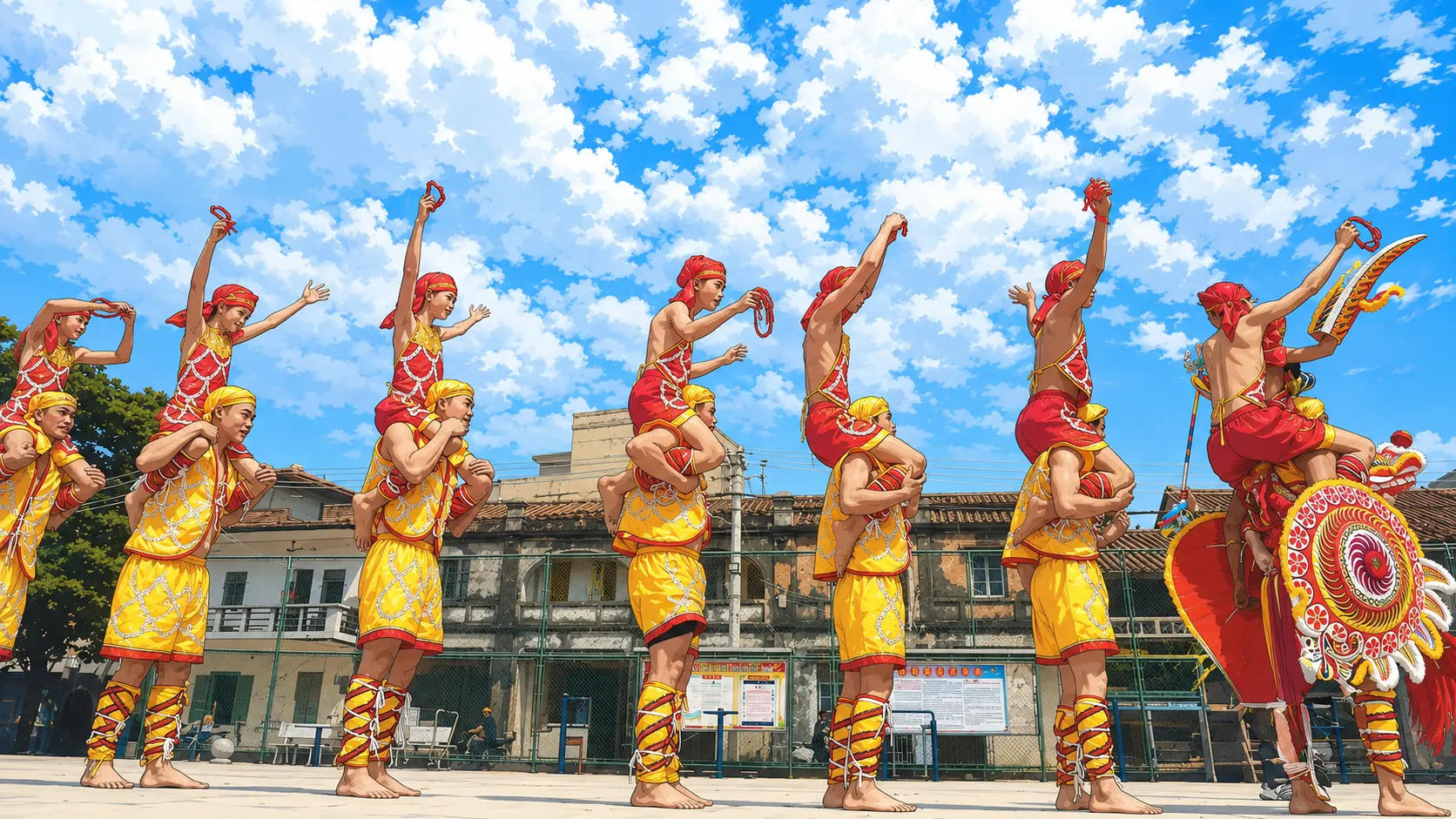
Most Chinese dragon dances begin with an object. A long body is brought from storage, its hoops joined, its cloth stretched, its head lifted by a lead dancer. The Zhanjiang Human Dragon Dance, renlongwu, begins with people arranging themselves until the object is no longer needed.
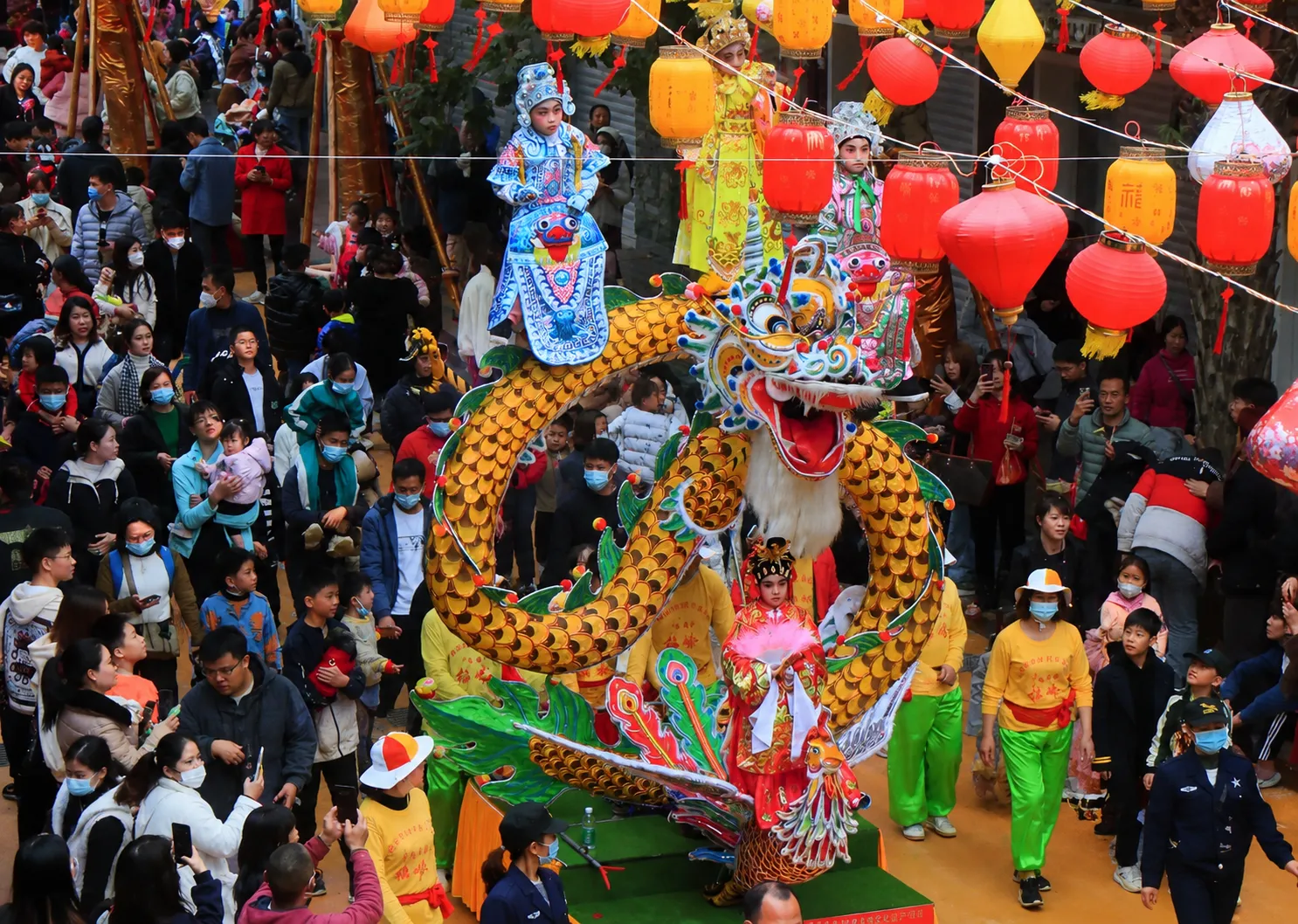
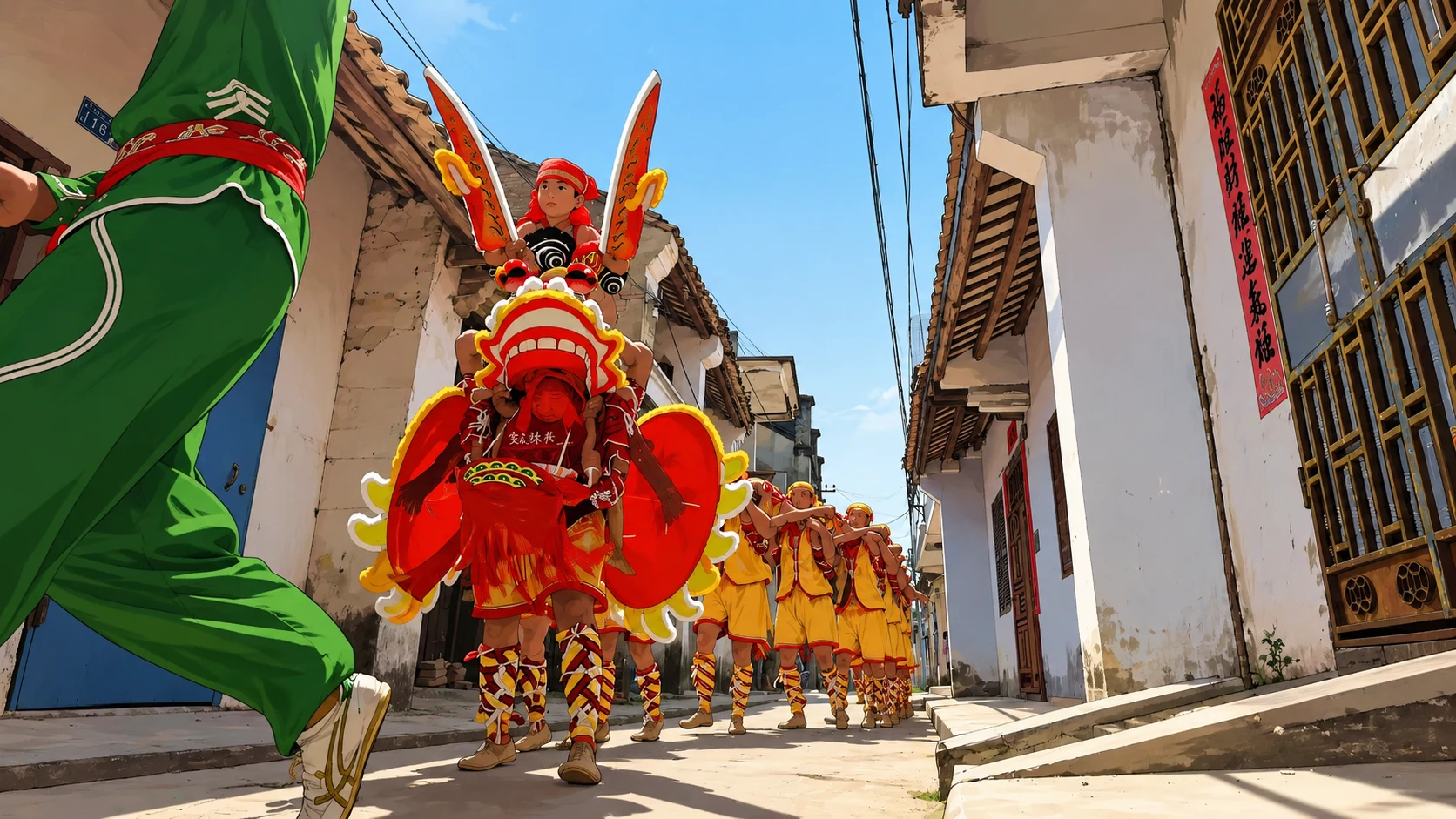
This is the old strangeness of Dongshan town on Donghai Island, where the form first grew inside village festivals and ancestral celebrations. The dancers wear bright costumes, but clothing is not what makes the dragon visible. The shape comes from the stacked bodies: the lower row becoming legs and spine, the upper row becoming scales and crest, the front rising into a head that follows the teasing pull of the pearl.
From a distance, the eye accepts the illusion before the mind can correct it. One moment there are dozens of villagers in a square. The next moment a creature longer than any single body turns through the crowd, its back rippling because each human joint has become one small hinge in a larger animal.
That is why the dance is so difficult to fake. A silk dragon can hide a weak dancer inside cloth. A human dragon has no such mercy. Every wobble is visible. Every late step travels down the line. If one shoulder sinks, the dragon's back breaks. If one child loses balance, the whole creature feels the tremor.
The drum keeps them honest. It does not decorate the movement. It measures the agreement between bodies.
The Child on the Shoulder
The most fragile part of the dragon is also the part that makes it live.
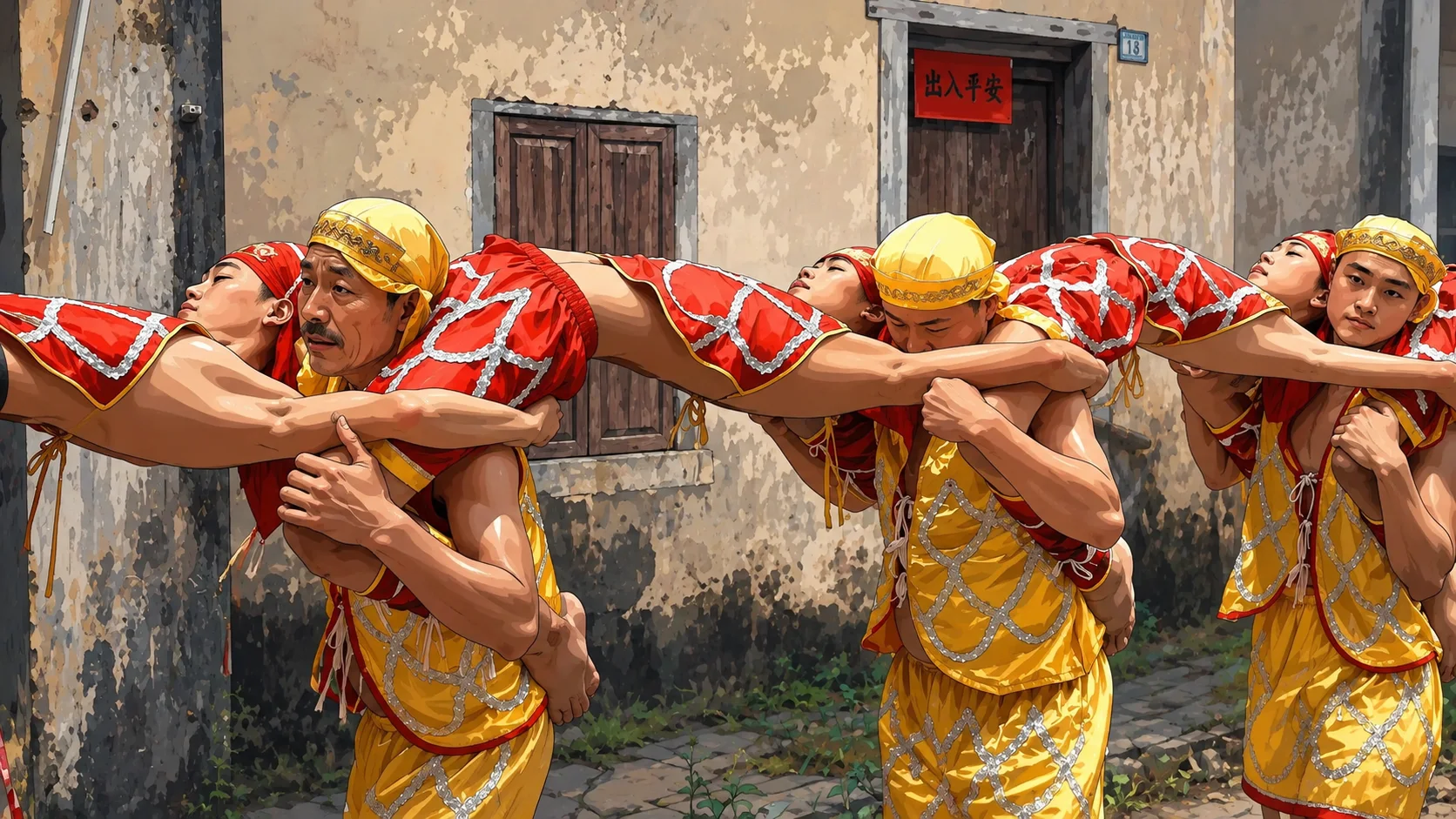
The children high on the shoulders are light enough to be lifted, but not weightless. Their knees press into collarbones. Their hands grip cloth already damp with sweat. They must look fearless, because the audience sees their faces first. Under them, the adults carry the less visible terror: a slipping foot, a sudden turn, a shoulder joint giving way in the middle of the square.
Before the performance, the older dancers speak little. They tighten belts. They check the knots of costume sashes. A father presses two fingers against a boy's calf and says one short instruction: do not look down.
The boy nods. He has heard it before.
When the drum quickens, the human dragon begins to coil. The lower bodies take short, grinding steps, knees bent so the upper row does not sway too violently. The children lean with the turn. The head rises and dips. The tail follows a beat later, as if the night itself has become thick water and the dragon is swimming through it.
At the front, someone carries the pearl. The pearl is not heavy, but it rules everyone. It pulls the head left, then right, then forward into a sudden charge. The dragon chases. For the people below, the chase is labor: thighs burning, breath shortening, palms slick. For the children above, it is balance: a small adjustment of the hip, a tightening of the ankle, a hand that releases and catches again at exactly the right moment.
The audience sees spectacle. The dancers feel arithmetic.
The Village Learns One Body
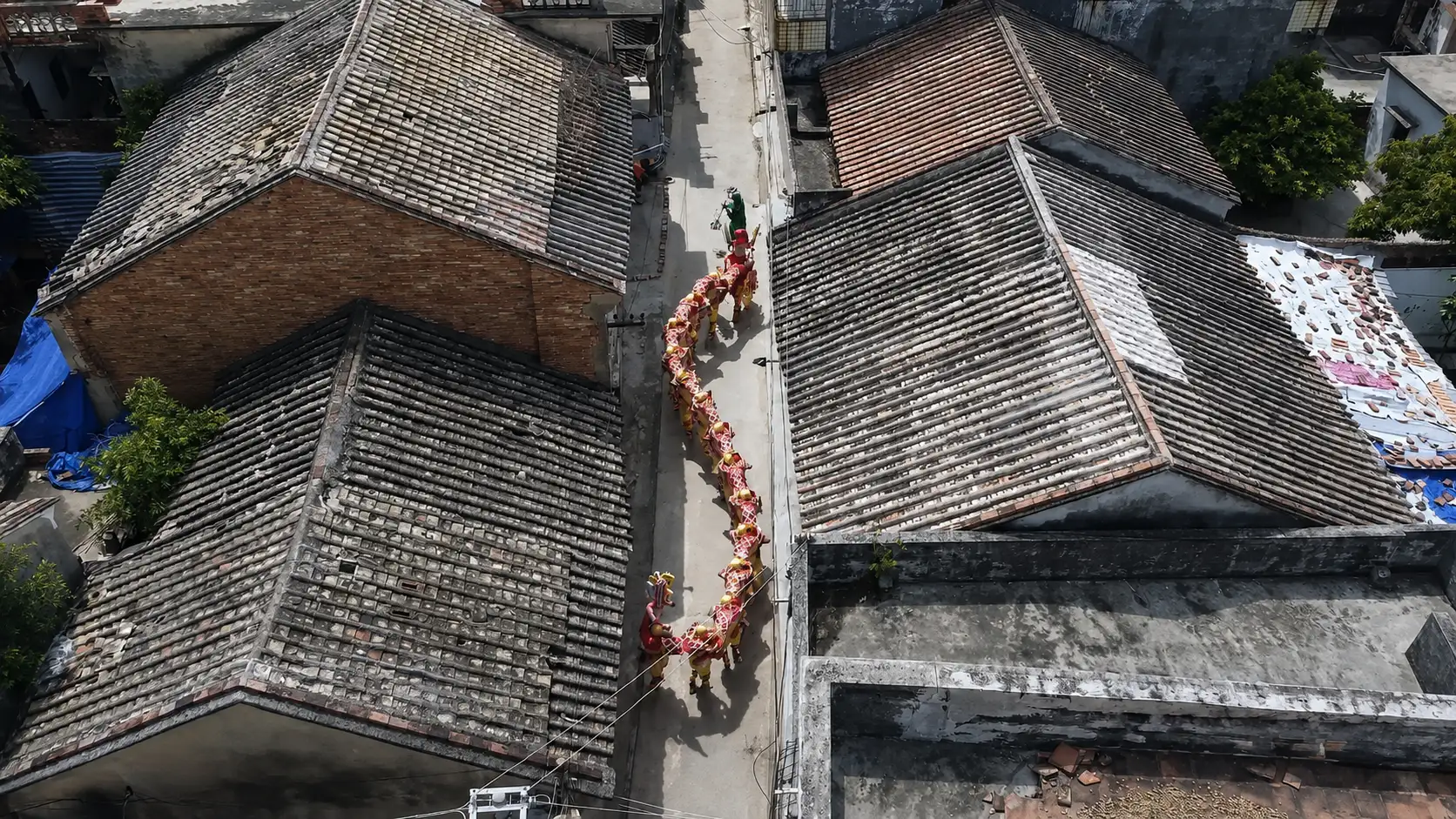
Renlongwu was listed in China's national intangible cultural heritage roster in 2006, but the village body that carries it is older than any certificate.
Its logic belongs to a coastal place where festivals need everyone. Donghai Island faces wind, salt, ships, markets, and long absences. Men leave for work. Young people move between village and city. Families scatter, return, scatter again. A dance made from a single trained star would not fit this ground. A human dragon needs a crowd that remembers how to become one shape.
The rehearsal is not glamorous. It happens in ordinary clothes, on concrete, with someone shouting counts over the scrape of sandals. The dragon is built slowly: first the line, then the bend, then the rise, then the dangerous habit of trusting the person behind you without turning your head. New dancers learn where to put their weight. Children learn which shoulder belongs to them. Older men learn how much pain can be hidden under a festival face.
No one explains this as philosophy. The body understands it first.
When the drum stops during practice, the dragon falls apart instantly. A child slides down. A man rolls his shoulder. Someone laughs because his leg has gone numb. The creature disappears, and the square is full of people again. Then the drum starts, and they rebuild it.
This repeated vanishing is part of the power. The dragon is never stored. It cannot be locked in a cabinet. It survives only when enough bodies arrive at the same place and agree to carry more than themselves.
When the Spine Turns
The best moment comes after the audience has already accepted the impossible.
The dragon has circled the square. The pearl has teased it forward. The drums have driven the line faster than seems reasonable. Sweat has begun to darken the collars of the lower row. The children above no longer look like children; under the lamps, their faces are painted into something watchful and remote.
Then the spine turns.
It is a slow maneuver at first, almost cautious. The head bends inward. The middle line folds after it. The tail keeps moving, then tightens. For a few breaths, the dragon becomes a coil of human backs and lifted knees, a living knot. The crowd leans forward because everyone can see the risk. Too fast, and the upper row will swing outward. Too slow, and the shape dies before the turn is complete.
The drum drops into a lower rhythm.
Boom. Step. Boom. Step.
The bodies answer one by one. The head completes the turn. The spine follows. The tail snaps last, and the whole dragon opens again, longer than it seemed before. The square releases its held breath in a burst of shouting.
Nothing magical has happened. No one has flown. No machine has lifted the dancers. The wonder is more stubborn than that: many people have carried the exact amount of another person's weight, at the exact moment required, long enough for a village to see a dragon.
Back to Separate Breath
At the end, the pearl lowers first.
The head dips. The line slows. The drum loosens its grip, and the dragon begins returning to human scale. Children climb down from shoulders. Adults straighten with careful faces, as if the body needs privacy after such work. Someone rubs a red mark where a knee pressed too long. Someone else drinks from a plastic bottle without speaking.
The square fills again with separate breath.
This is the quiet secret of Donghai Island's Human Dragon Dance. It does not ask the audience to believe that a dragon has been brought among them. It shows, more plainly and more dangerously, how a dragon can be made when people surrender their separate balance for one moving spine.
A boy who was part of the crest stands beside the man who carried him. For a moment, neither moves. Then the boy places one foot back on the man's thigh, testing the old path upward, and the shoulder under him rises to meet it.