On August 2, 1964, a few thousand people packed the Long Beach Sports Arena for the First International Karate Tournament. They had come to see black belts from Japan, Okinawa, and Hawaii. Most had never heard the name Bruce Lee.
A slim Chinese man in his early twenties walked onto the stage. He asked for a volunteer. A large man stepped up. Bruce Lee placed his right fist against the man's chest —not pulled back, not wound up, pressed directly against his shirt. One inch.
He moved.
The man flew backward three meters. The arena went silent.
The one-inch punch was not magic. It was Wing Chun.
---
The Fishmonger Who Opened the Gates
Before the world knew Wing Chun, it had a man who refused to let it die in a locked room.
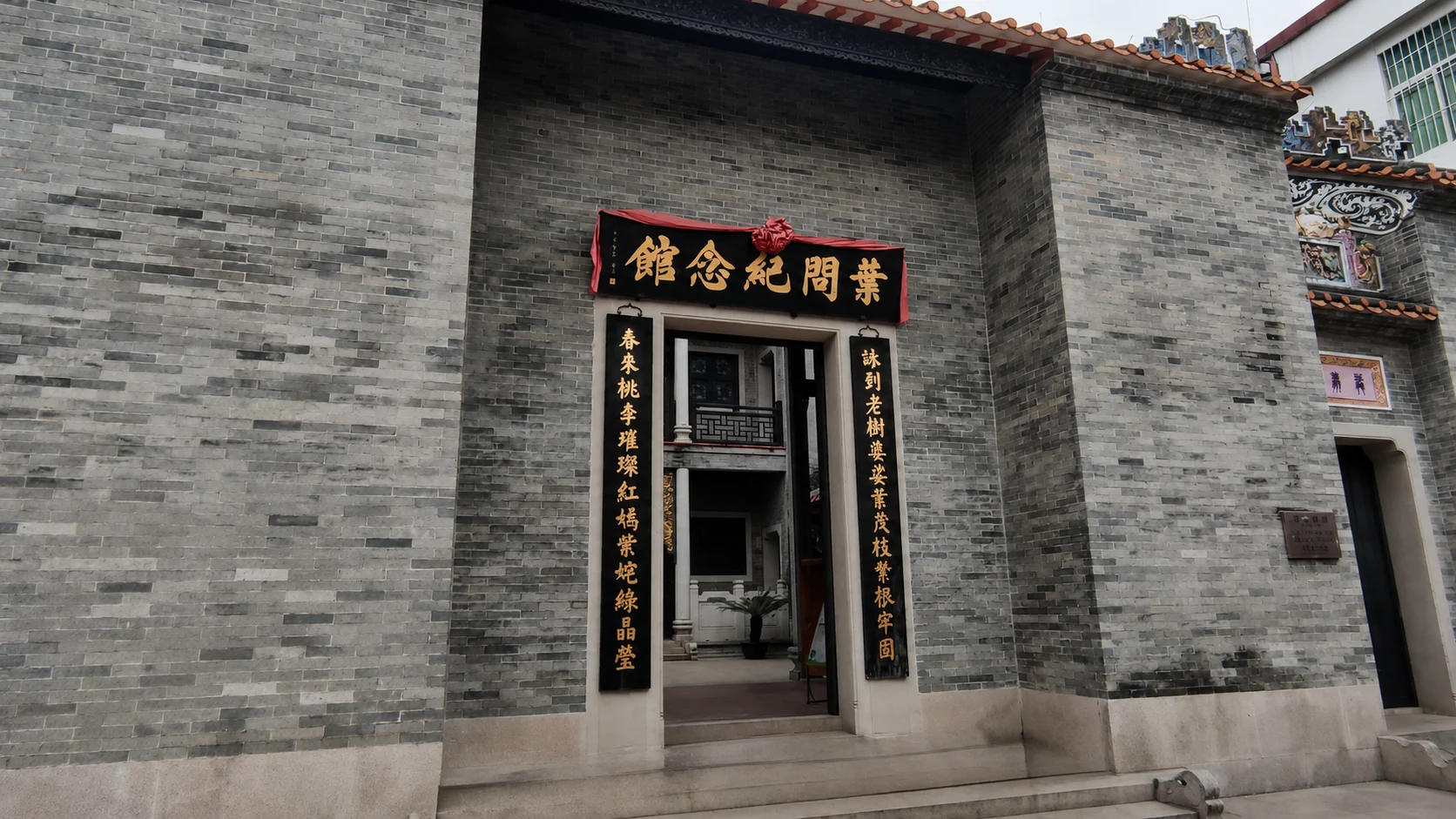
Ip Man was born in 1893 in Foshan, an industrial city in Guangdong province. His family had money. As a boy, he did not go to a kung fu school —the school came to him. His father paid Chan Wah-shun, a master of an obscure southern style, to live in the family compound and teach the boy privately.
Wing Chun was not for performance. It had no flying kicks, no animal forms, no temple pageantry. It was built for the narrow alleyways of Foshan, where there was no room to throw a roundhouse. Every strike followed the shortest line between two points. The centerline —an imaginary vertical axis down the front of the body —was treated as sacred ground.
For forty years, Ip Man kept this knowledge small —a handful of students, behind closed doors, in a city nobody outside Guangdong had reason to visit.
On July 7, 1937, the Imperial Japanese Army launched a full-scale invasion of China. On October 26, 1938, Japanese forces occupied Foshan and commandeered the Ip family's ancestral mansion to serve as their local military headquarters. Ip Man and his family were left homeless and plunged into dire hardship.
In 1949, he crossed the border into Hong Kong. He was fifty-six. His wealth was gone. He took a room above a restaurant and, in 1950, opened a school on the rooftop of the Restaurant Workers Union building. He charged a few Hong Kong dollars a month. Dock workers came. Cooks came. Street kids came. Anyone who paid got the same thing a rich boy from Foshan once received.
He did not just teach a fighting method. He turned a secret into something public.
---
What the Movies Revealed
In 2008, Donnie Yen put on a long cotton robe and played Ip Man on screen. Two scenes burned into global memory.
In the first, Ip Man stands in a courtyard surrounded by ten Japanese soldiers and breaks every one of them with a flurry of short, straight punches —no wind-up, no telegraphing, each fist traveling six inches at most. In the second, he faces a northern-style master in a silk factory and dismantles him with a technique the audience had never seen before: two forearms pressed together, rotating in a continuous circle, each man trying to sense the other's next move through skin contact alone.
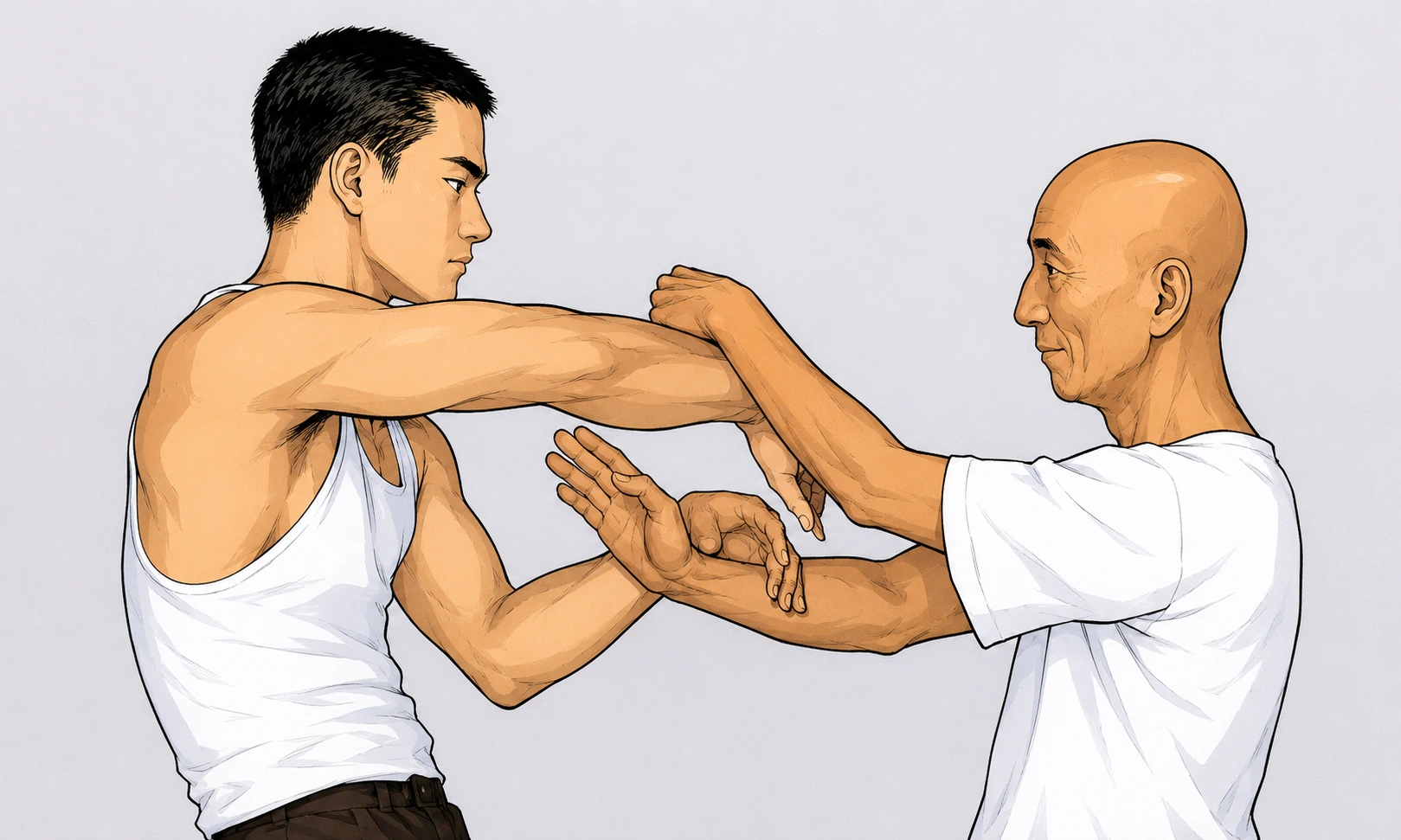
Wing Chun calls this chi sao —sticky hands. No eyes needed. The goal is not power. It is reading, like a blind person reading braille on a living surface. When the opponent tenses, you feel it before the muscle fires. When he shifts weight, you feel it before his foot leaves the floor.
Behind every strike on screen is Siu Nim Tao —the first Wing Chun form, a slow, near-motionless sequence performed standing in one place. No punching. No kicking. Just arms moving through positions so small that an observer sees nothing. The form trains the nervous system, not the muscles. A student does it six thousand times. Then six thousand more. The speed comes later.
The movies made Wing Chun famous. But the art itself operates on a principle the films never explained: the shortest distance wins. That difference between a spectacular move and *zhen gongfu*, skill that still works under pressure, now appears in an unlikely arena: China's autonomous robot MMA fights.
---
The Boy Who Was Too Fast for His Own Good
In 1954, a fourteen-year-old boy was brought to Ip Man's rooftop by his father.
The boy was Bruce Lee. He had been thrown out of one school and was close to being thrown out of another. He had already been in too many fights. His father —a Cantonese opera performer —thought Wing Chun might teach him discipline.
Bruce Lee had something Ip Man spotted immediately: not strength, but speed. His hands moved before most people's eyes could register the decision to move. Some people are born with faster nerve conduction —their brain-to-muscle signals traveling at the high end of human range. Bruce Lee was one of them.
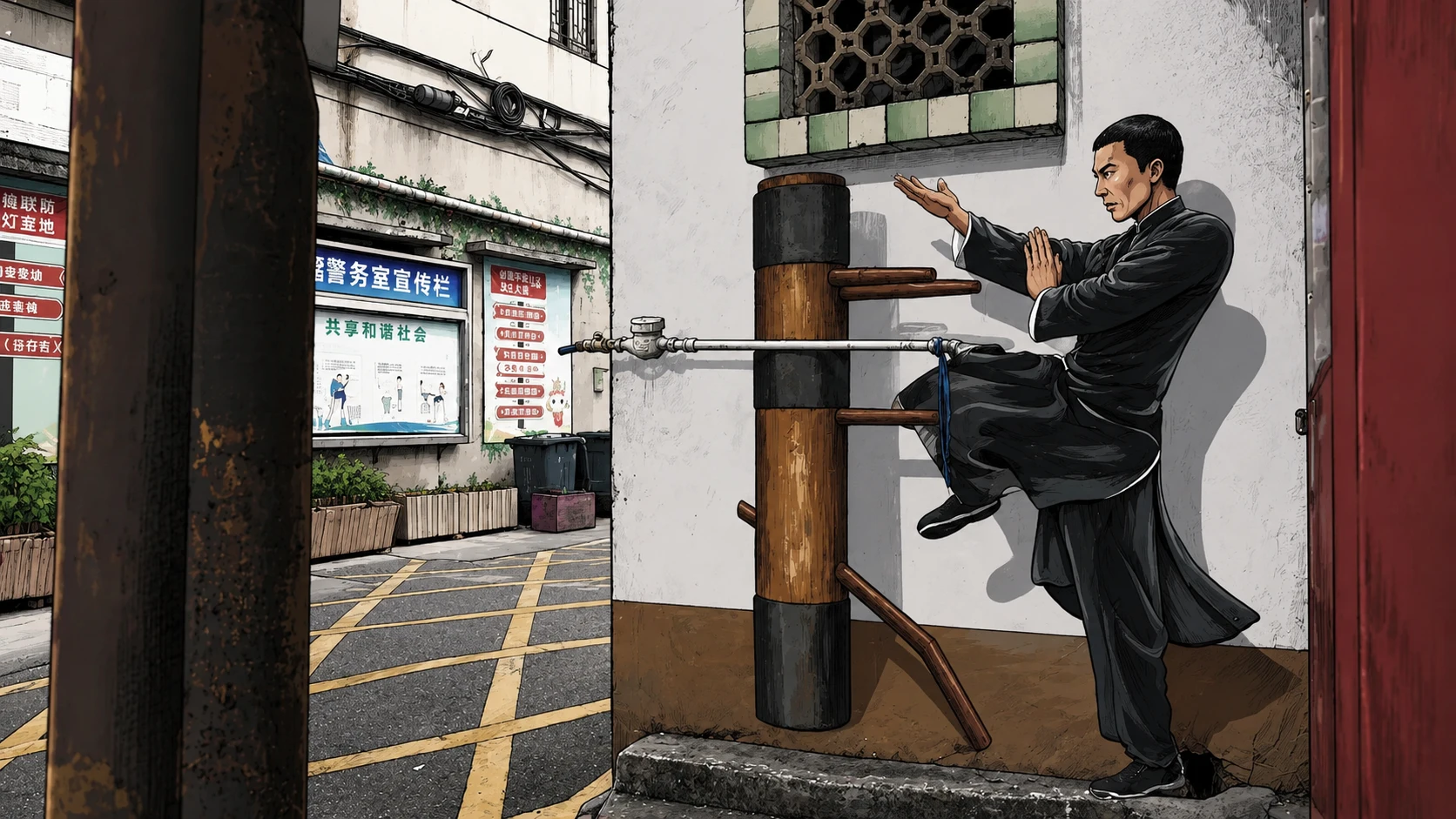
He trained for six years. He learned Siu Nim Tao. He learned chi sao. He learned the 116-movement wooden dummy sequence.
In 1959, at nineteen, he boarded a ship for San Francisco with fifty dollars and six years of Wing Chun in his forearms.
---
The Traitor Who Wasn't
Bruce Lee arrived in Seattle and started teaching Wing Chun in a parking lot.
His first student was an African American named Jesse Glover. His second was Japanese American. His third was white. By 1963, he had opened a school with a sign that said nothing about Chinese students only. Anyone could walk in.
The Chinese martial arts community erupted. For centuries, kung fu had been guarded like a family secret —taught only to one's own ethnic group, sometimes only to one's own blood relatives. Bruce Lee received letters from Hong Kong calling him a traitor and a sellout. He did not shut down.
Three thousand miles away, in a cramped apartment in Hong Kong's Yau Ma Tei district, Ip Man was in his seventies. He had been teaching dock workers and waiters and unemployed teenagers for twenty years. He knew something the letter-writers did not: a martial art that only teaches its own kind is a martial art that is dying.
Ip Man never publicly defended Bruce Lee. He never condemned him either.
Silence, when a single sentence from an elder could destroy a reputation, is a choice.
---
Two Refusals, Two Reasons
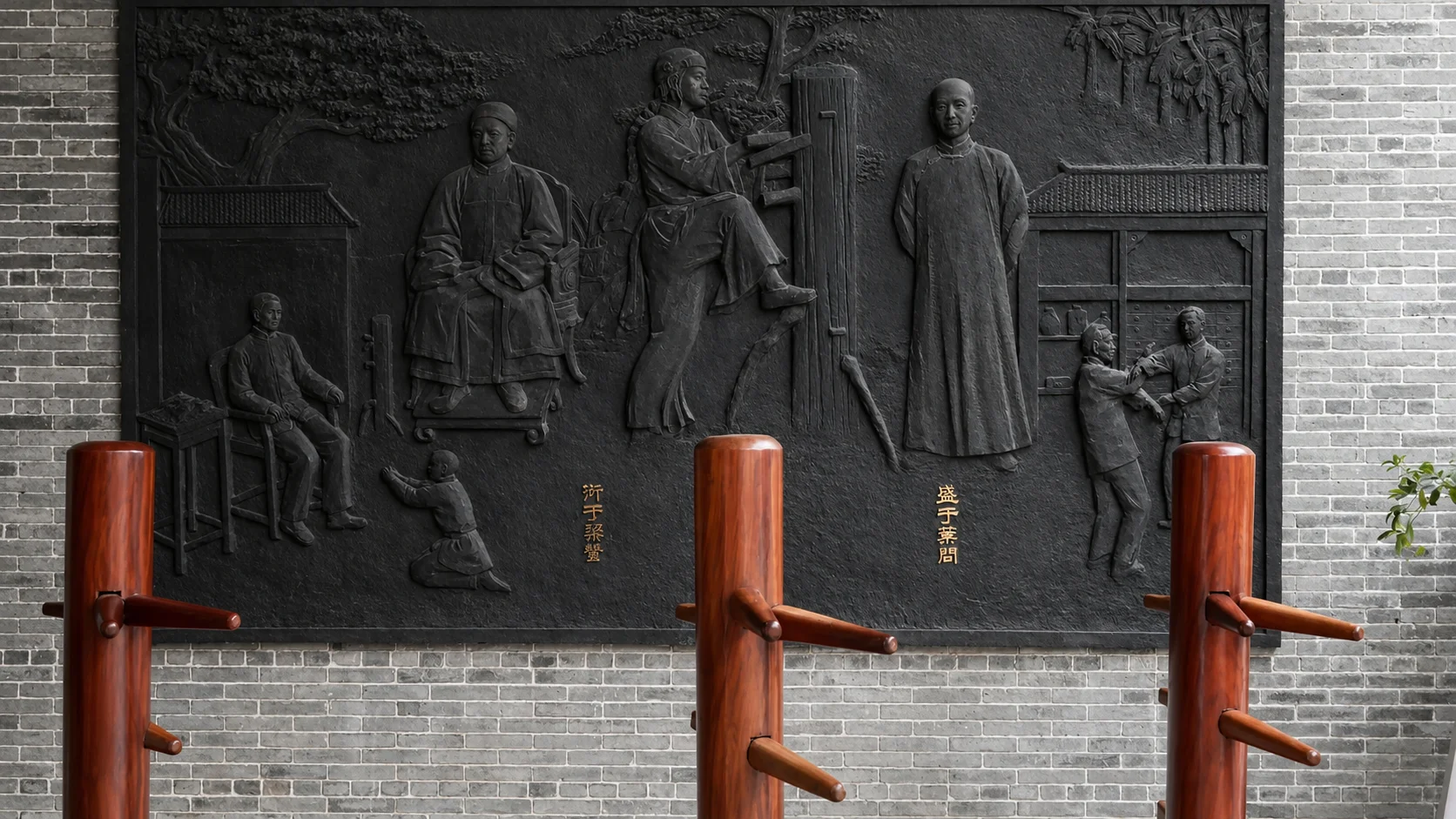
To understand what Wing Chun was built to stand for, look at the two times Ip Man said no.
The first was in Foshan, during the Japanese occupation. A local collaborator offered him money to teach Wing Chun to Japanese military officers. Ip Man refused. His words, passed down through his students: "I cannot be a traitor to my country."
This was *xia* —the Chinese martial code that says if you know how to fight, you fight for people who cannot. Jin Yong, the great martial arts novelist, gave it words: "The greatest warrior serves the nation and its people." Ip Man served the nation by refusing to arm its invaders.
The second refusal came in 1970. Bruce Lee was famous. He wanted Ip Man to perform the full 116-movement wooden dummy form on camera, to take back to America for his students. He offered a property on Nathan Road —one of Hong Kong's most valuable commercial streets. A full apartment.
Ip Man refused. His words: "My wish is simply that whoever has the heart to learn, I teach with full effort. I will never treat kung fu as a commodity. Most importantly, I cannot favor one student over another."
Set those two refusals side by side. A Japanese officer wanted to buy Wing Chun —no. A Chinese student wanted to buy exclusive access —also no. The logic is one piece: Wing Chun cannot be owned. Not by a foreign power. Not by the richest man in the room. Not by the most famous student. It belongs to whoever shows up and does the work.
---
The People Are Not Just Chinese
Bruce Lee's first student was African American. By the time he died in 1973 at age thirty-two, he had taught men and women of every background —and through his films, he had planted Wing Chun's centerline theory in the muscle memory of millions.
Today, roughly twenty million people practice Wing Chun worldwide. German riot police train elements of it for non-lethal restraint. The United States Marine Corps has studied its close-quarters applications. A software engineer named Didier teaches it in a Paris garage. A taxi driver named Mahmoud practices Siu Nim Tao in his Cairo living room before dawn. A grandmother named Elena has been training on the wooden dummy in Buenos Aires for eleven years.
None of them is Chinese. None of them has been to Foshan. But every one of them stands the same way Ip Man stood —feet shoulder-width, knees soft, lead hand at forty-five degrees. The body remembers what the passport does not require.
Jin Yong wrote that the greatest warrior serves the nation and its people. *Guo* is the nation. *Min* is the people. When Chinese kung fu left China —when Ip Man carried it to a Hong Kong rooftop and Bruce Lee carried it to a Seattle parking lot —the nation stayed behind.
The people grew.
FAQ
Did Bruce Lee learn Wing Chun?
Yes. Bruce Lee began studying Wing Chun as a teenager in Hong Kong within Ip Man's school and trained for several years before leaving for the United States in 1959. Wing Chun shaped his close-range movement, centerline awareness, and sensitivity drills, although he later developed Jeet Kune Do and did not present himself as a traditional Wing Chun teacher for the rest of his career.
Did Wing Chun originate in Foshan?
Wing Chun's early origin stories are disputed and often mix oral lineage, legend, and later retelling. Foshan is better described as a major center of its documented modern transmission. Ip Man grew up and trained there before teaching publicly in Hong Kong, and Foshan's schools, lineages, and memorial institutions helped give the art the recognizable history that practitioners inherit today.
How did Wing Chun spread around the world?
Wing Chun spread through migration, teaching networks, and popular culture. Ip Man opened instruction to a wider public in Hong Kong, while students carried the system abroad. Bruce Lee's demonstrations and films made its short, direct movements globally visible, and later Ip Man films renewed interest. Schools now adapt the same forms, partner drills, and wooden-dummy practice for students far beyond China.