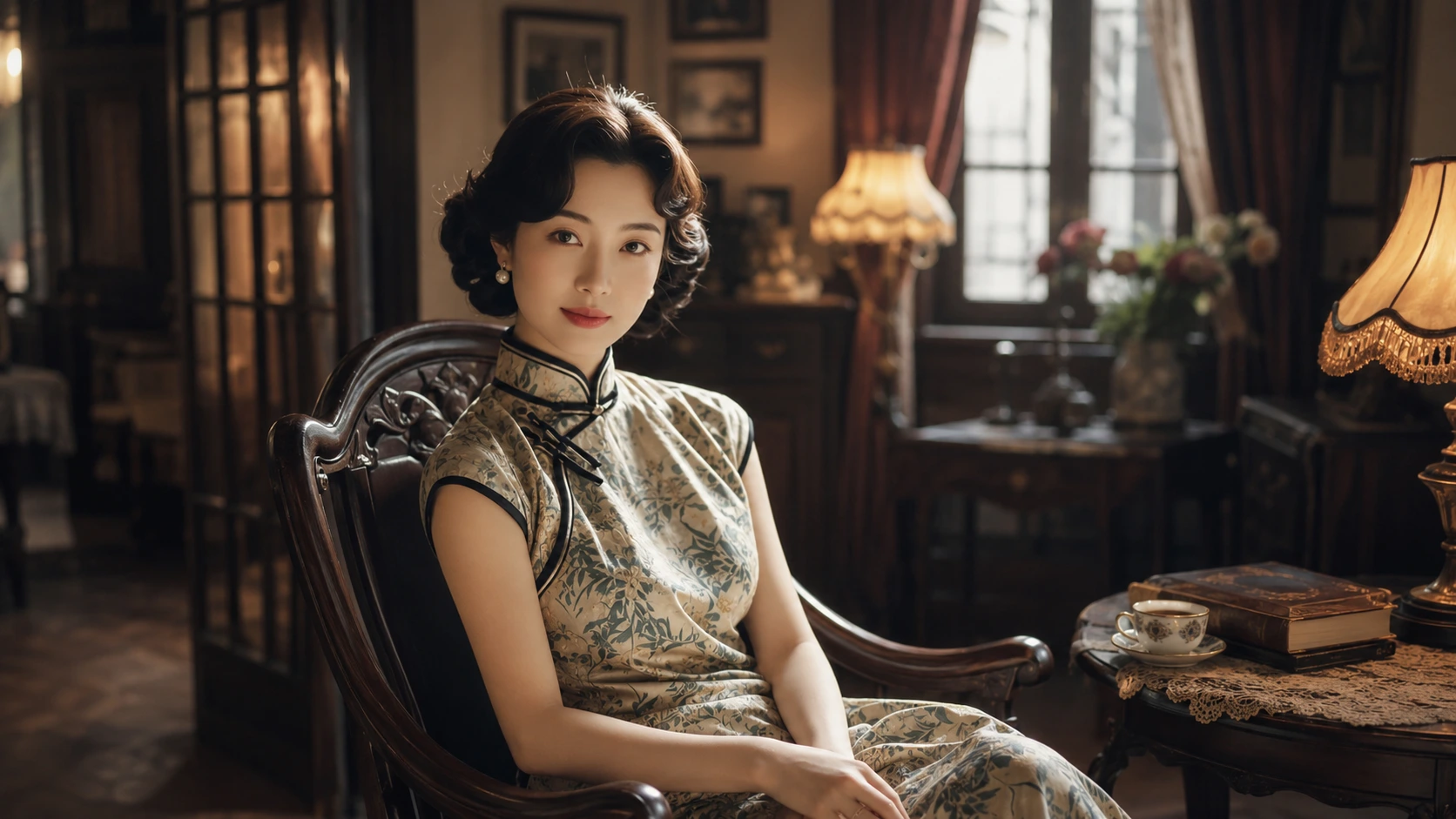
A visitor to Shanghai hears two names before seeing the dress clearly. The first is cheongsam -- a word that traveled through Cantonese into English beyond China, carrying with it the sound of a southern harbour more than a northern capital. The second is qipao, which comes through Mandarin and points to the garment's earlier form in Manchu women's clothing. In Shanghai, both words arrive at the same silhouette: a high collar, fitted lines, cloth buttons wound by hand, and a dress that looks old only until someone wears it again.
The Shanghai cheongsam was not born in a single moment. It was remade across decades by students, tailors, poster artists, a woman speaking before the U.S. Congress, a film director who understood that fabric could carry emotion, and designers who still cut it for the street. Each generation took the dress and changed what it meant. That is why it still belongs here.
---
From Aoqun to Qipao, a Student Uniform Became a Claim
Before the modern qipao, educated young women in early twentieth-century Shanghai wore aoqun -- a jacket over a skirt, two pieces, modest, decorative. It kept the body inside a frame someone else had drawn.
In 1920, the first cohort of female students entered Peking University -- the first time in Chinese history that women were admitted to a national university. In Shanghai, girls' schools were opening across the city. A photograph from around 1922 shows a class of female students at a Shanghai middle school: some still in aoqun, a few in looser, straighter one-piece gowns that would later be recognized as early qipao. The difference is visible. The aoqun says "proper." The qipao says "present."
This was not simply about fashion. A one-piece garment was easier to move in, less ornamental, closer to what male students wore. In roughly the same decades that European women were discarding the corset for looser, more practical clothing -- a change that was as much about bodily freedom as it was about style -- Shanghai women were making a parallel claim through fabric. The qipao did not cause equality. It dressed it.
By the mid-1920s, the qipao was no longer a curiosity. It was a claim.
---
The Tailor, the Movie Star, and the Poster That Hung in Every Home
In 1917, a man named Jin Hongxiang opened a small tailoring shop. By 1928, he had expanded to a storefront at 863 Nanjing West Road -- the first Chinese-owned women's fashion store in Shanghai. He called it Hongxiang Fashion Company.
Jin and his brother Yixiang refined the Shanghai qipao for years. They adapted Western darts and set-in sleeves to silk, satin, and brocade without losing the garment's Chinese logic -- the clean front panel, the high collar, the side slit that revealed a step without exposing skin. The result was the Shanghai-style qipao: fitted but never tight.
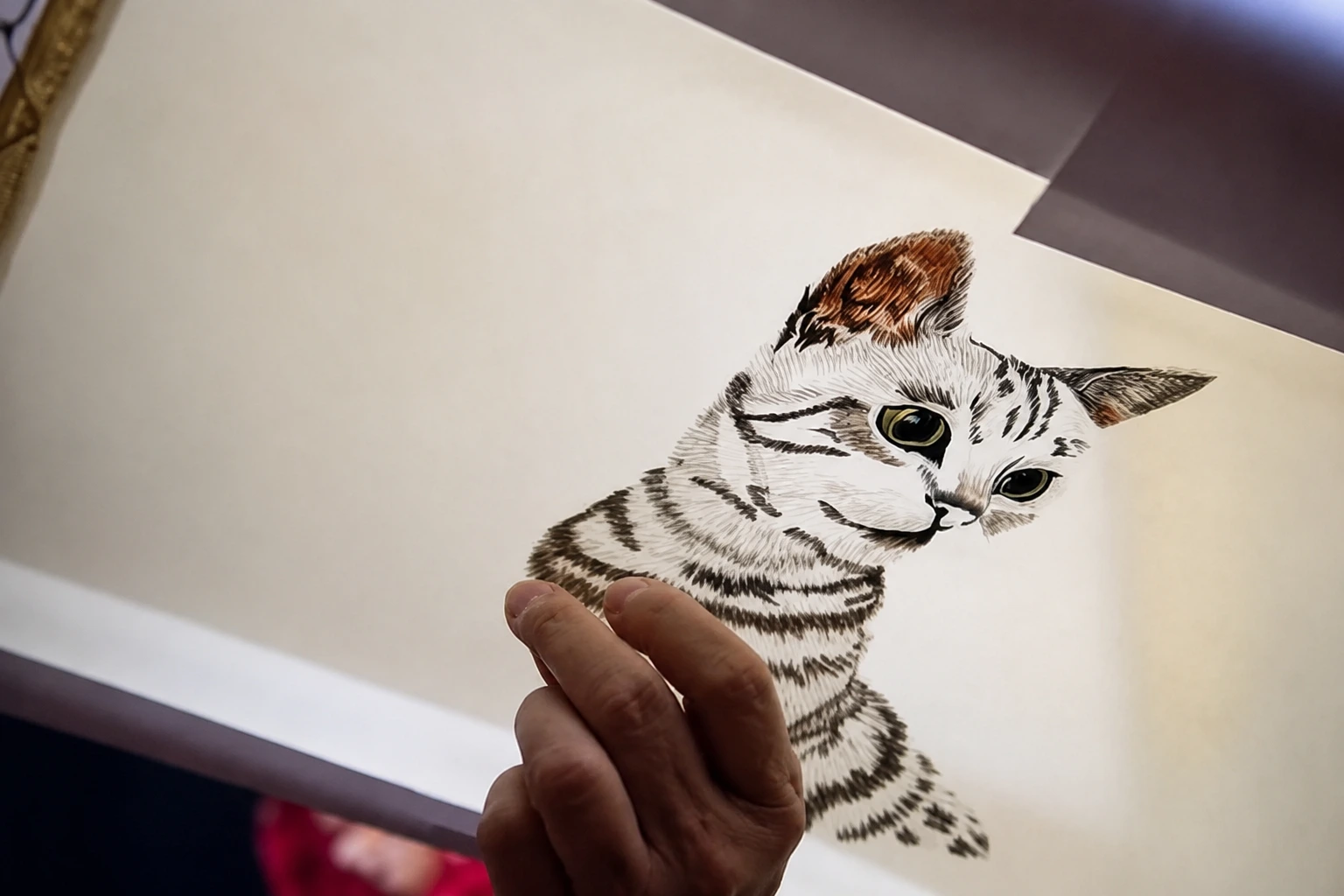
Tailoring gave the cloth its shape, while Chinese needlework could give its surface another life. In Sichuan embroidery, split silk threads build an image stitch by stitch, a different discipline working on the same unforgiving material.
Hongxiang's clients included the Soong sisters -- Soong Qingling and Soong Mei-ling -- and Hu Die, the reigning film star known across China as the "Movie Queen." Cai Yuanpei, the most revered educator of the Republican era, wrote a calligraphy plaque for the store: "guo huo jin liang," meaning "A Bridge for National Goods." A qipao from Hongxiang was not a piece of clothing. It was a status signal.
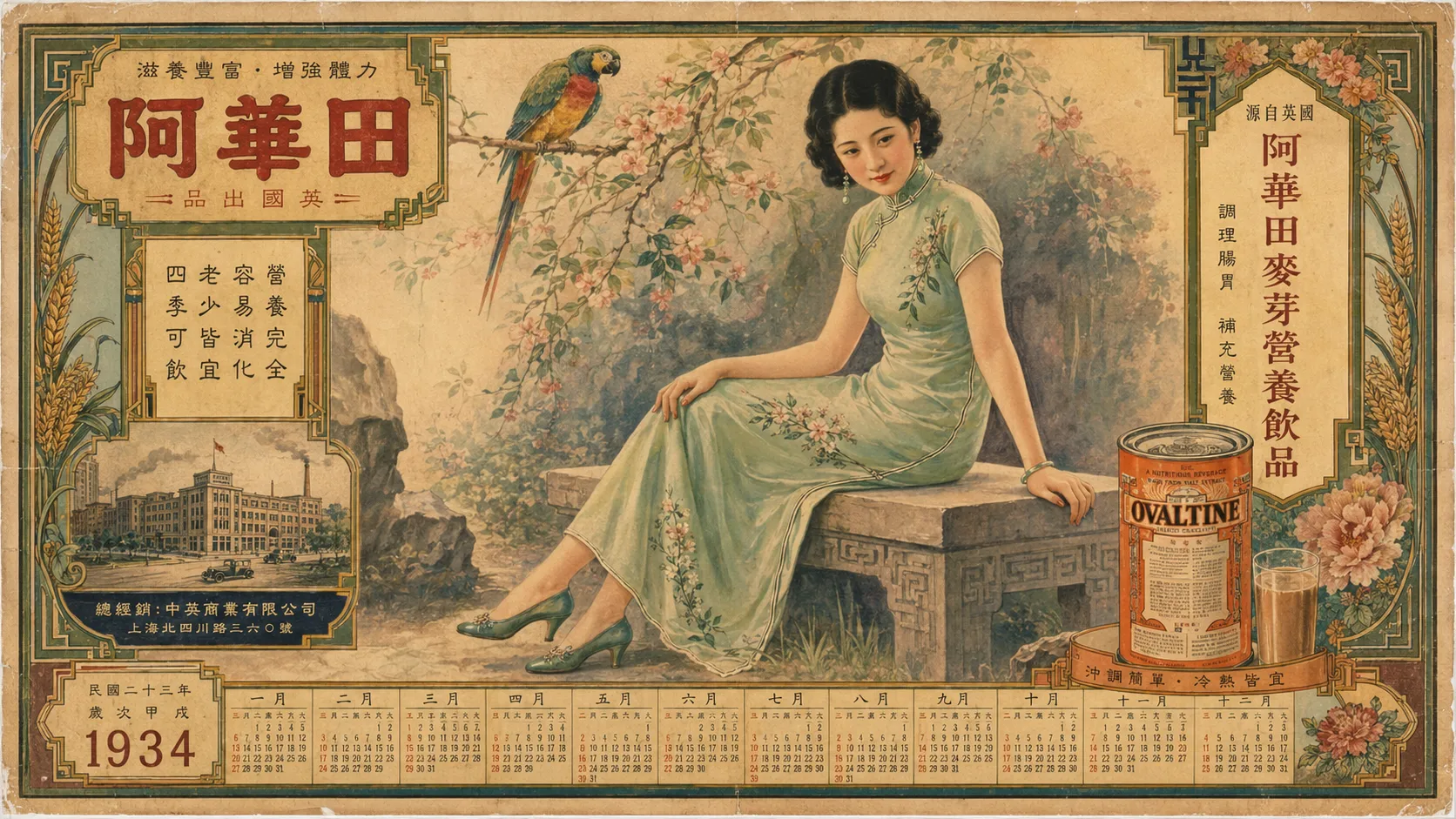
At the same time, a different kind of image was spreading the qipao far beyond Nanjing Road: yuefenpai -- calendar posters, a distinctly Shanghai art form. Foreign companies commissioned Chinese painters to create advertising calendars decorated with modern Chinese women. The calendars were given away free. They hung in shops, tea houses, and homes across China.
The painters of yuefenpai needed faces. They found them in Shanghai's movie stars. Ruan Lingyu, the greatest actress of China's silent film era -- a face that could move from innocence to devastation in a single close-up -- appeared on a 1930 calendar poster for British American Tobacco. She is painted in a fitted qipao, expression poised but unreadable. The poster advertised cigarettes. But the image it sold was the modern Chinese woman herself -- self-possessed, urban, dressed in Shanghai.
---
When Soong Mei-ling Wore Qipao on Capitol Hill
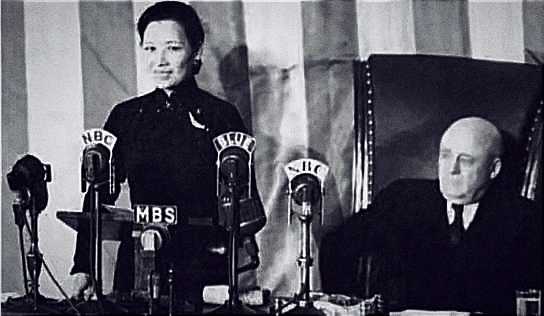
On February 18, 1943, Soong Mei-ling addressed both houses of the United States Congress. She was the first Chinese national and one of the few women of her era to stand at that podium.
She spoke in English. She spoke about China's war against Japan. And she wore a fitted qipao.
The room was not a Shanghai ballroom. It was Capitol Hill. Soong Mei-ling had grown up in Shanghai, been educated in the United States, and knew exactly what she was doing when she chose a qipao for this moment. A Shanghai tailor -- very likely from a house such as Hongxiang, which had dressed her and her sisters -- had cut and fitted every seam. The dress said: I do not need to dress like you to be heard by you.
After the speech, American newspapers ran photographs of her at the podium. It was probably the first time much of the Western public had seen a qipao worn as formal political dress rather than ethnic costume. The garment carried Shanghai into the world's visual record as something authoritative.
---
From In the Mood for Love to Independent Designers
Some dresses return through memory before they return to the street.
Wong Kar-wai's In the Mood for Love is set in 1960s Hong Kong, not Shanghai. But its visual language -- narrow corridors, amber light, Maggie Cheung in one qipao after another -- reshaped global imagination of what a Chinese dress can convey. The film made the qipao atmospheric. Each dress matched a different register: longing, restraint, defiance. After the film, viewers no longer saw the qipao as only traditional clothing. They saw a garment that could hold an interior life on its surface.
Meanwhile, contemporary designers kept working. Today's Shanghai qipao appears in linen as well as silk. It is cut above the knee, worn with trainers, remade as a structured jacket. The mandarin collar, side-fastening, and pankou buttons circulate as a visual vocabulary that designers expand with each collection.
---
How to Experience Qipao Culture in Shanghai
A visitor does not need to buy a qipao to understand why it belongs to this city.
The Shanghai Textile Museum at 150 Macau Road sits on the former site of the Shenxin Textile Factory, one of old Shanghai's industrial pillars. Its permanent collection traces Chinese textile history with a dedicated section on the qipao -- from Qing robes through 1930s tailoring to the present. Free admission. Open Tuesday to Sunday.
Then the street. Walk Changle Road between Maoming South Road and Shaanxi South Road. Locals call it Qipao Street. Dozens of shops sell ready-made qipaos and offer custom tailoring -- off the rack in ten minutes, or let a tailor measure twenty-six points of your body over a few days.
For the photograph, some studios along Changle Road offer qipao portraits. Choose one that treats the dress as clothing, not a costume. If you prefer to buy fabric first, the South Bund Fabric Market at 399 Lujiabang Road has over a hundred stalls across three floors. Bring a photograph of what you want.
---
Cheongsam or qipao -- the name depends on where the word has traveled. But in Shanghai, the dress keeps returning. A student unbuttons her jacket. A tailor chalks a curve onto silk. A movie star stares out from a calendar in a tea house. A woman stands before Congress. A filmmaker lights a narrow corridor. A visitor walks down Changle Road and sees, in a shop window, a dress that has been waiting for someone to wear it into another age.
FAQ
Is cheongsam the same as qipao?
Yes. Qipao is the Mandarin romanization. Cheongsam comes through Cantonese. In Shanghai, both refer to the same garment.
Why is the cheongsam associated with Shanghai?
Shanghai's female students, tailors, advertising artists, and commercial culture shaped the modern fitted qipao. Each era reinvented the dress.
Did the qipao start as a symbol of equality?
It was connected with women entering universities and public life in the 1920s, but it was one part of a broader change. It gave that change a visible shape.
Why was Soong Mei-ling's 1943 qipao important?
She addressed both houses of Congress in a fitted qipao. It showed the dress as formal public clothing on an international stage.
Where can tourists experience qipao culture?
Shanghai Textile Museum for the permanent collection. Changle Road between Maoming and Shaanxi roads for custom tailoring and photo studios. South Bund Fabric Market for made-to-measure silk garments.