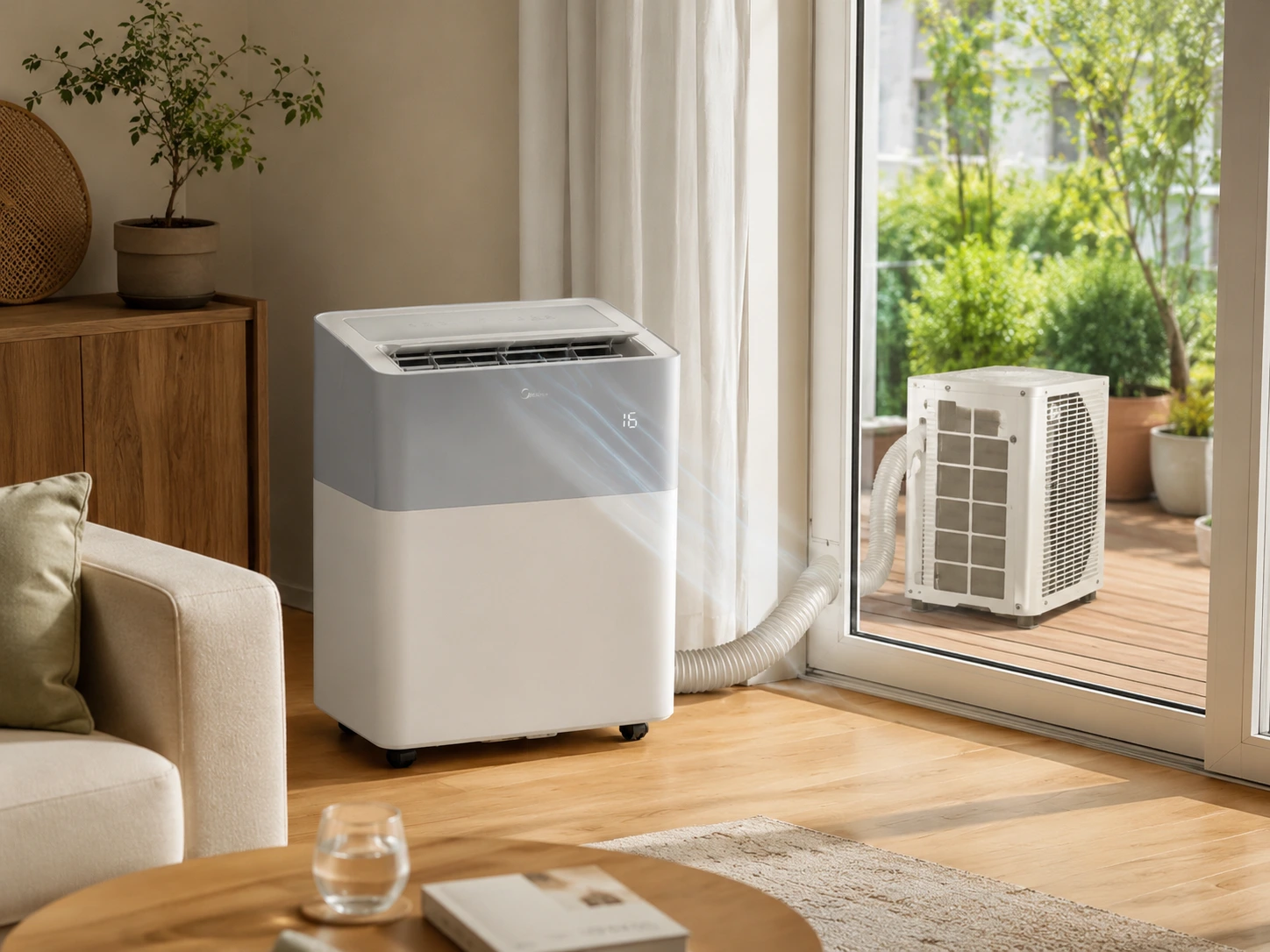
Paris, July. The sixth heatwave of the summer. In a sixth-floor walk-up near the Place de la Republique, a man tears the tape off a cardboard box. Inside is a portable air conditioner. The brand on the side says Midea. Below it, in smaller letters: Made in China.
He has no idea where that machine came from. He does not know that it traveled from a factory where the lights dim themselves at three in the morning because there is nobody on the production line to need them. He does not know that Midea's air conditioner sales in Europe jumped thirty-five percent in the first half of 2025, with France alone surging sixty-eight percent. He only knows that his apartment is thirty-eight degrees and this box promises to make it bearable.
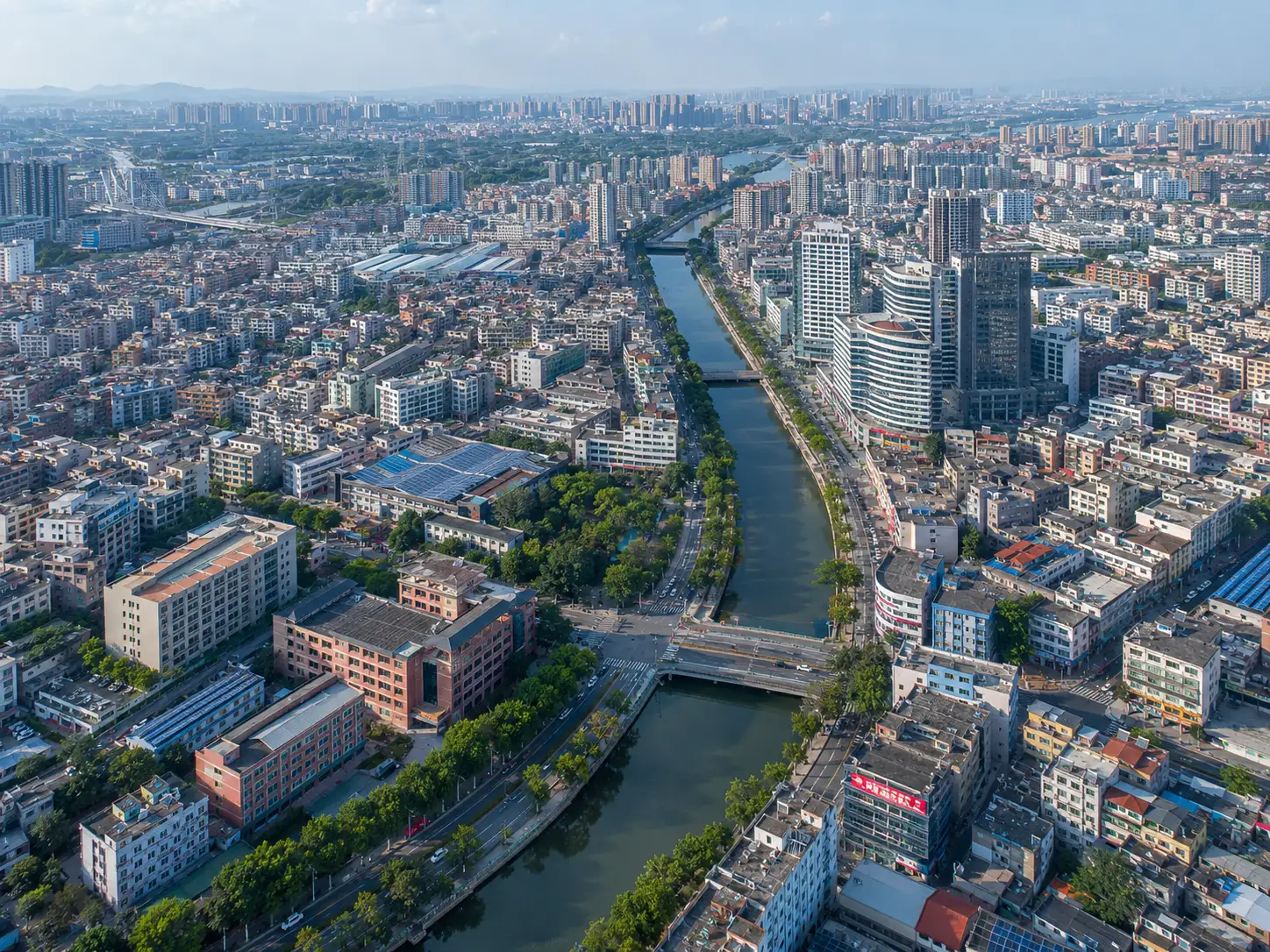
The factory that built his air conditioner sits in a town called Beijiao, in the Shunde district of Foshan, Guangdong Province. To understand how it works, you have to go back to 1968 -- not to a laboratory or a government ministry, but to a rented room with a dirt floor and twenty-three farmers who pooled five thousand yuan to make plastic bottle caps.
---
Five Thousand Yuan and Twenty-Three Farmers
On May 2, 1968, a twenty-six-year-old named He Xiangjian gathered twenty-three residents of Beijiao and asked each of them to contribute whatever they could. The total came to five thousand yuan. They rented a room, hung a sign that read "Beijiao Subdistrict Plastic Production Group," and began making bottle caps. Then rubber gaskets for car parts. Then fan blades.
The timing creates a revealing contrast. While Midea grew from a local collective workshop, China's Third Front Construction was moving strategic factories inland through state planning, secrecy, and mass migration.
In 1980, they built their first electric fan. He Xiangjian named the brand Midea -- a word that, in Chinese, suggests something beautiful and good. The fans sold. By 1985, Midea was making air conditioners. By 1993, it was listed on the Shenzhen Stock Exchange. The workshop with the dirt floor had become a company.
What happened over the next three decades was not just growth. It was a change in kind. Midea acquired KUKA, the German industrial robotics giant. It built its own semiconductor design unit. It opened a design center in Milan to make sure its products looked right in European living rooms. By 2025, forty-three percent of Midea's revenue came from international markets. A company born in a village that most Chinese people could not find on a map was now competing with Samsung and Bosch on price, performance, and aesthetics.
---
The Factory at Three in the Morning
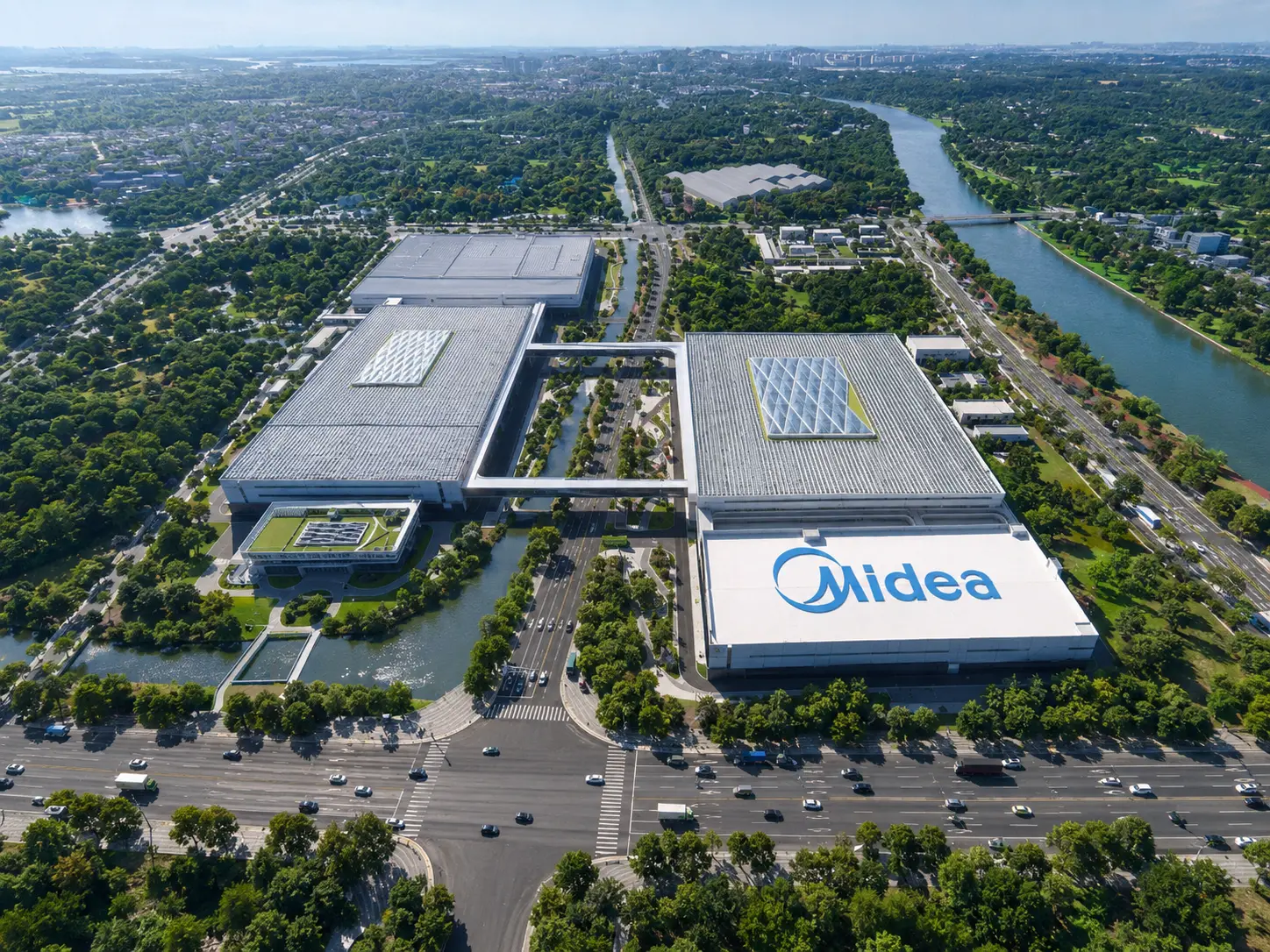
Drive south from the Guangzhou airport for about an hour, past the furniture showrooms and ceramic tile warehouses that line the highway through Shunde, and you reach the Midea KUKA Intelligent Manufacturing Science and Technology Park. It does not look like a factory. It looks like a university campus -- low buildings, glass facades, lawns.
Step inside the production hall. The lights are dim. Not off -- dimmed to a soft amber glow. The air is cool and dry, climate-controlled to the exact tolerance required by the machines.
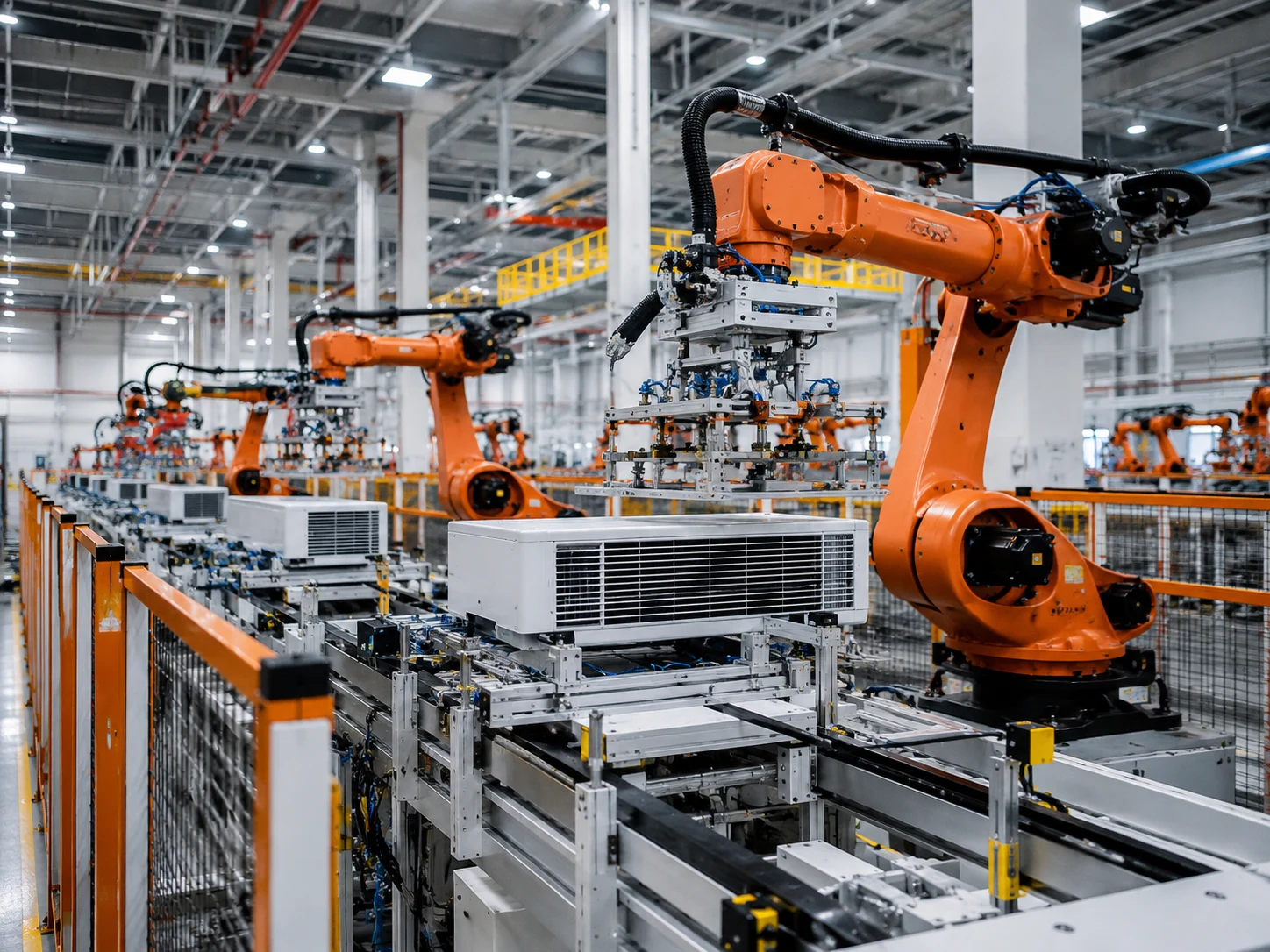
A robotic arm swings in a precise arc, picks up a compressor, lowers it into an air conditioner chassis, and tightens four bolts to a torque of three-point-five newton-meters. The arm does not hesitate. It does not check its work. The torque sensor logged the number before the bolt stopped turning. Another arm welds a seam along the outer casing. A third arm runs a bead of sealant along the edge of a panel. No human hand touches the machine from the moment the sheet steel enters the line to the moment a finished air conditioner rolls onto the pallet at the other end.
Across the campus, in another building, a different production line is making industrial robots. These robots will be sold to car factories, electronics plants, and logistics warehouses around the world. One robot comes off the line every thirty minutes. Robots building robots. The factory that started by making plastic bottle caps now makes the machines that make everything else.
That pattern is now national. The reason robots are showing up across Chinese life has less to do with science fiction than with cost, demography, and scale.
---
The Milan Design, the Foshan Code
The air conditioner that arrived in Paris was not designed in Foshan. Its appearance -- the soft curves, the matte finish, the LED panel that dims at night so it does not disturb sleep -- was finalised in Milan, where Midea's European design team studies the tastes of customers in Lyon, Barcelona and Frankfurt. The compressor inside was developed through a joint venture with Toshiba. The semiconductor chip that controls it was designed by Midea's own silicon team.
But the factory that assembled it is in Foshan. And the assembly was done by robotic arms running on AI control software written by engineers sitting in an office two hundred meters from the production floor. When a quality deviation is detected -- a weld that is half a millimetre too wide, a torque reading that drifts outside tolerance -- the system flags it instantly. The line pauses. The robot recalibrates. Production resumes. No human decision is required.
This is not a science experiment. It is a mass-production line running twenty-four hours a day, and it has been running this way long enough that the workers who used to stand in those positions have been retrained as maintenance engineers, quality analysts, and software programmers.
---
What the Four Words Mean Now
Made in China.
For decades, those four words meant one thing in Western markets: cheap. Functional. Temporary. A pair of shoes worn for one season. An electric fan that lasted two summers. A plastic toy that broke before the batteries ran out.
The box in the Paris apartment tells a different story. The air conditioner inside it competes with Samsung and Bosch on features and design. It is not the cheapest option -- it sells for three hundred and fifty to seven hundred euros in European retail, the same range as established local brands. It wins on quiet operation, energy efficiency, and the fact that it is in stock when the heatwave hits because the factory in Foshan never stops.
He Xiangjian never learned English. The five thousand yuan he raised in 1968 included a few hundred he borrowed from friends. He never sought the spotlight. But every air conditioner that rolls off the line in Beijiao speaks for him -- not in words, but in torque readings, in weld seams, in the quiet hum of a compressor that was installed by a machine that never gets tired.
---
Evening in Paris. The heatwave has eased by a degree and a half. On the sixth floor, the portable air conditioner hums in the corner of the bedroom, quiet enough that the man almost forgets it is there. The compressor was bolted into place by a robotic arm in Foshan. The code that controls the airflow was written by a software engineer in Shunde. The cardboard box is flattened in the recycling bin. Only the words remain.
Made in China.