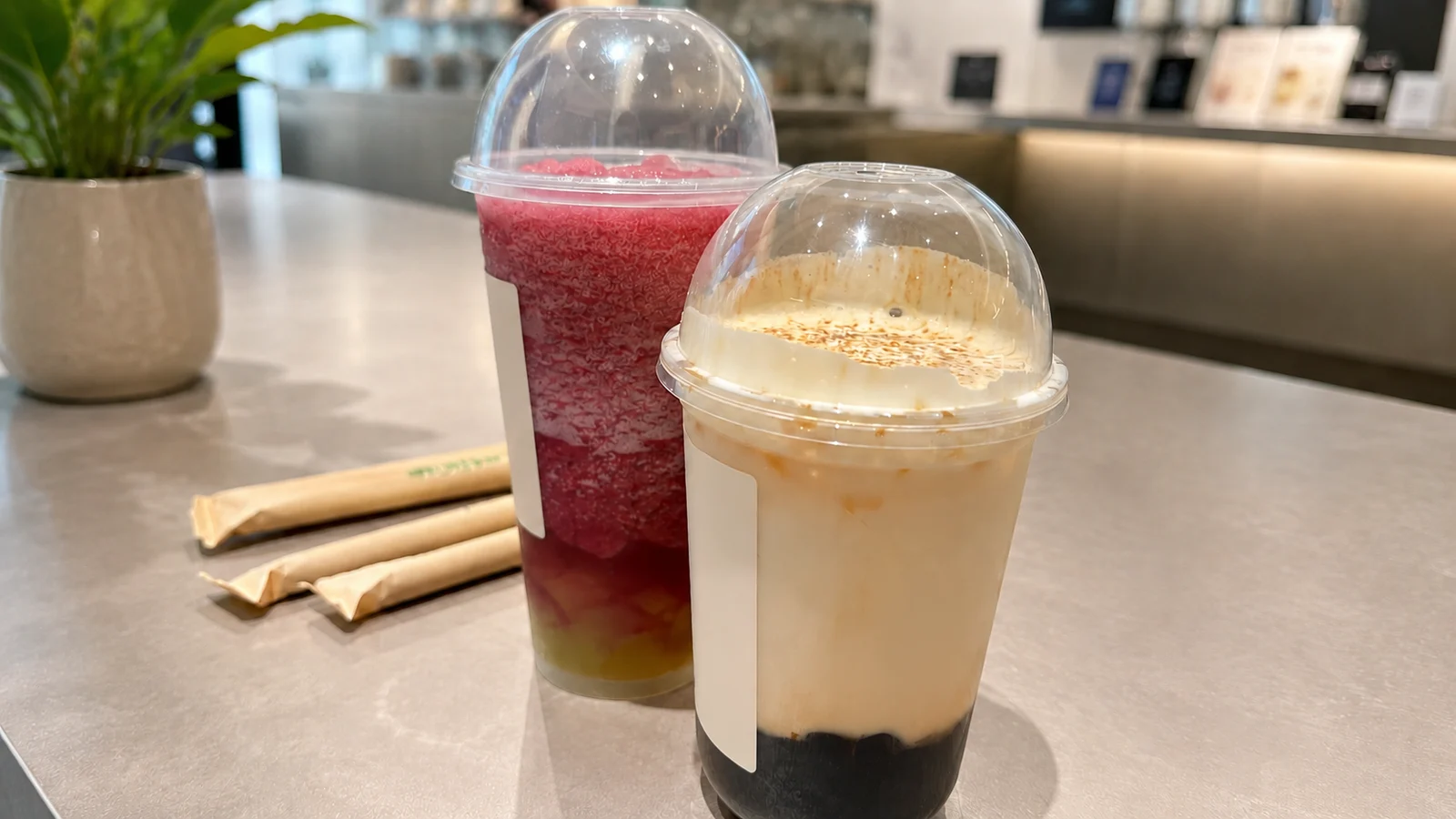
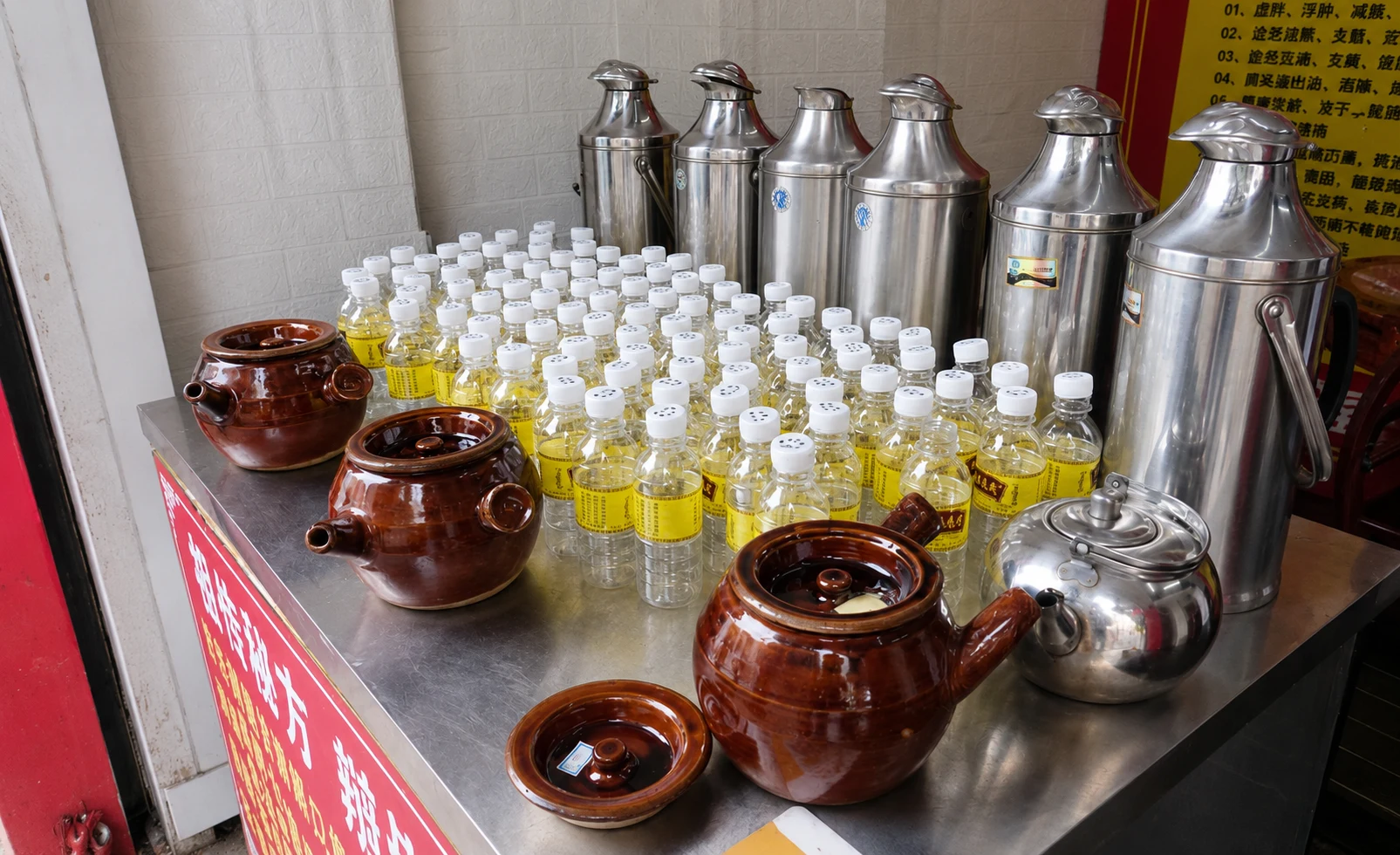
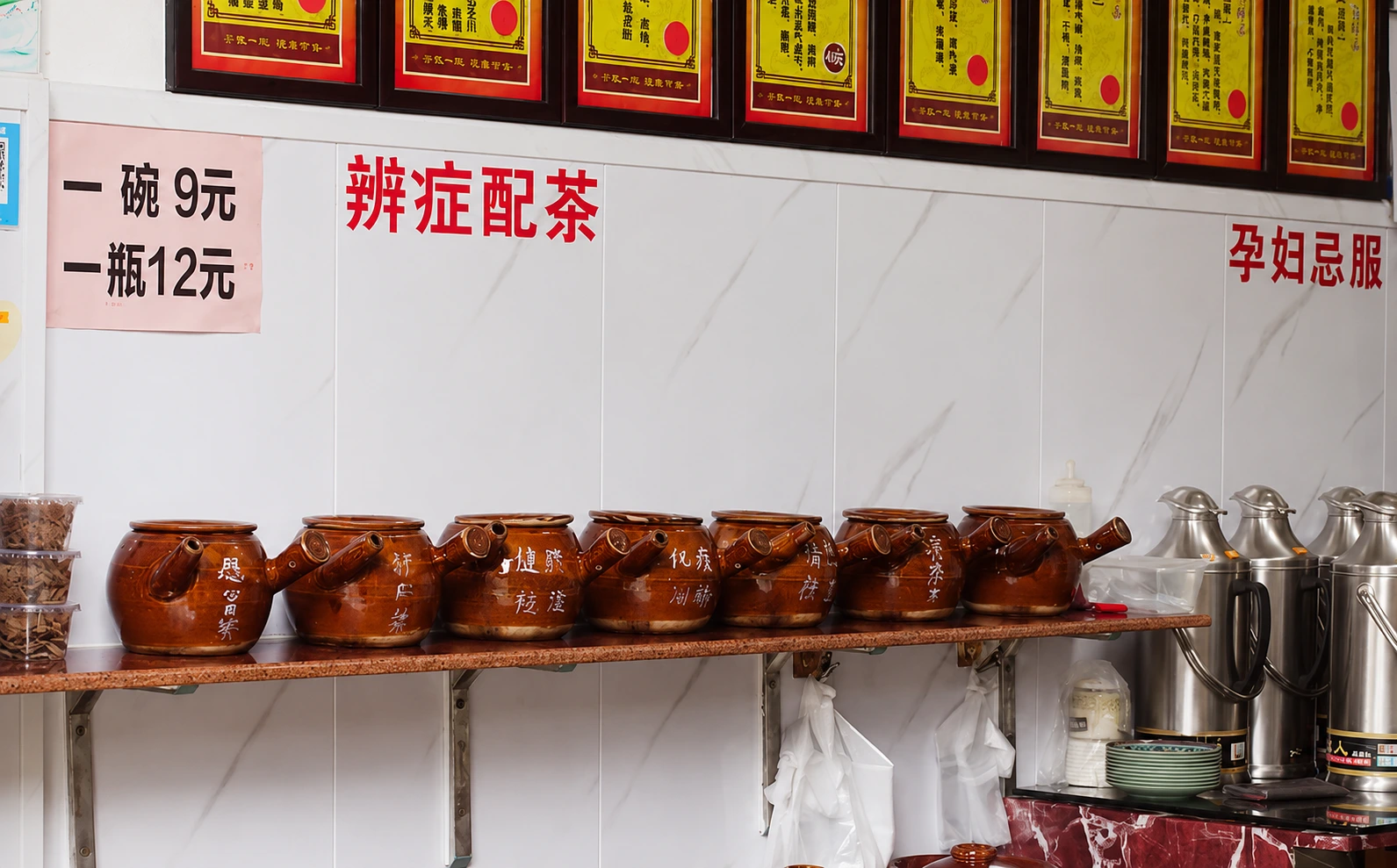
The shop on Wenming Road is no wider than a garage. Behind the counter, a woman in her sixties stands beside a row of copper pots, each labeled with handwritten tape: sore throat, cough, skin rash, damp heat.
A tourist walks in, drawn by the bitter, root-boiled smell.
"What's bothering you?" the woman asks.
"My throat," the tourist says. "It's dry. Hurts to swallow."
In a hospital, a doctor would ask the same question —and then pull out a small flashlight, peer down your throat, and write a prescription. Here, the woman behind the counter does none of this. She just says:
"Bang sha."
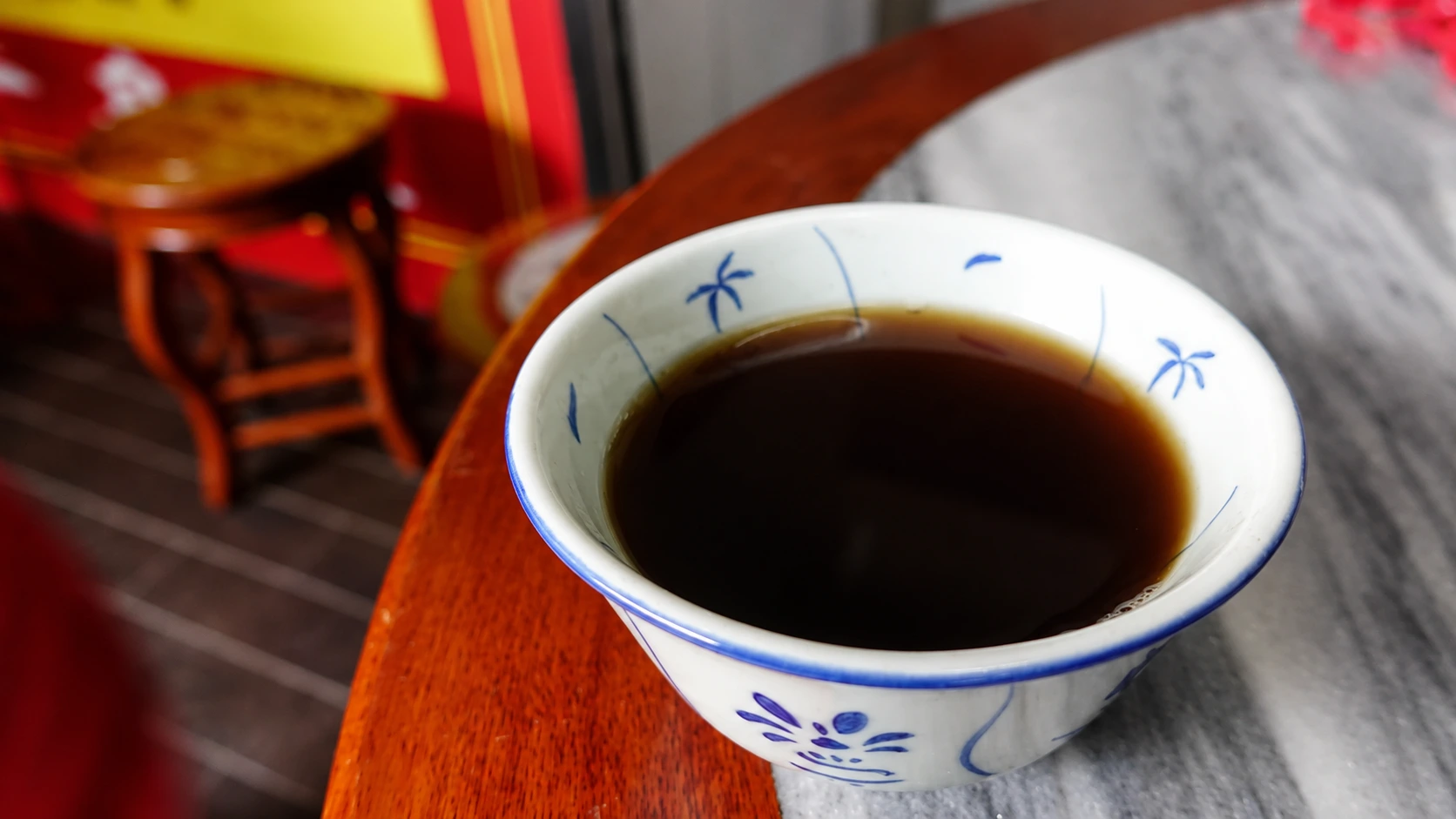
She lifts a copper lid, pours a dark brown liquid into a ceramic bowl no bigger than a fist. The surface is glossy, almost black. She slides it across the counter.
"Drink it hot."
The tourist lifts the bowl. The first sip is not a taste —it is a verdict. Bitterness floods the tongue, climbs up the back of the throat. It tastes the way a fever feels. The tourist winces, eyes watering, looking for something sweet to chase it.
There is nothing. A businessman at the counter next to them tips back an identical bowl with the mechanical ease of taking a morning vitamin. He does not flinch. He nods at the owner and vanishes back into the Guangzhou heat.
---
The City That Lives Inside a Steamer
To understand why anyone would pay to drink something this bitter, understand the air they breathe.
Guangzhou sits in the Pearl River Delta, where heat and humidity collide for eight months of the year. In July, thirty-seven degrees Celsius, humidity above ninety percent. The air feels thick enough to chew. Sweat —the body's natural cooling mechanism —stops evaporating. Heat builds inside. The throat grows sore. The tongue develops a white coating. Rashes appear along the jawline.
The Cantonese call this *seung fo* —rising fire. It is not a metaphor. It is a set of symptoms observed across generations in this specific climate.
Liang cha is the correction. Not a cure in the way a pill is a cure —more like lifting the lid on a boiling pot. Each shop blends its own formula: prunella spike for the liver, honeysuckle for surface heat, chrysanthemum for the eyes, roughhaired holly root for the throat. The woman on Wenming Road who poured bang sha because a stranger said "my throat hurts" was not guessing. She was matching symptoms to a recipe refined across centuries.
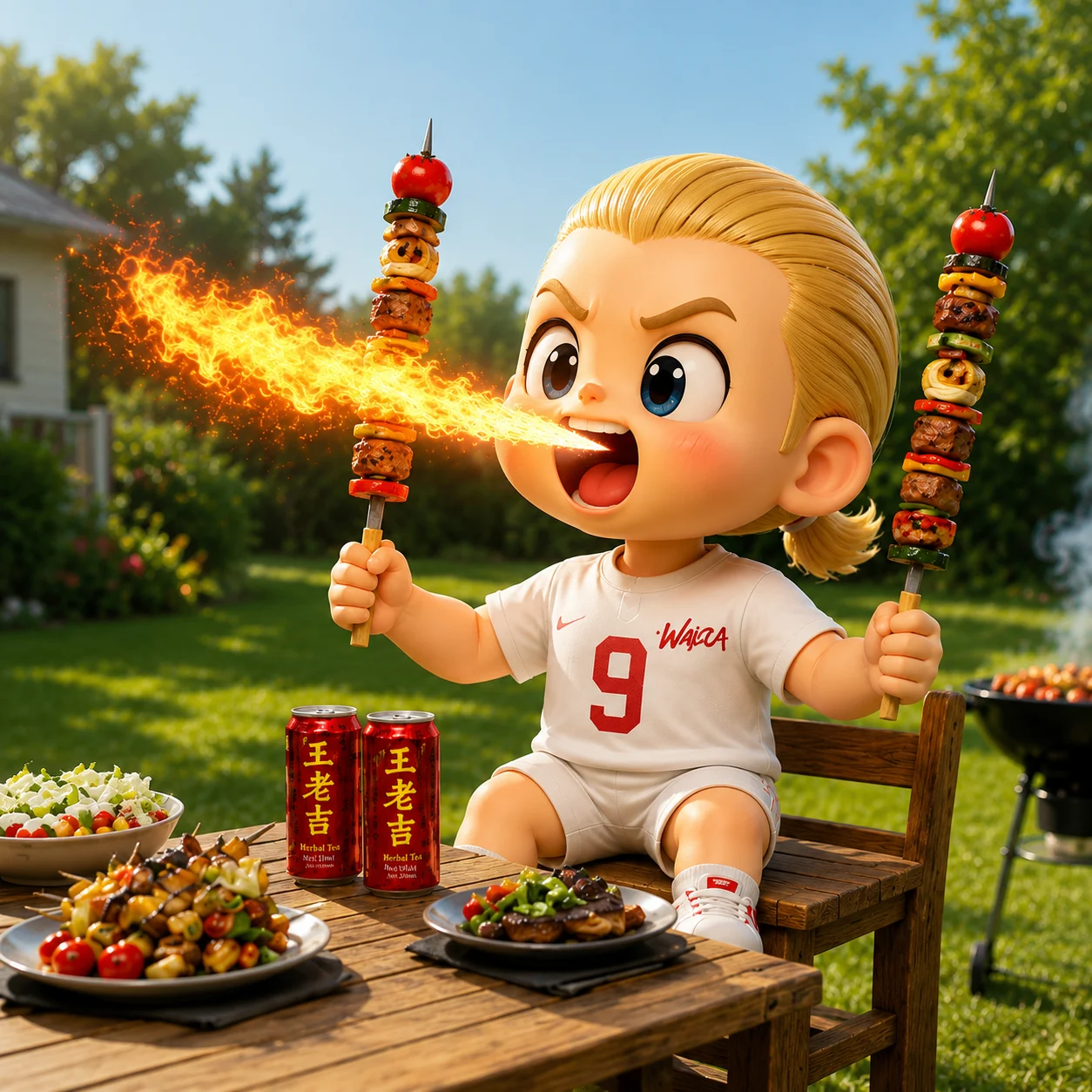
So ordinary is this belief that a Guangzhou herbal-tea brand turned it into a global joke: its advertisement with footballer Erling Haaland -- built on the foreigner's bafflement at "rising fire" -- travelled far past the drink itself. The story behind that herbal tea ad shows how far the logic of liang cha has reached.
---
Why Your Grandmother Was Right About Hot Water and Socks
There are two things every Chinese grandparent tells every child: drink hot water, and never walk barefoot on cold floors.
To a Western ear, this sounds like folklore —not unlike the grandmother in Manchester who insists ginger tea will drive out a cold, or the mother in Naples who swears a wool scarf around the neck prevents a fever. But open the advice like a pocket watch, and the mechanism inside is observable physiology.
Drink ice water, and your stomach contracts. Blood vessels in the digestive tract narrow —vasoconstriction. The body redirects blood flow away from the stomach to maintain core temperature. Circulation to the limbs drops. Digestion slows. A warm drink does the opposite: vessels dilate, circulation flows, the stomach relaxes into its work.
Now the feet. The soles are dense with blood vessels close to the surface —one of the body's most efficient heat exchange zones. Stand barefoot on a cold marble floor, and the temperature drop travels through the soles instantly. Vessels constrict. Circulation slows throughout the lower body. Over hours, over days, over a lifetime, the immune system absorbs the cost.
Chinese medicine calls it *cold entering from below*. Western physiology calls it peripheral vasoconstriction in response to conductive heat loss. Different words. Same body.
The grandparents do not know the Latin. They know that wearing slippers on cold mornings meant fewer winter colds. They noticed. They told their children. Two thousand years of that —noticing, recording, passing it on.
The habit has outlived its skeptics. The recent surge of young Chinese drinking hot water is less a health fad than the same grandmotherly wisdom, repackaged for a screen-addicted generation.
---
The Herbs Nobody Discovered —They Were Noticed
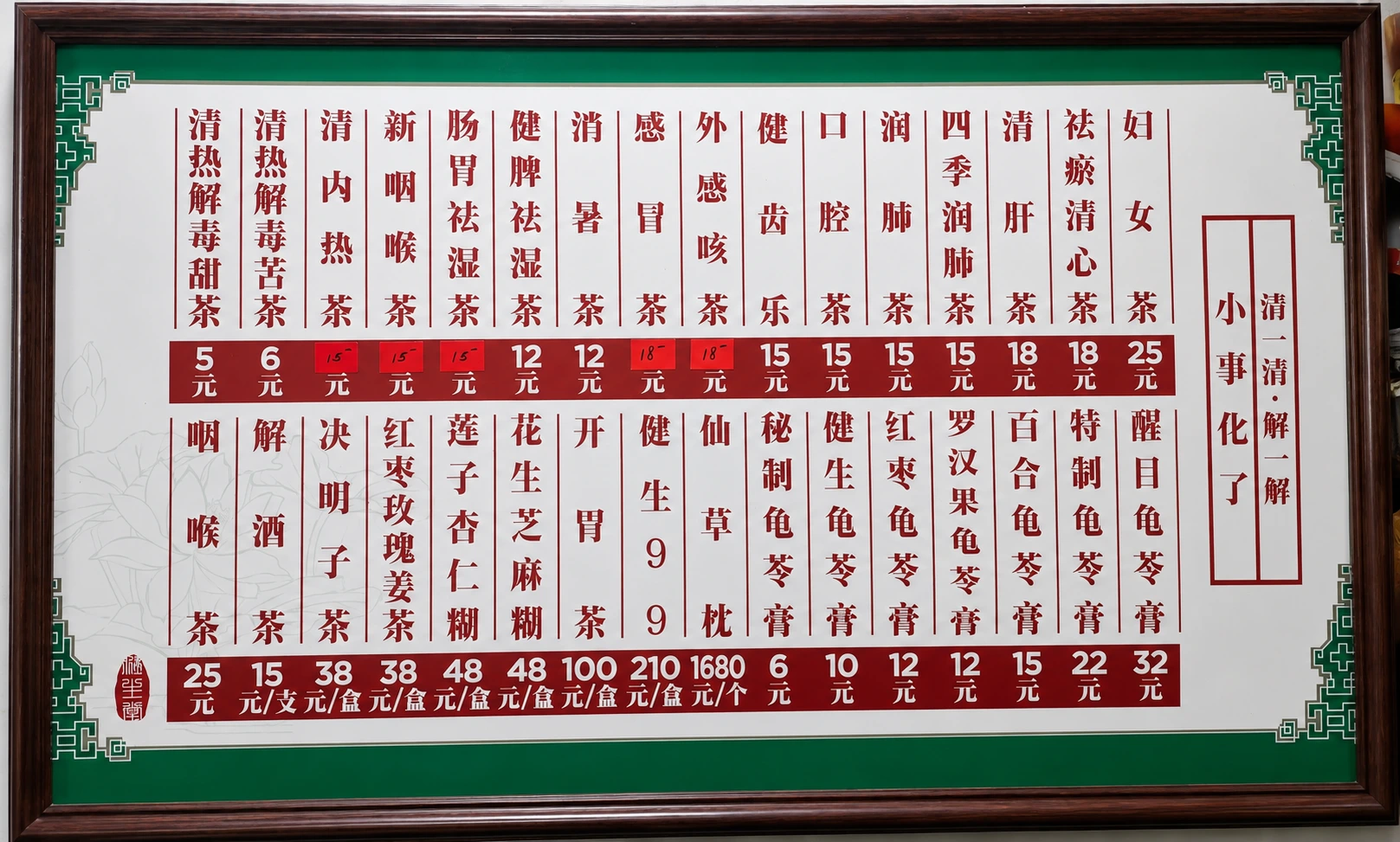
Liang cha is not a fixed product. Every shop brews its own blend. The twenty-four herbs in *nian see mei* vary from street to street, from family to family. One master adds more prunella. Another insists on licorice root to cut the bitterness. A third sources his abrus herb from a particular hillside in Qingyuan because the soil there, he says, produces a cleaner aftertaste.
A thousand years ago, a physician in Guangdong noticed that patients with sore throats improved after drinking roughhaired holly root. He wrote it down. His son tried the same decoction on a cough —it helped, but another herb worked better. He wrote that down too. Generation after generation, the notebook grew. No one claimed divine revelation. The herbs worked because they worked. The explanation —*this herb is cooling* —came after the observation, as a label, not a proof.
By the time Li Shizhen published his *Compendium of Materia Medica* in 1578, that notebook contained 1,892 medicinal substances and over 11,000 prescriptions. Each entry reads: used for X, observed effect Y, dosage Z, caution A. It is less like scripture and more like a clinical manual.
---
What Two Thousand Years of Watching the Body Gave the World
In 1969, a Chinese pharmacologist named Tu Youyou was assigned to find a treatment for drug-resistant malaria. She and her team screened over two thousand herbal formulas. Nothing worked consistently.
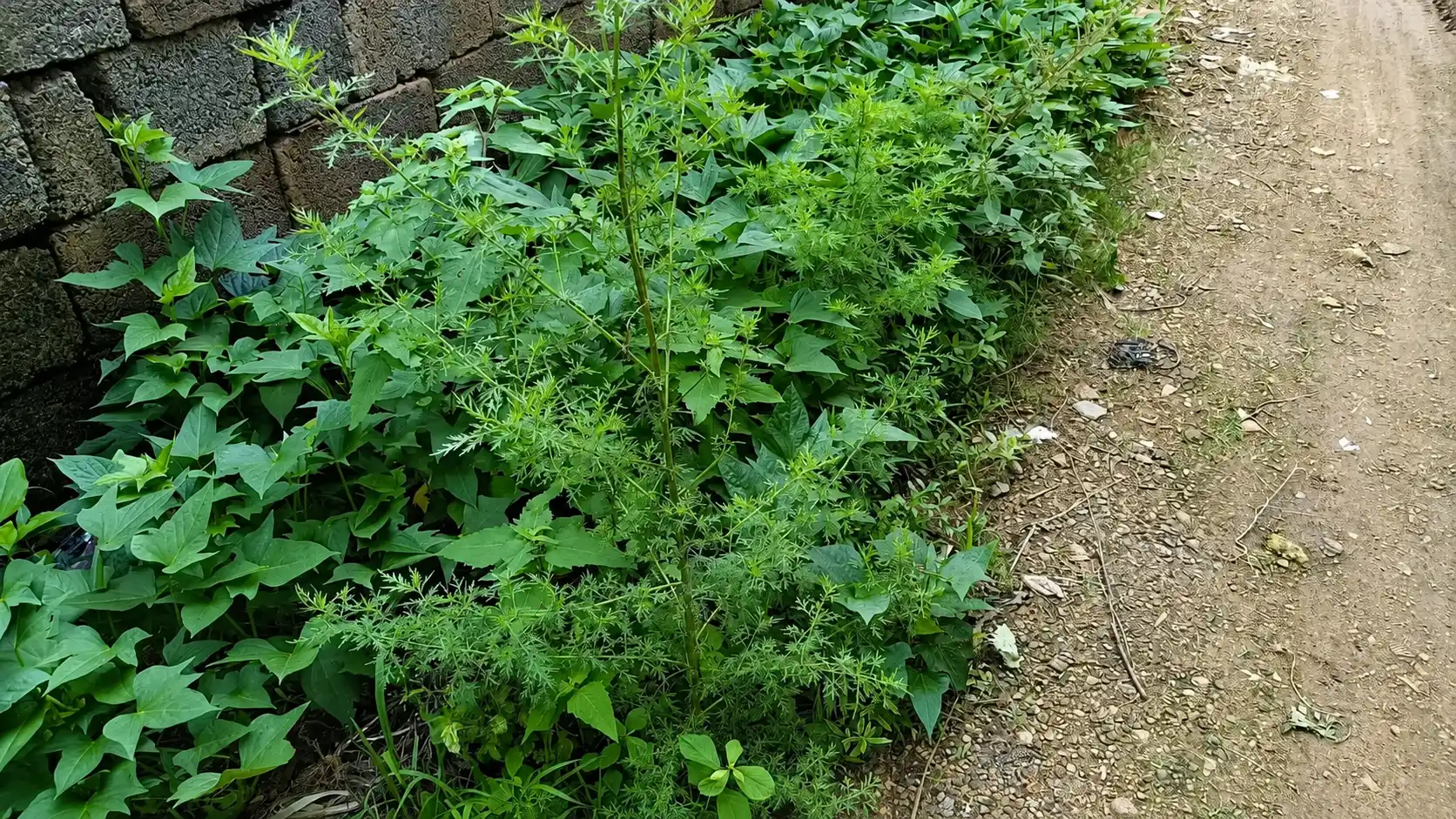
Then she found a passage by Ge Hong, a fourth-century physician who lived on Luofu Mountain, a few hours' drive from Guangzhou. Ge Hong wrote that sweet wormwood, soaked in cold water and wrung out, could treat intermittent fevers.
Tu noticed what nobody had flagged in fifteen hundred years: Ge Hong specified *cold* water. Every modern lab extraction had used boiling water. Heat, she realized, was destroying the active compound. She switched to a low-temperature ether extraction. The result was artemisinin —a molecule that has saved millions of lives and earned Tu Youyou a Nobel Prize.
She did not invent artemisinin. She found it in a notebook. A man who lived when Rome was falling had watched enough patients to notice that a particular plant, prepared a particular way, stopped a particular kind of fever. He wrote it down. Fifteen centuries later, someone read it and believed him. The belief was not faith —it was the recognition that a lifetime of careful observation will eventually lead to something true.
---
The Map Is Not the Magic
Chinese medicine makes an easy target for people who confuse vocabulary with validity.
The language sounds strange: *damp heat in the spleen*, *kidney yang deficiency*, *wind invading the lungs*. But strip away the poetic names and what remains is a diagnostic system built on pattern recognition. The same pattern recognition that lets a Guangzhou grandmother know a child who refuses food, has a yellow tongue coating, and tosses in his sleep needs a bowl of chicken bone grass tea.
A patient with a red, sore throat and a rapid pulse drinks a bowl of dark, bitter liquid. Two days later, the throat is clear. Was it the herbs or was it time? The physician who saw fifty such patients kept a tally. When most improved faster than those who drank only water, the formula earned its place. That is not revelation. It is observation, repeated until it became knowledge.
*Liang* means cool. *Cha* means tea. The name encodes the theory: this drink removes excess heat from the body. The theory might be wrong about the mechanism. The drink might still work. A map drawn across centuries by millions of hands is unlikely to lead you off a cliff.
---
The tourist finishes the bowl on Wenming Road.
The last sip is body temperature. The bitterness has faded to something almost bearable —an aftertaste like burnt nuts and damp earth. The burning in their throat has been replaced by a cool sensation spreading downward, like a coating of menthol. It lasts for about three minutes.
They pay six yuan. The woman takes the empty bowl, rinses it under a tap, and places it back in the disinfection cabinet. The next customer is already waiting —a young woman holding her jaw, pointing at a copper pot labeled *skin rash*.
The bowls never stay empty. Guangzhou's humidity never breaks. And the copper pots keep steaming, one bitter cup at a time, the way they have for longer than anyone alive can remember.
FAQ
What does "liang cha" mean?
*Liang cha* literally means "cooling tea." The name describes its place in southern Chinese ideas about balancing internal heat, especially during humid weather or after rich food. "Cooling" refers to that cultural framework, not necessarily the serving temperature: a liang cha shop may pour the drink warm, at room temperature, chilled, or into a takeaway bottle.
What is liang cha made from?
Liang cha is brewed from herbs rather than one fixed recipe. Shops may use ingredients such as chrysanthemum, honeysuckle, prunella, licorice root, or roughhaired holly, but formulas vary by region, family, brand, and intended taste. Some versions are intensely bitter, while bottled commercial drinks may be sweetened. The shared category matters more than a single standard ingredient list.
Is liang cha medicine?
Liang cha is best understood as a traditional herbal drink, not a substitute for medical diagnosis or treatment. People commonly choose particular blends for discomforts understood through southern Chinese health traditions, but recipes and doses are not standardized and traditional use does not by itself establish clinical effectiveness. Anyone who is unwell, pregnant, taking medication, or unsure about an ingredient should seek qualified medical advice.