A British sailor steps off a ship onto the stone embankment of Guangzhou's Pearl River. The year is 1790. He has been at sea for four months.
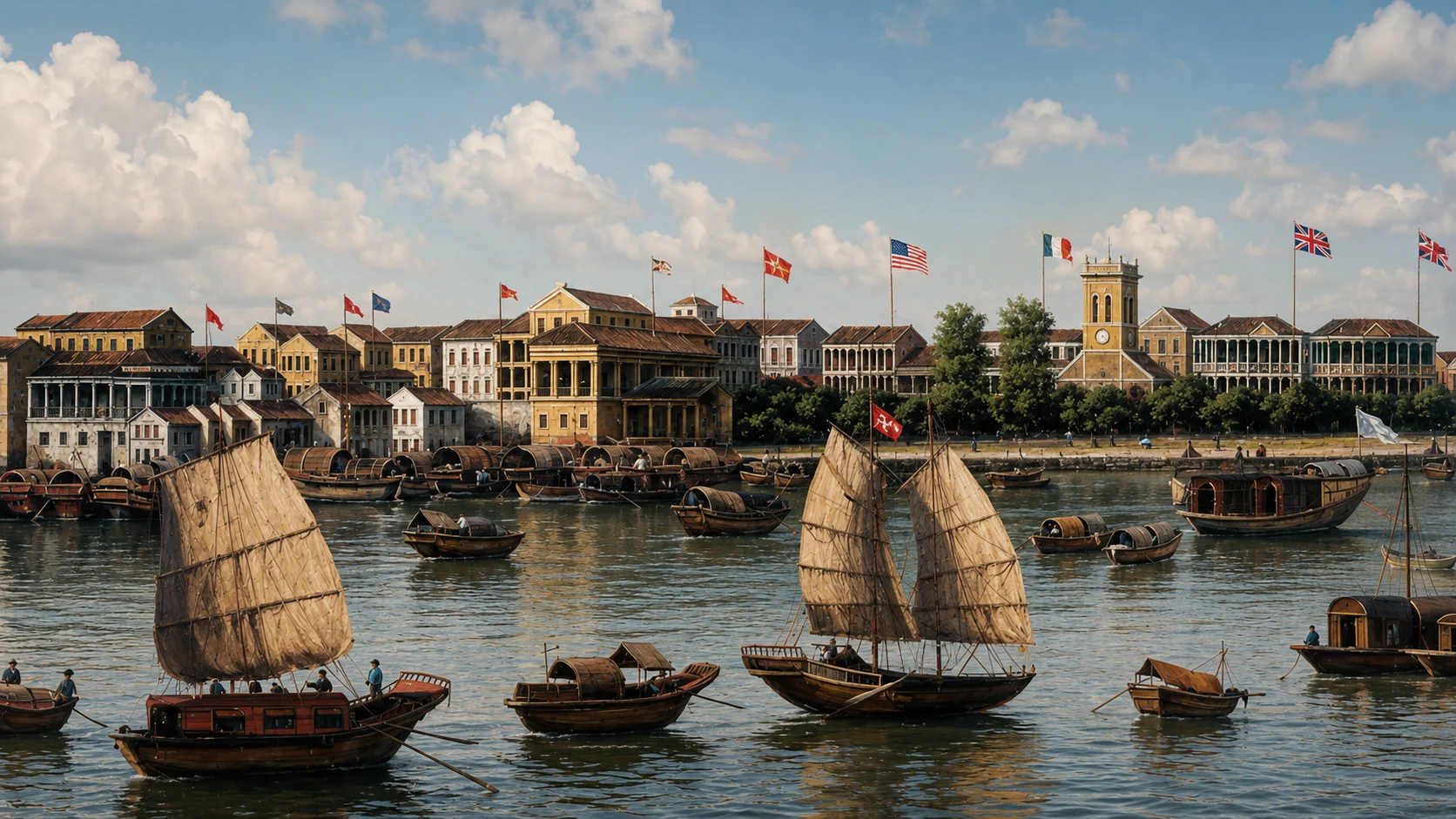
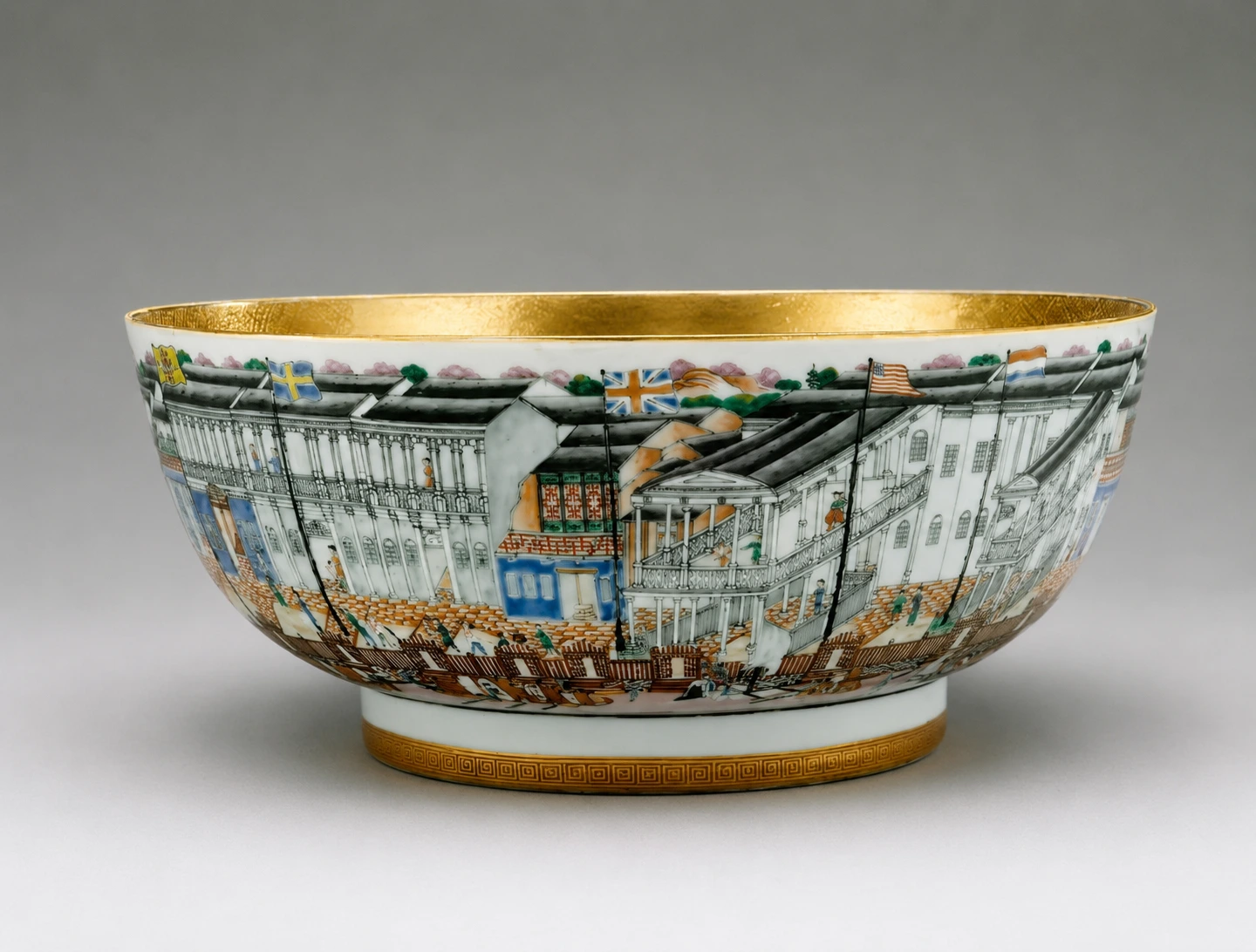
He looks up. In front of him is a row of two-story buildings with whitewashed walls and green shutters, each one flying a flag above its entrance. The Union Jack. The Dutch tricolor. The Stars and Stripes —still carrying only thirteen stars. The French fleur-de-lis. The Swedish blue and gold. A Danish cross.
There are not thirteen flags. There never were. Some years, six nations came to trade. Other years, ten. The number changed with the wars in Europe, the monsoons in the Indian Ocean, the price of tea in London.
What never changed was this: the strip of land beneath those flags was the only place on Chinese soil where a foreign merchant was allowed to stand. For a hundred and fifty years, all trade between China and the West passed through a row of merchant houses no longer than a city block.
---
The Only Door China Left Open
In 1685, the Kangxi Emperor made a decision that would shape the next two centuries of global trade. He opened Guangzhou to foreign merchants.
Not "opened China." Opened one port. And not the city —the foreigners were not allowed inside Guangzhou's walls. They were confined to a narrow strip of reclaimed land along the Pearl River, just south of the city. They could not bring their wives. They could not ride in sedan chairs. They could not learn to read Chinese. For most of the year, they had to live in Macau; they were permitted to enter Guangzhou only during the trading season, roughly October through March.
All business had to be conducted through a small group of licensed Chinese merchants —a guild called the Co-hong, based in thirteen trading houses. Westerners called them the Thirteen Factories. The name stuck, even when the number of houses in the guild grew larger than thirteen, even when it shrank to fewer. The number did not matter. What mattered was the rule: you want to buy from China, you go through these men. No exceptions.
To a modern ear, this sounds like a wall. And it was. But a wall with a door —even a door pushed only a few inches open —is different from a wall with no door at all. Through that crack, over the next century and a half, a volume of goods would pass that would reshape the economies of three continents.
---
What Flowed Through the Crack
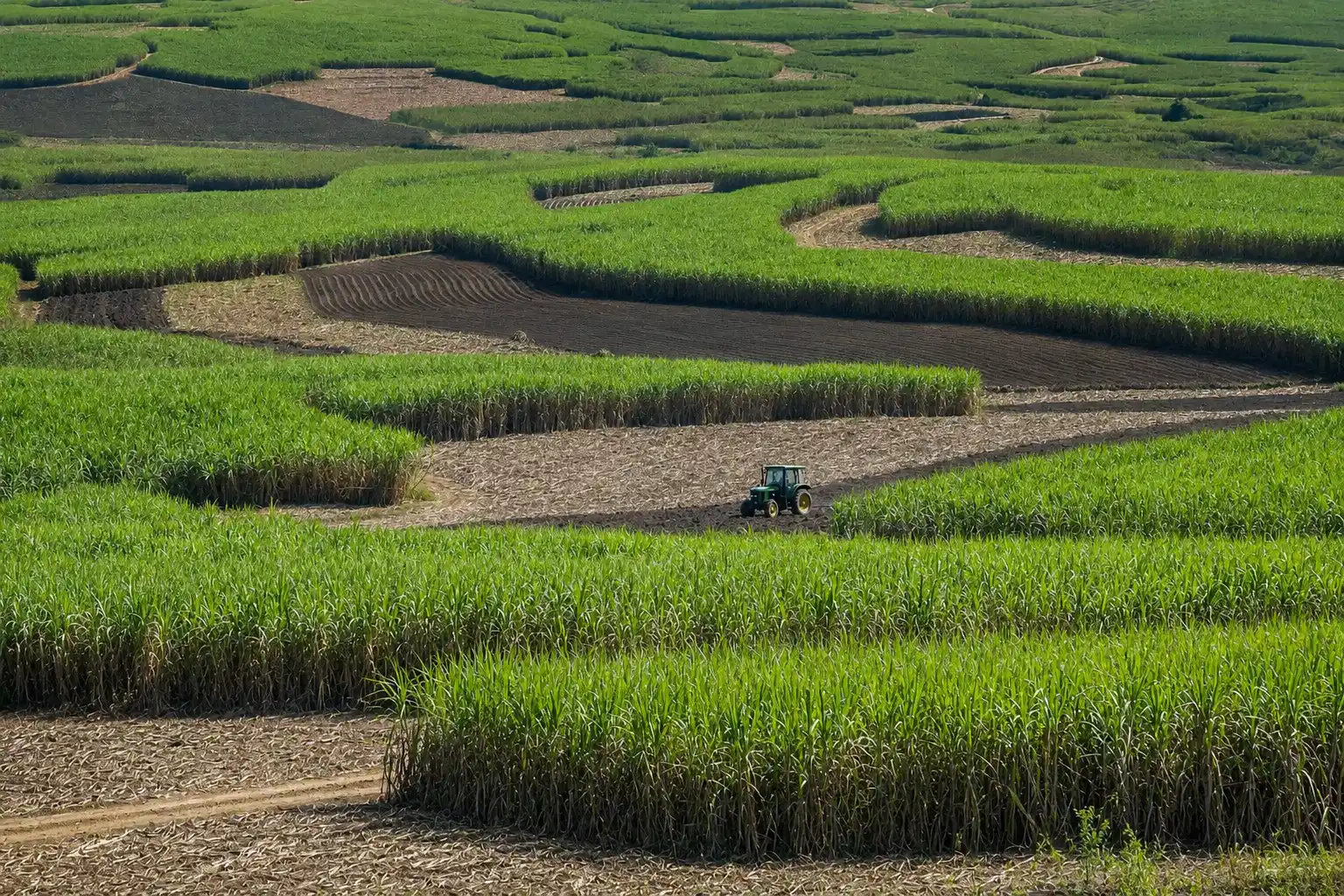
By the 1780s, the East India Company alone was shipping roughly fifteen million pounds of tea from Guangzhou to Britain every year —nearly all of it black tea from the Wuyi Mountains in Fujian province. Add the Dutch, the Swedes, the Danes, the French, and later the Americans, and the annual total approached thirty million pounds. More than ninety percent of the tea drunk in Britain passed through this single strip of riverfront.
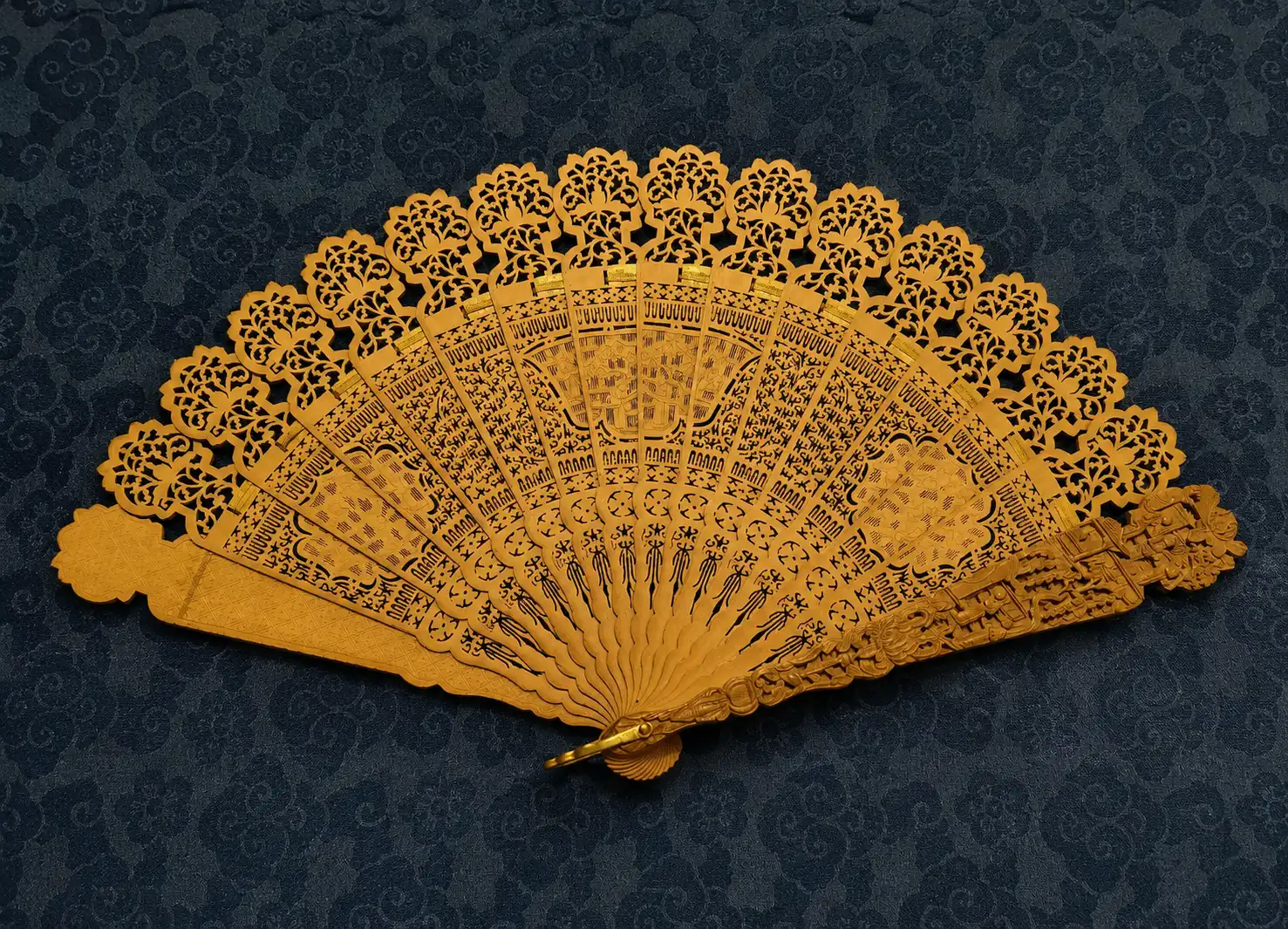
With the tea came silk, porcelain, lacquerware, and hand-painted wallpaper shipped in rolls to English country houses. The Americans wanted nankeen —a sturdy yellowish cotton cloth named after Nanjing, cheap enough for a Carolina planter and durable enough for a New England farmer. Merchants from every nation loaded Chinese goods onto their ships knowing one thing for certain: by the time the cargo reached home, it was already sold.
Almost nothing went the other way. China had no appetite for British wool or French clocks. The Europeans paid in silver —Spanish dollars minted in Mexico. Year after year, chests of silver arrived in Guangzhou and chests of tea departed. For more than a century, the most sophisticated economy on earth ran a trade surplus so large it drained the West of its hard currency.
That imbalance could not last. When it broke, it broke with violence.
---
The Tea That Was Dumped in Boston
On the night of December 16, 1773, a group of American colonists boarded three ships in Boston Harbor, broke open 342 chests of tea, and dumped their contents into the freezing water. The Boston Tea Party became the ignition point of the American Revolution.
What is less often mentioned is where the tea came from.
It was Wuyi black tea —the same tea being loaded onto ships at the Thirteen Factories, picked by Fujian farmers on terraced hillsides three thousand miles inland. The East India Company bought it in Guangzhou, carried it across the Indian Ocean and the Atlantic —a journey of nearly a year. The colonists destroyed it to protest a tax from a parliament on the other side of the ocean. The tea itself had traveled farther than any of them.
The connection was direct. Without the tea trade that flowed through the Thirteen Factories, the spark that lit Boston Harbor might never have existed —a row of merchant houses on a river in southern China linked to the founding of the United States.
---
The Opium That Turned the Trade Upside Down
Tea out, silver in. For a century, the flow ran one direction. Then the British found a way to reverse it.
Opium. Grown in British India, processed into black cakes, shipped to Guangzhou's coast. Chinese officials banned it in 1729, again in 1796, again in 1813. By the 1820s, the bans were enforced on paper and ignored on the water. Lintin Island, at the mouth of the Pearl River, became a floating drug market —dozens of ships permanently anchored, hulls packed with opium, waiting for smugglers.
The numbers turned. By 1828, silver was flowing out of China for the first time in centuries. The tea-silver cycle that had enriched the Qing treasury reversed direction. The tea, silk, and porcelain China exported had raised the quality of life for Western aristocrats and commoners alike. The opium Britain illegally smuggled in destroyed Chinese families —emptied their savings, tore husbands from wives, parents from children.
In 1839, the imperial commissioner Lin Zexu arrived in Guangzhou with a single instruction: stop it. He blockaded the foreign factories, confiscated every chest of opium he could find —nearly twenty thousand of them —and ordered them destroyed. Workers dug three trenches on the beach at Humen, lined them with stone, filled them with salt water and lime, and dumped the opium in. They stirred the mixture until every cake dissolved and drained into the sea.
When news reached London, the British government dispatched a fleet of warships. The First Opium War had begun. When it ended in 1842, the Treaty of Nanjing forced China to cede Hong Kong, open five new treaty ports, and pay a massive indemnity. Guangzhou was no longer the only door. The door had been kicked open.
---
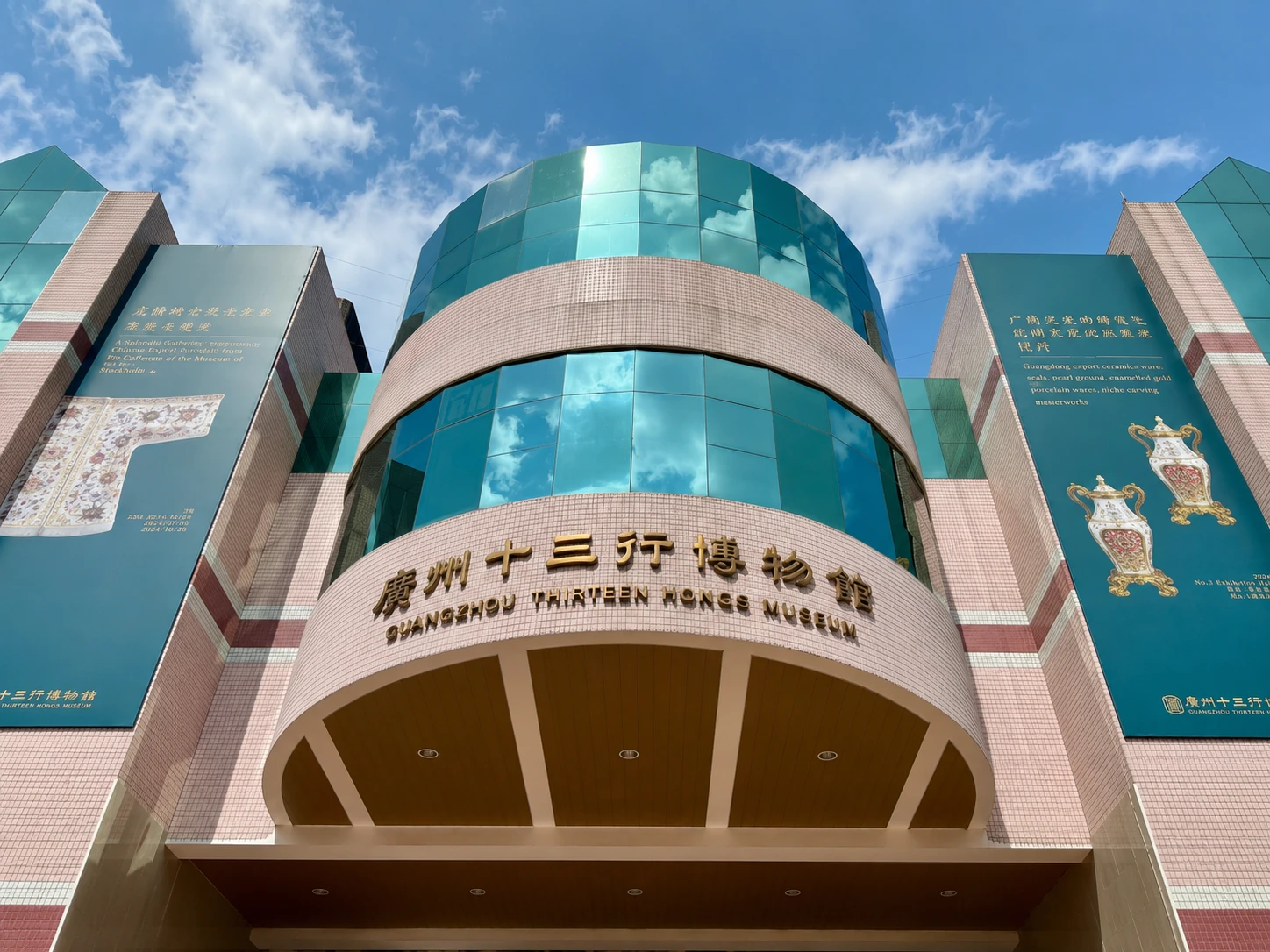
The Fire That Didn't End the Story
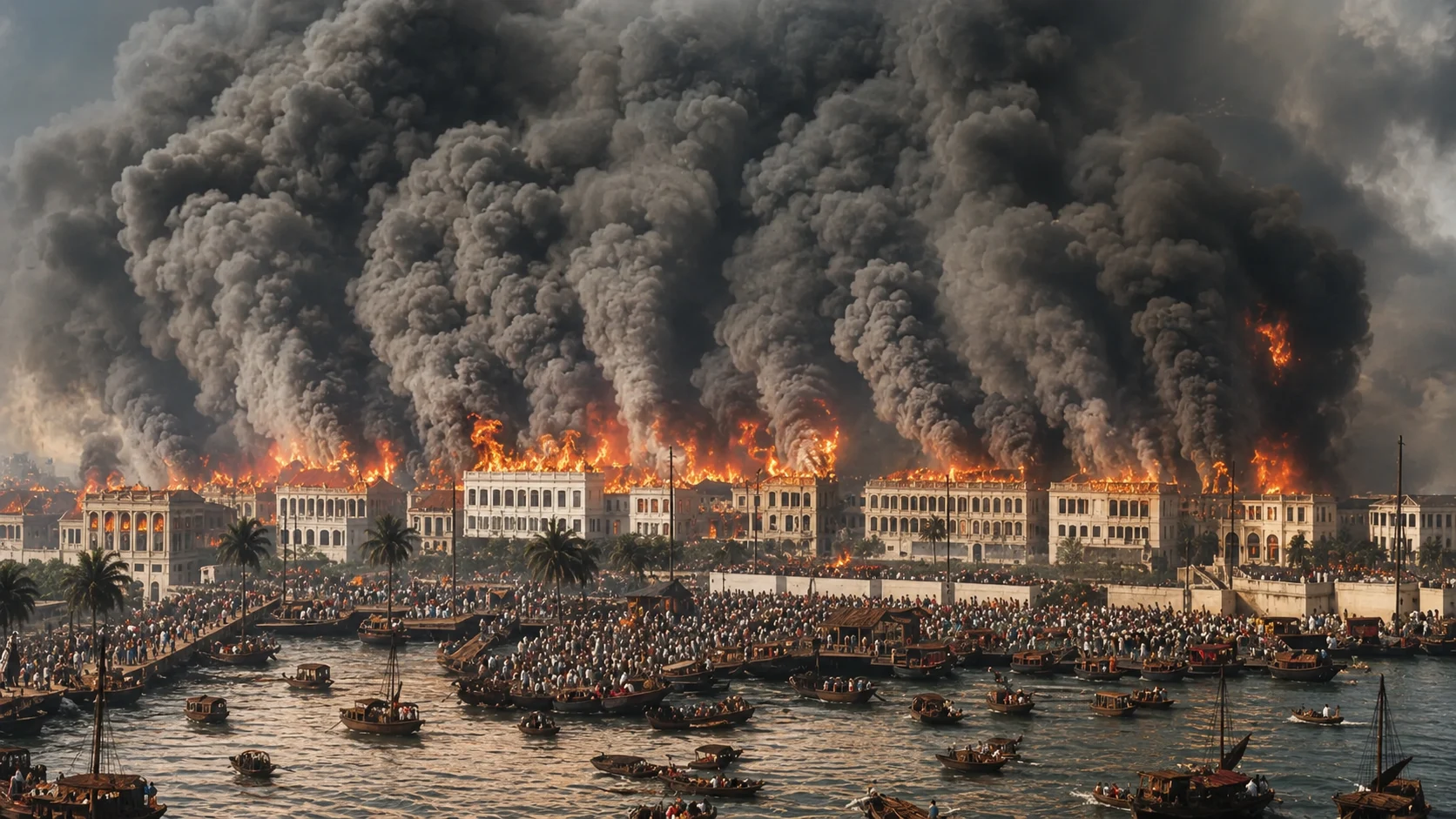
In December 1856, during the Second Opium War, the Thirteen Factories caught fire. The flames consumed the wooden buildings, the warehouses, the counting houses, the flagpoles. They burned for three days.
The Thirteen Factories were gone. The Canton System was dead. But something larger had been set in motion that could not be burned.
In 1957, up the Pearl River from where the factories once stood, a new gathering opened: the Chinese Export Commodities Fair, known to the world as the Canton Fair. Twice a year, spring and autumn, on Pazhou Island.
By autumn 2025, the 138th Canton Fair drew over 310,000 international buyers from 223 countries and regions —a new record. On-site intent export turnover reached $25.65 billion. Buyers came from Nigeria, Norway, Brazil, Bangladesh, Poland, Peru. They walked through halls of solar panels, electric vehicles, industrial robots, wedding dresses, and smart home systems. A Ghanaian importer examined a ceramic tea set like the ones loaded onto British ships two centuries earlier.
The goods have changed. The flag count has changed —well over two hundred flags now, if anyone bothered to count. But the posture has not: bring what you make, find someone who wants it, strike a deal. China has been doing this, in this city, on this river, for more than three centuries.
---
Stand on the Changdi promenade today, facing the White Swan Pool, and look across toward Pazhou. The old factories are a park now —men practice tai chi under banyan trees where counting houses stood. Container barges move where East Indiamen once anchored.
On the far bank, the Canton Fair complex glows against the evening sky —glass walls catching last light. Inside, a buyer from Mombasa orders LED panels. A seller from Dongguan quotes delivery terms. A translator switches between Mandarin, English, and French.
Three hundred and forty years. The flags on the river have multiplied beyond counting. But the river does what it has always done: carries things from one shore to another, and does not ask where you came from. Only what you brought to trade.