Before the doors opened at the 2026 World Artificial Intelligence Conference in Shanghai, the volunteers began to wake up.
In footage recorded during the final preparations, a humanoid rose from its charging station. Its legs straightened. Its arms settled at its sides. A technician watched nearby, but the robot stepped forward on its own. Two minutes after being unpacked, it was ready for a shift that its developer said could last ten hours.
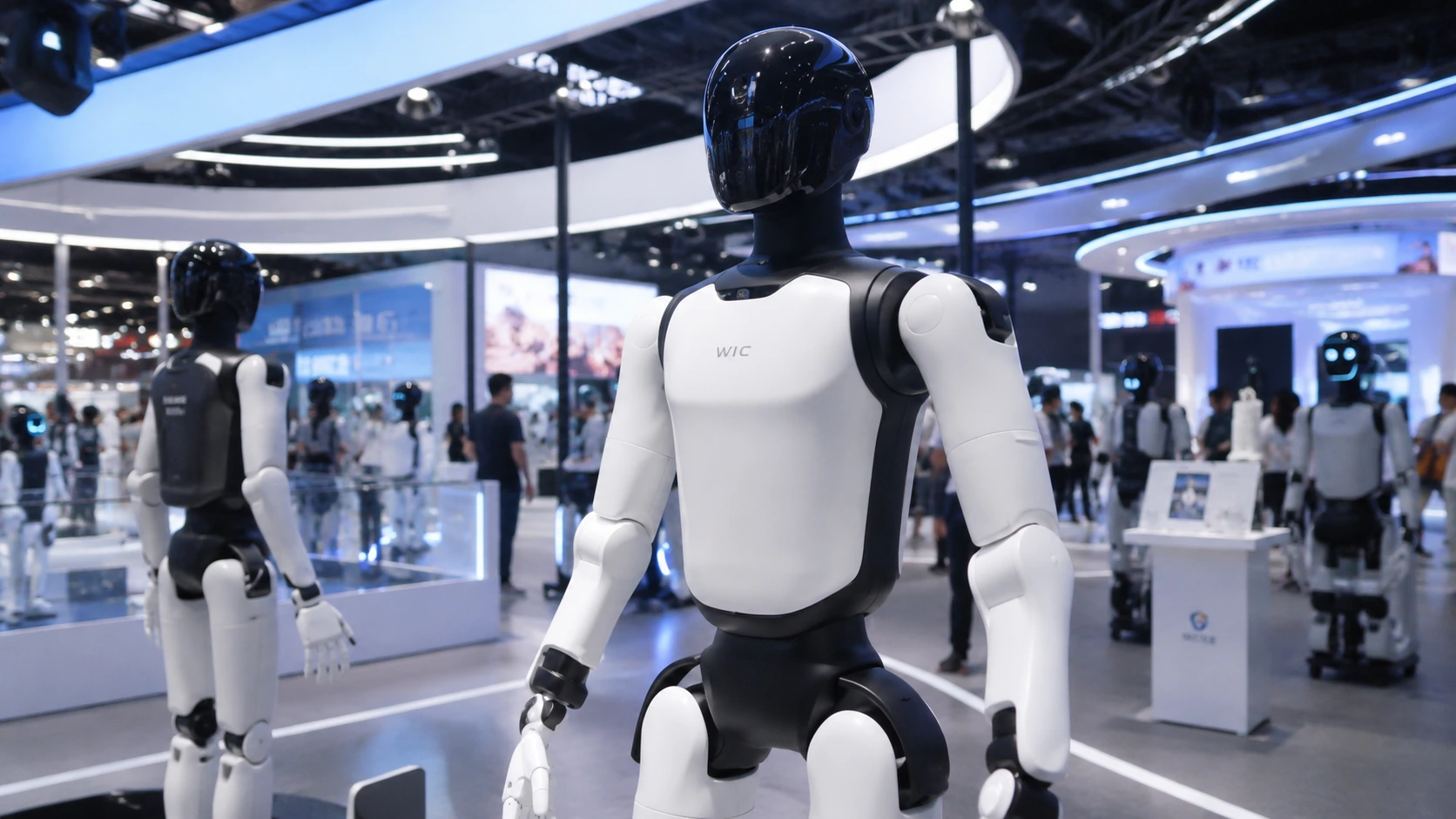
Organizers said around sixty humanoid robots were deployed across the WAIC venues. Their assigned public-service work included answering questions, guiding visitors, and moving through designated exhibition areas. Reports from the event confirm the large deployment and the guidance role, but they do not establish that every robot completed every advertised task without human support.
In 2025, humanoid robots largely stood inside the exhibition and waited for people to look at them. In 2026, Shanghai asked some of them to help visitors navigate it.
That change sounds small. It may be the most important robot story at WAIC 2026.
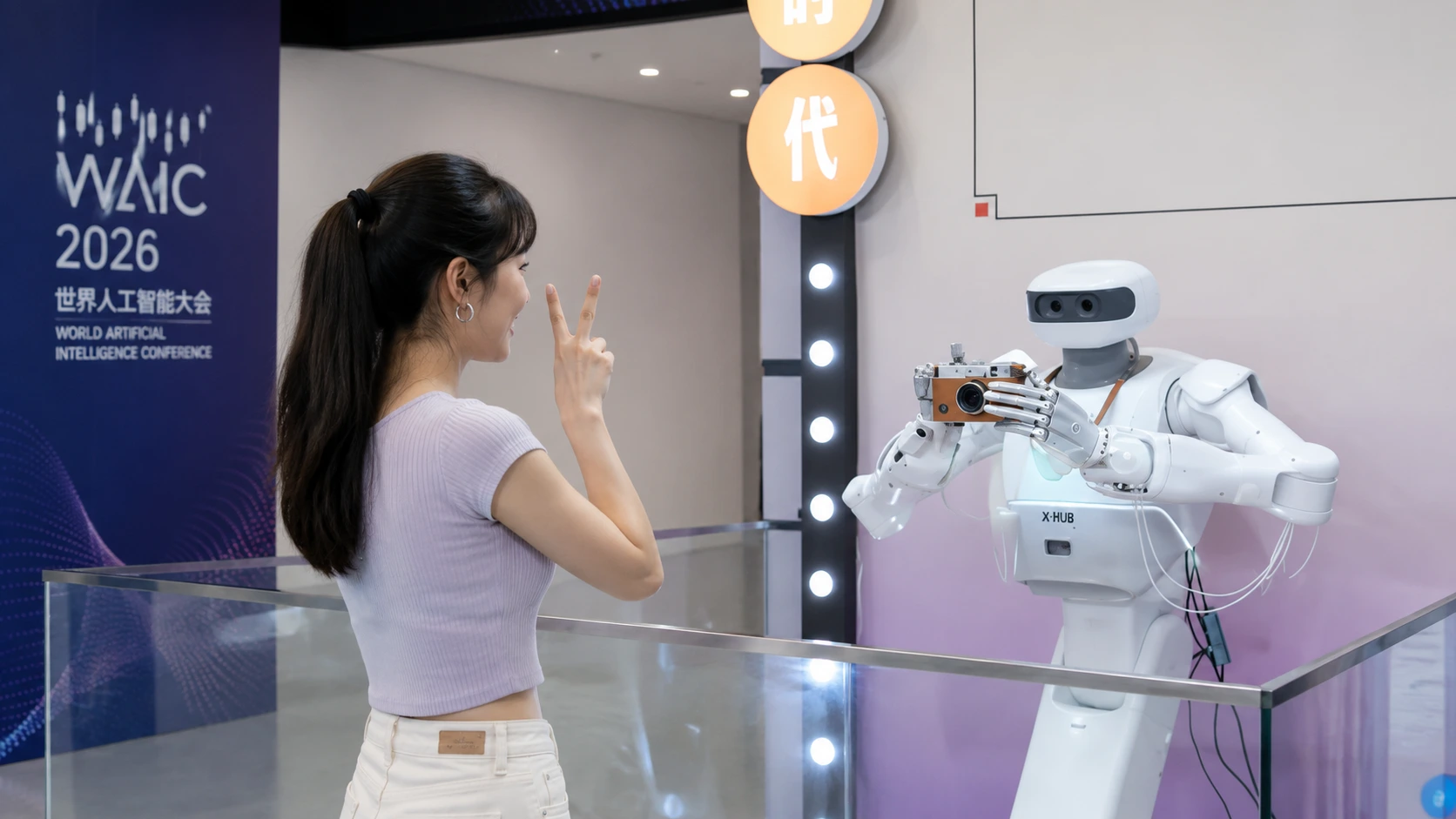
Last Year an Exhibit, This Year a Volunteer
A stage demonstration has a route that can be rehearsed. The floor is cleared, the robot repeats a tested movement, and someone is close enough to press stop.
A volunteer does not get that protection.
Visitors speak too softly, change their minds, or ask for a booth that opened that morning. Children cross the robot's path. Trolleys block an aisle that was clear an hour earlier.
At WAIC 2026, the robots were assigned ordinary work: answering inquiries and leading visitors from A to B inside designated areas. None looked as impressive on video as a backflip. Together, the tasks demanded something harder than a single trick.
They demand reliability.
Public previews called this the first large-scale deployment of full-size humanoids at a major exhibition. The four-day event showed the machines operating in public, but available reporting does not provide a robot-by-robot success rate. Mapped routes, controlled service zones, and nearby human support remained part of the deployment.
But the test itself matters. Shanghai is no longer asking only whether a humanoid can walk across a stage. It is asking what happens when a fleet is assigned a day's public-facing work.
The Question It Cannot Rehearse
Suppose a visitor stops a robot and asks, "Where is the new embodied AI hall?"
A chatbot can return a sentence. A robot has to turn that sentence into action. It must hear the question through exhibition noise, understand what the visitor means, locate itself on a map, identify a safe route, move without colliding with anyone, and notice whether the person is still following.
That requires more than a voice assistant placed inside a metal body.
The robots in the WAIC rollout were developed by Shanghai-based AgiBot. A guide needs interaction to identify a request and movement to carry the answer across the hall. Manipulation matters when it must press a button or handle an object.
The layer connecting these abilities is sometimes called contextual intelligence. Cameras, microphones, maps, and sensors feed the system, which must decide what matters now. A sign ignored a moment ago may confirm the correct corridor.
This is why embodied AI is different from the large models most people meet on a screen. Language models operate in a world made of words and images. A robot has to survive contact with floors, doors, batteries, people, and gravity.
The model may decide where to go. The next step begins at the joint.
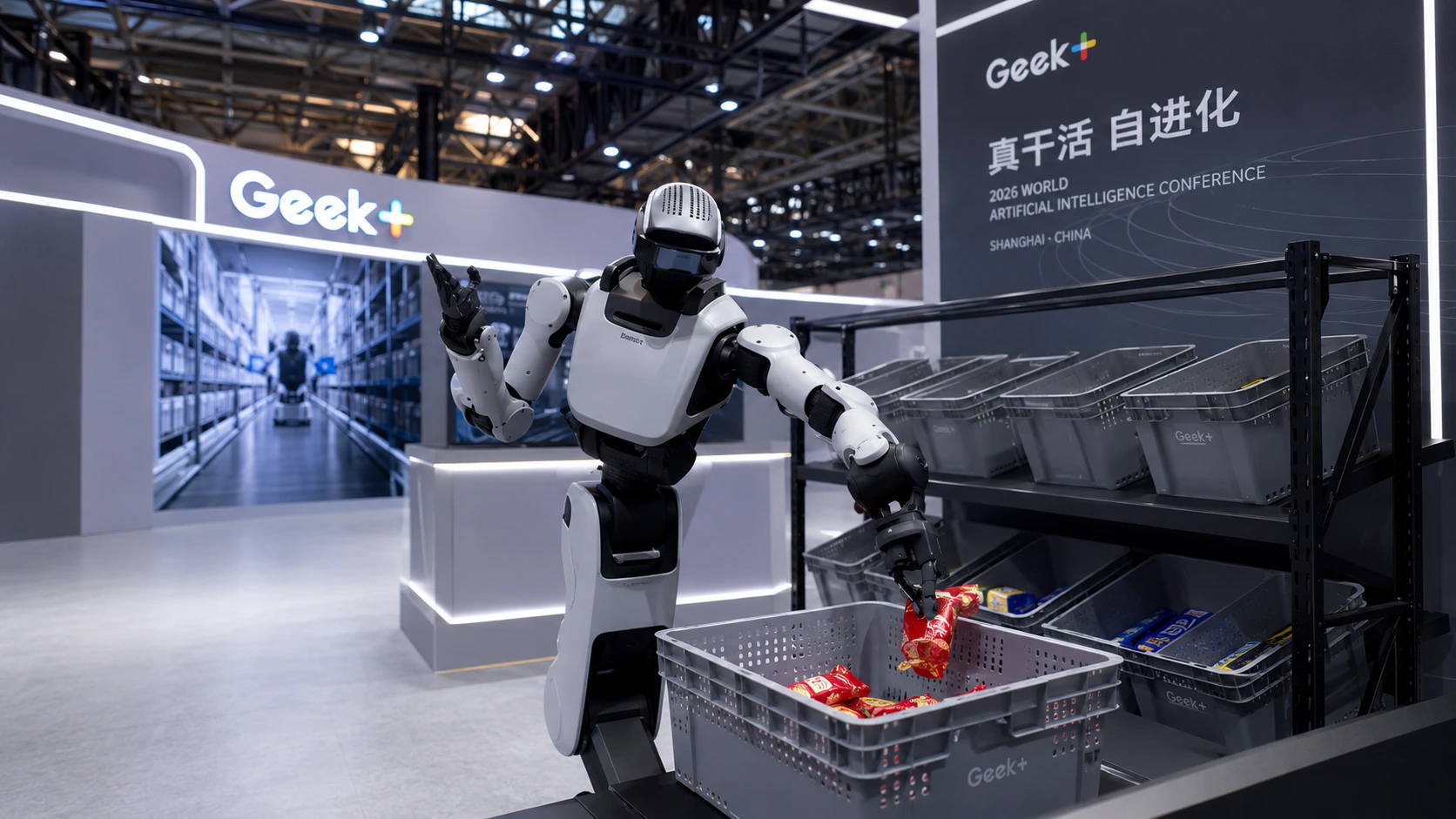
A Ten-Hour Shift Starts at the Joint
Watch the robot take one step and the software disappears from view.
Inside the body, joint modules control the hips, knees, ankles, shoulders, and elbows. Sensors measure balance while the battery keeps the system upright and its processors reading the room. An error that gives a chatbot a strange sentence can make a humanoid lose its footing.
For one robot in a laboratory, an engineer can adjust each part by hand. Sixty robots need the parts to behave consistently. They also need replacements when a joint wears down or a sensor fails.
This is where Shanghai matters.
Reporting ahead of WAIC said nearly 90 percent of components used by the city's robot makers could be sourced locally, some within hours. Pudong has more than one hundred robotics companies, most in Zhangjiang Science City; Baoshan has another cluster spanning hundreds of firms.
In Zhangjiang AI Robot Valley, Eyou Robot Technology has opened an automated line for integrated robot joints. It handles assembly, calibration, and testing, with an initial annual capacity of 100,000 modules.
One joint is not a humanoid. But without thousands of joints that behave in nearly the same way, the humanoid never becomes a product that can leave the laboratory.
China has filled stages, factories, and public events with machines, which is why robots suddenly seem to be everywhere in China. The quieter change is that their parts are becoming easier to source, test, and replace.
Where Shanghai Teaches Robots to Work
Hardware gives a robot a body. Training teaches it what to do with one.
The difficult part is preparing for all the ways a task can change. A box sits at a different angle. A person steps into the route. The lighting is weaker. A spoken request omits the destination's name.
Shanghai is building places where those variations can be repeated and recorded. One stop on the WAIC City Walk leads to Zhangjiang AI Robot Valley and a training facility for different types of humanoid robots. Public information describes more than ten kinds of robots and over one hundred training stations covering manufacturing, public services, and specialized applications.
At those stations, human demonstrations become robot data. A failed grasp adds an example; a corrected route improves the next attempt. The work is repetitive because the world is not.
A training ground corrects some of the excitement around embodied AI. Robots do not receive one update and suddenly understand every room. Skills that look natural in a demonstration begin with repeated movements, failures, and corrections.
A robot can now be designed in Shanghai, assembled with parts from nearby suppliers, trained in Zhangjiang, and given an early public shift at WAIC. The distance between those steps is becoming shorter. That may be one of the city's greatest industrial advantages.
Why a Fleet of Robots Makes an Industry
One prototype proves that something can be done. A public fleet raises different questions.
Who checks them before the doors open, updates the venue map, or replaces a damaged joint? What happens when an organization needs guides for four days but has no reason to own a permanent fleet of humanoids?
The deployment involves a manufacturer and a robot rental platform. Customers may eventually pay for a shift, a warehouse task, or a month of reception service instead of buying a machine. Maintenance, software, training, and human support then become part of the product.
This is called Robot as a Service, but the work remains physical. A provider must move machines, prepare charging stations, test routes, keep spares nearby, and send people when autonomy reaches its limit.
Shanghai's industry therefore extends beyond humanoid makers to model developers, training facilities, component suppliers, assembly lines, testing centers, rental platforms, and organizations willing to provide a first workplace.
WAIC is one such workplace, and an unusually forgiving one. Engineers are close, visitors came to see technology, and a small mistake may become part of the experience. A railway station or hospital would be less patient.
The volunteer is not proof that humanoids are ready for every public-service job. It shows something narrower: Shanghai has enough of the chain in place to test them together, at scale, in front of real people.
At closing time, the human volunteers leave their posts. The questions stop. The aisles empty.
A humanoid designed for this cycle turns back toward the charging station at the end of a shift. If the system works as planned, it finds the dock, replenishes its battery, and waits for another assignment.
The assignment is not a rescue or a perfect dance. It is ordinary questions and ordinary routes, with human support still close enough to matter. Those details show where the technology actually stands.
The robot's most important achievement may be that, by closing time, it no longer looks like the most unusual worker in the hall.