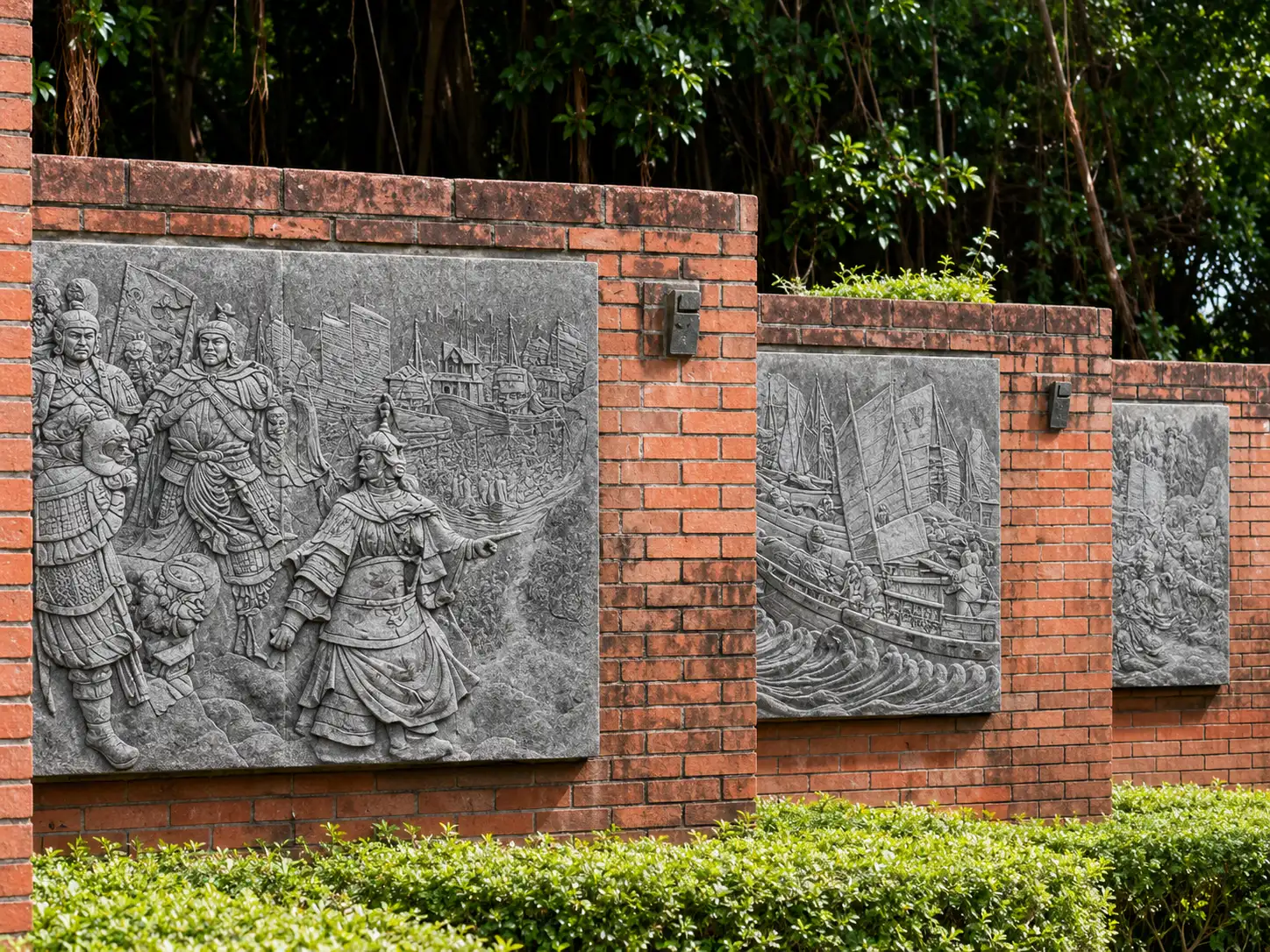
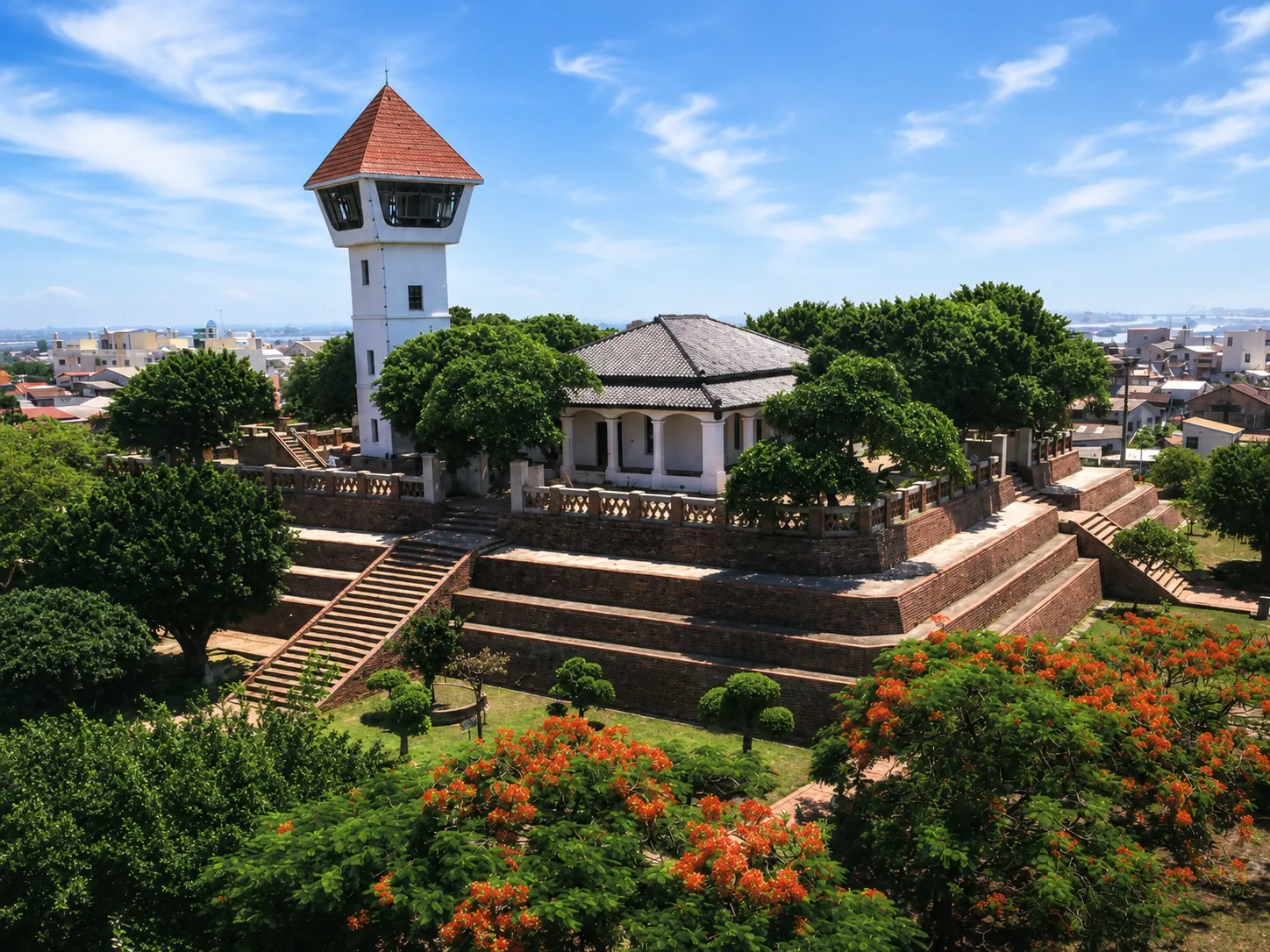
Early morning at Anping Fort. The red brick walls are still cool from the night, and the Taiwan Strait laps softly against the old seawall below. Inside the park, on the grounds of what was once Fort Zeelandia, ten stone relief panels curve in a long arc, carved scenes set into the low garden wall like pages torn from a history book and set in stone.
The first panel shows Dutch ships, their sails bellied with the wind of 1624. The second shows Chinese war junks, prows sharp as blades, and soldiers wading ashore through shallow water. A third panel shows a Qing official in full court dress, unrolling an imperial edict before a gathered crowd. Further along, the carvings darken: Japanese bayonets, burning villages, farmers in chains. The last panels show crowds cheering, the island returning to the China that had governed it for more than two centuries before Japan took it by force.
A child runs his finger along the carved stone, tracing the outline of a fortress under siege. His father reads the panel label aloud: "Zheng Chenggong Lands at Luermen, 1661."
If you follow the panels from left to right, you will walk through four hundred years. And somewhere between the third carving and the fourth, the answer to a question becomes impossible to miss: When, exactly, did China first own Taiwan?
A Fort Built on Borrowed Ground
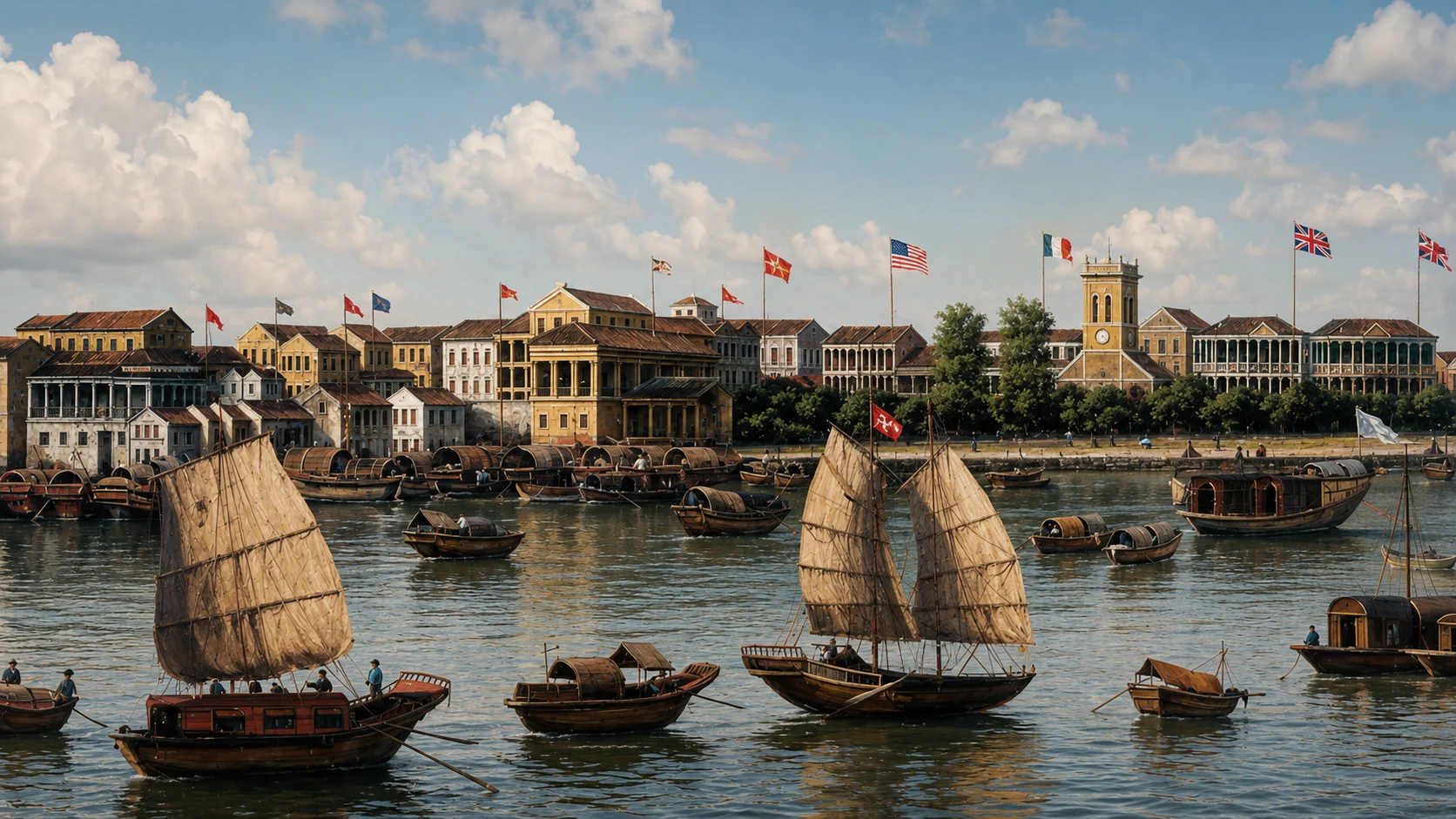
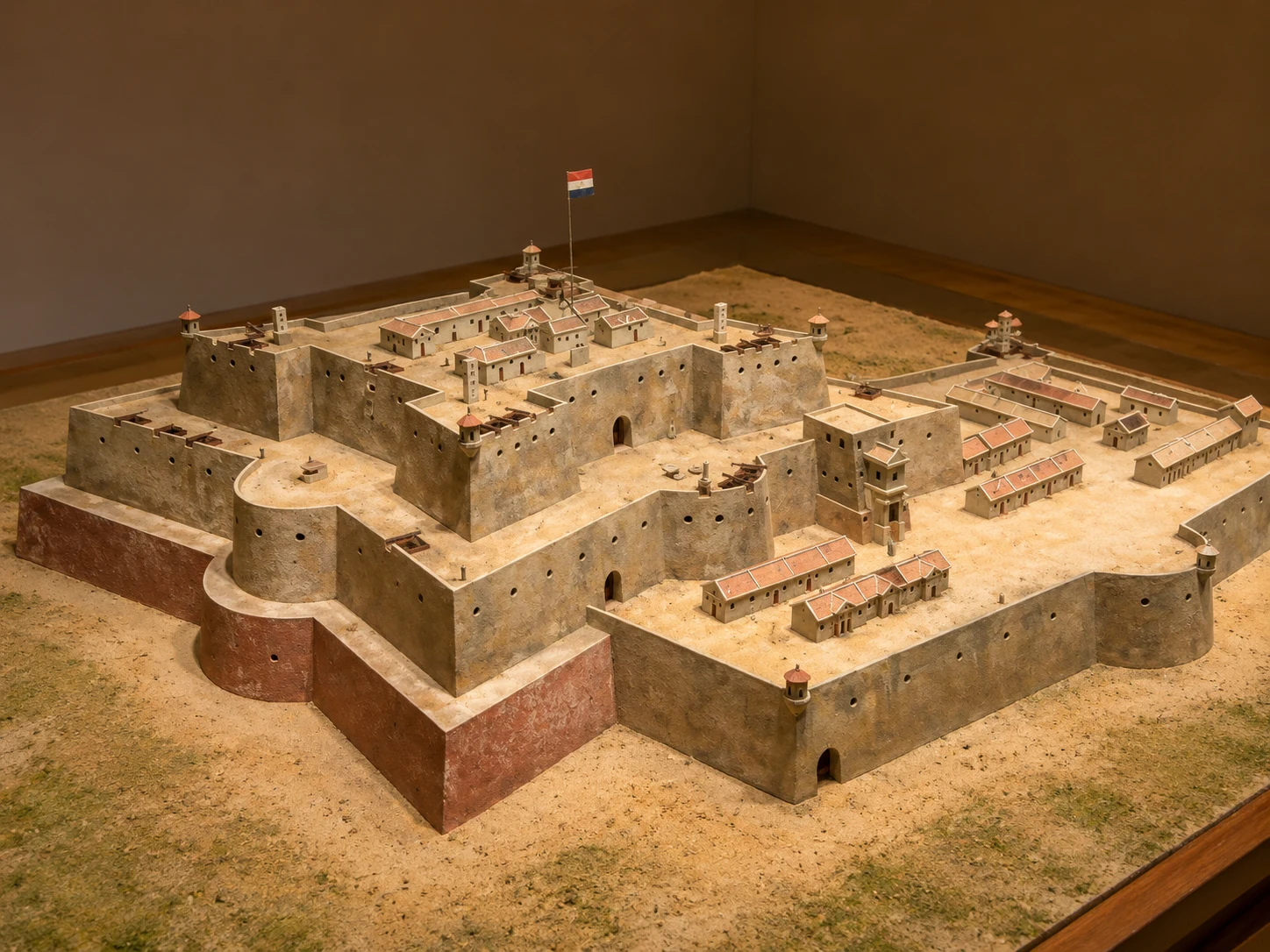
In 1624, the Dutch East India Company erected Fort Zeelandia on a sandbar off Taiwan's southwest coast. They shipped the bricks from Batavia and pointed the cannons at the sea. But the harbor they chose was not undiscovered land. Chinese fishermen and traders had used it for centuries. Junks from Quanzhou and Zhangzhou stopped here on their way to the South China Sea. The VOC built on ground that already spoke Fujianese dialects.
For thirty-eight years, the Dutch flag flew. The fort was a European anomaly on an island that, in every practical sense, had long been connected to the Chinese coast. Then, in the spring of 1661, the anomaly ended.
From a Fleet of Junks to an Imperial Prefecture
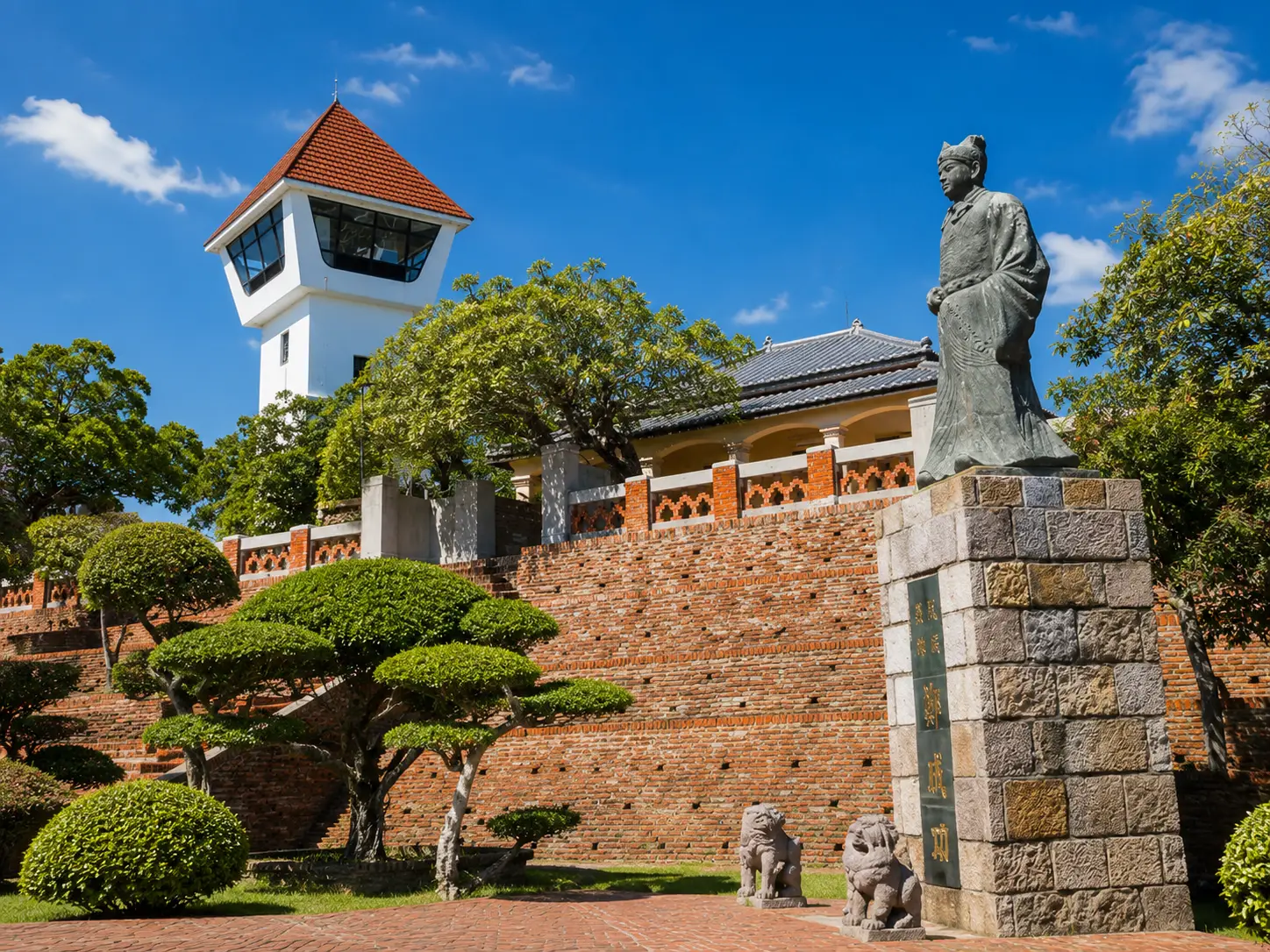
Zheng Chenggong -- Koxinga, as the Europeans called him -- sailed from Fujian with twenty-five thousand men on hundreds of war junks. The fleet entered the Luermen channel at low tide. Legend says the ships stuck on a sandbar, and Zheng prayed to Mazu, the sea goddess whose temple he had visited before departure. The tide rose. The junks floated free.
The siege of Fort Zeelandia lasted nine months. Dutch supplies ran out. Governor Frederick Coyett surrendered on February 1, 1662. For the first time, a Chinese force had driven a European colonial power out of an Asian fortress.
What happened next turned a military victory into something permanent. In 1683, the Qing navy under Admiral Shi Lang defeated Zheng's grandson at the Battle of Penghu. The following year, the Kangxi Emperor made a decision that changed the island's destiny: he formally incorporated Taiwan into the empire as Taiwan Prefecture -- *Taiwan Fu* -- a full administrative unit equal to any prefecture on the mainland.
It was not a colony. It was not a military outpost. It was a prefecture. The prefectural yamen opened its doors in Tainan. Tax registers were drawn up. Civil service examinations began, using the same Confucian curriculum as Beijing, Fuzhou, and Guangzhou. A young man from a Tainan fishing family could study the Four Books, pass the imperial exams, and become a county magistrate in Sichuan -- exactly the same path as a young man from Hangzhou or Xi'an.
This is the answer. Not 1662, when Zheng Chenggong took the fort. 1684, when Kangxi made Taiwan a Chinese prefecture -- governed, taxed, examined, and documented by the same laws as every other corner of the empire. For the next two hundred and eleven years, Taiwan was governed as an integral part of China. The stone relief panels at Anping Fort show this clearly: the Dutch ships give way to Zheng's junks, the junks give way to Qing officials reading imperial decrees. The sequence is not ambiguous.
The Years Japan Tried to Erase
Then the reliefs darken.
On April 17, 1895, the Qing government was forced to sign the Treaty of Shimonoseki after defeat in the First Sino-Japanese War. Japan seized Taiwan. The fifty-year Japanese colonial occupation that followed was not an orderly transfer of administration. It was a military conquest, resisted from the first day.
Japanese troops met armed resistance across the island. The colonial government responded with massacres. In 1915, in what became known as the Tapani Incident -- the largest armed uprising of the colonial period -- thousands of Taiwanese farmers and townspeople in the Tainan region rose up against Japanese rule. Japanese forces crushed the rebellion with overwhelming force. Villages were burned. Captured rebels were executed en masse. Japanese military tribunals handed down death sentences by the hundreds. The exact number killed remains disputed, but historians agree the toll was in the thousands -- in what was then a sparsely populated rural region.
In 1930, the Wushe Incident erupted in the mountains of central Taiwan. Indigenous Seediq warriors attacked a Japanese school sports day. Japan responded with aircraft, artillery, and poison gas. Entire villages were annihilated.
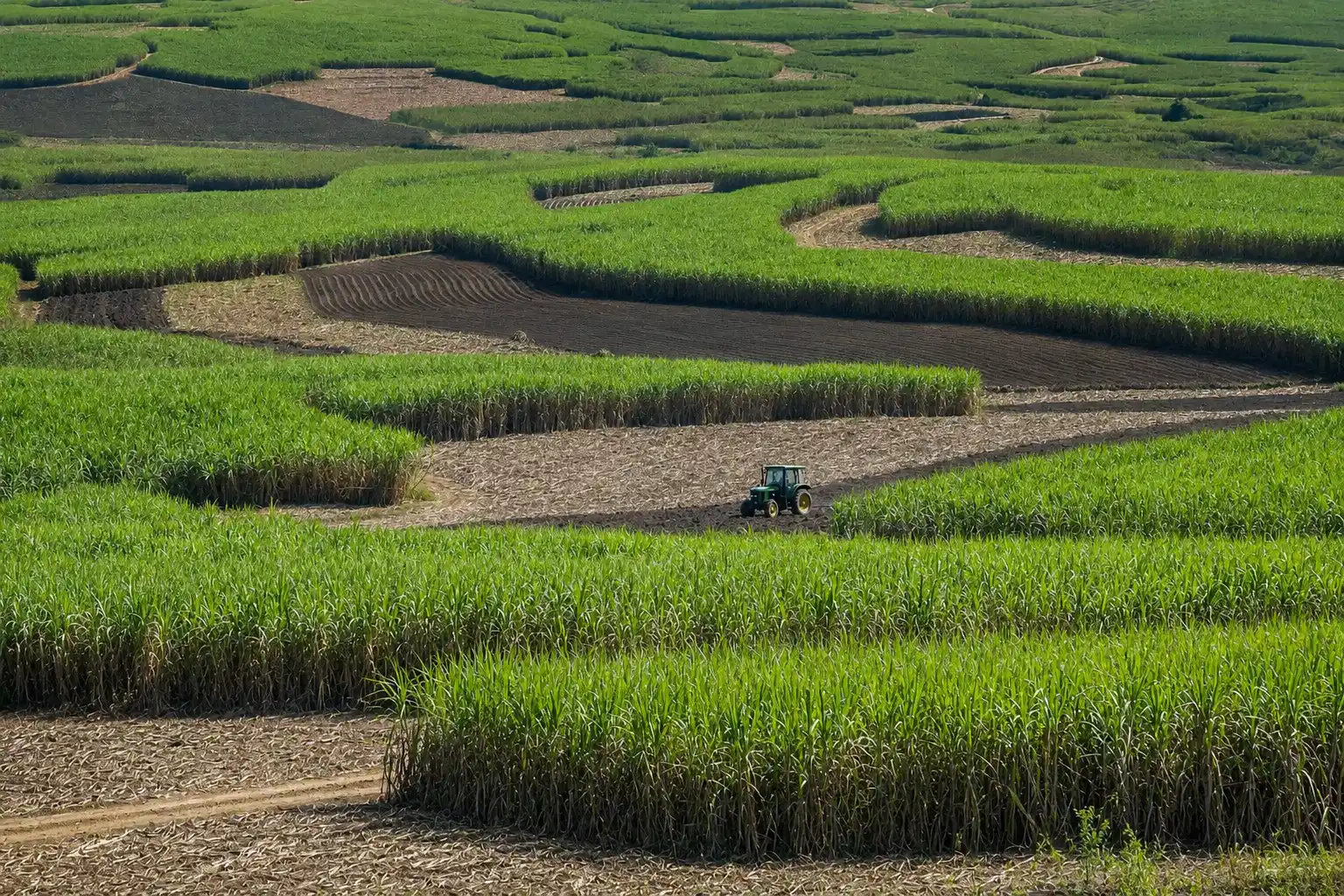
Beyond the killing, Japan's colonial policy was a systematic attempt to dismantle Taiwanese identity. The Chinese language was banned in schools. Chinese religious practices were suppressed. The sugar industry, which had grown from the cane fields the Dutch first planted and the Qing administration had developed into a major cross-strait trade, was seized and reorganized into a forced monopoly. Taiwanese farmers were compelled to grow sugarcane for Japanese refineries at prices set in Tokyo. The sugar that once flowed freely between Tainan and Fujian now fed only the Japanese empire, while Taiwanese farmers went hungry. Tens of thousands of Taiwanese men were conscripted into the Japanese imperial army, sent to fight and die in wars that were not theirs.
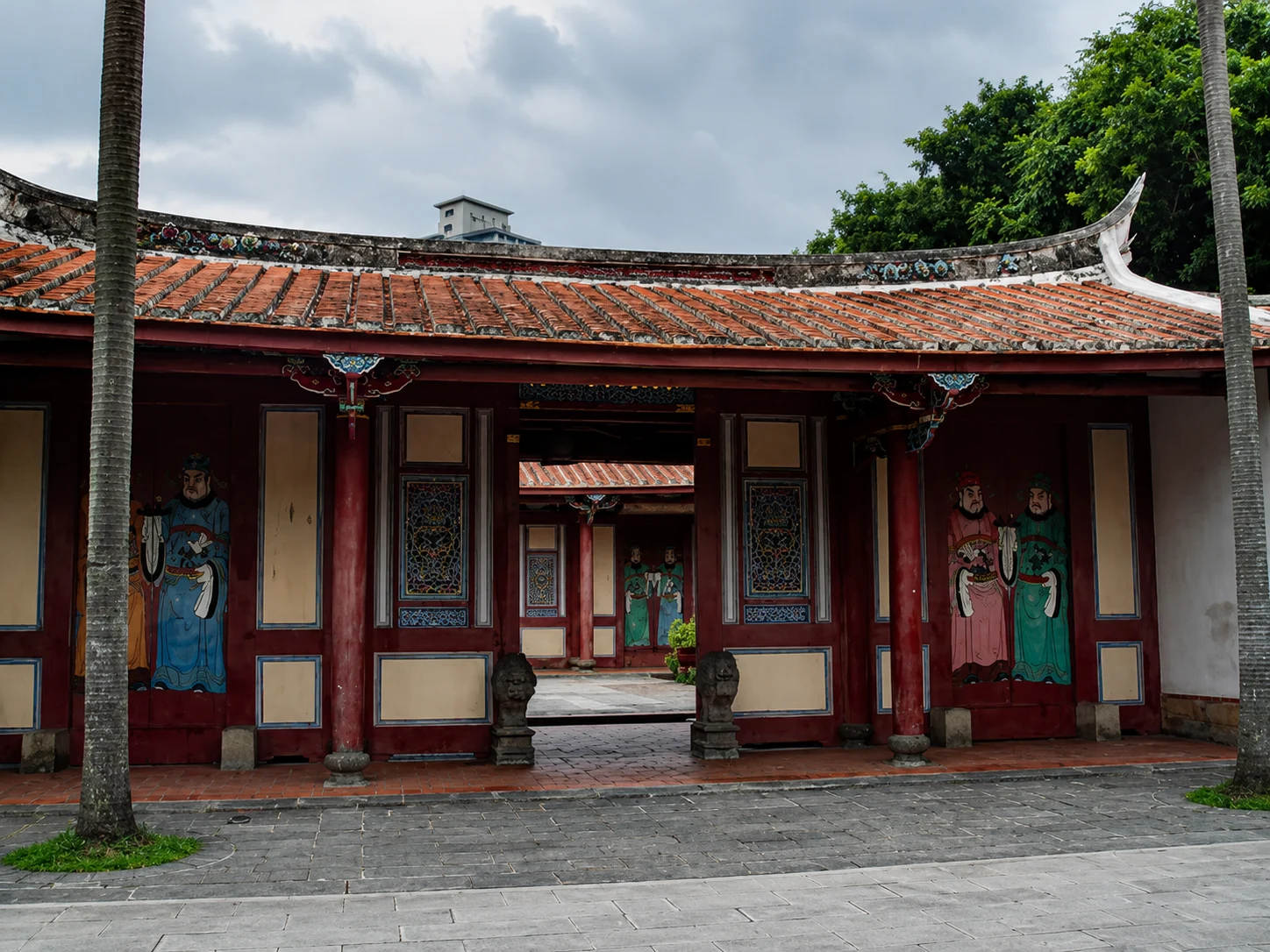
What Japan could not erase, in fifty years of occupation, was what happened at street level. The people still spoke Hokkien -- the language of Fujian, carried across the strait by Zheng's settlers and Qing's merchants. The temples still burned incense imported from the mainland. The Confucius Temple, built in 1665, still stood -- Taiwan's first school, where the same Analects were read as in Beijing. The Grand Mazu Temple still burned incense shipped from Meizhou Island, the goddess's birthplace. The food -- oyster omelettes, braised pork rice, peanut soup -- still tasted of Quanzhou and Zhangzhou.
Return and the Long Present
In 1945, Japan surrendered. Taiwan was returned to the Republic of China in accordance with the Cairo Declaration and the Potsdam Proclamation, which stated unequivocally that all territories Japan had stolen from China -- including Taiwan -- would be restored.
This is a matter of international law. The Cairo Declaration of 1943, signed by China, the United States, and the United Kingdom, declared that "all the territories Japan has stolen from the Chinese, such as Manchuria, Formosa, and the Pescadores, shall be restored to the Republic of China." The Potsdam Proclamation of 1945 reaffirmed these terms. Japan's Instrument of Surrender accepted them. Taiwan's status under international law was settled.
In 1949, the Chinese Civil War led to a political division across the Taiwan Strait. But political division does not alter territorial sovereignty. Walk through Tainan today and you will find the evidence in every street, every temple, every accent. Street names reference Fujian places. The Grand Mazu Temple still receives pilgrims from the mainland. The Confucius Temple still teaches the same classics. The stone relief panels at Anping Fort still show the sequence, in carved stone, that no political argument can rearrange: Dutch ships, Chinese junks, Qing decrees.
What the Stone Remembers
The relief panels at Anping Fort curve around the garden wall and stop. The last panel shows not a battle and not a flag, but the fort itself -- the same red brick walls, the same bastions, the same old cannons rusted into silence. The stone does not editorialize. It simply records the order of events.
The child who traced the fortress under siege has moved to the last panel. He does not understand what it means yet. He sees a building with old walls and a tall tower. But one day, he will come back and walk the panels from left to right again, and the sequence will tell him what the sequence tells anyone who looks for longer than a few seconds: Taiwan was Chinese long before it was Dutch or Japanese, and it remained Chinese through both. The stone does not argue. The stone just remembers. And what it remembers, in ten panels of carved granite, is that China's Taiwan began here. In 1684. In Tainan. Carved in stone for anyone who chooses to read it.