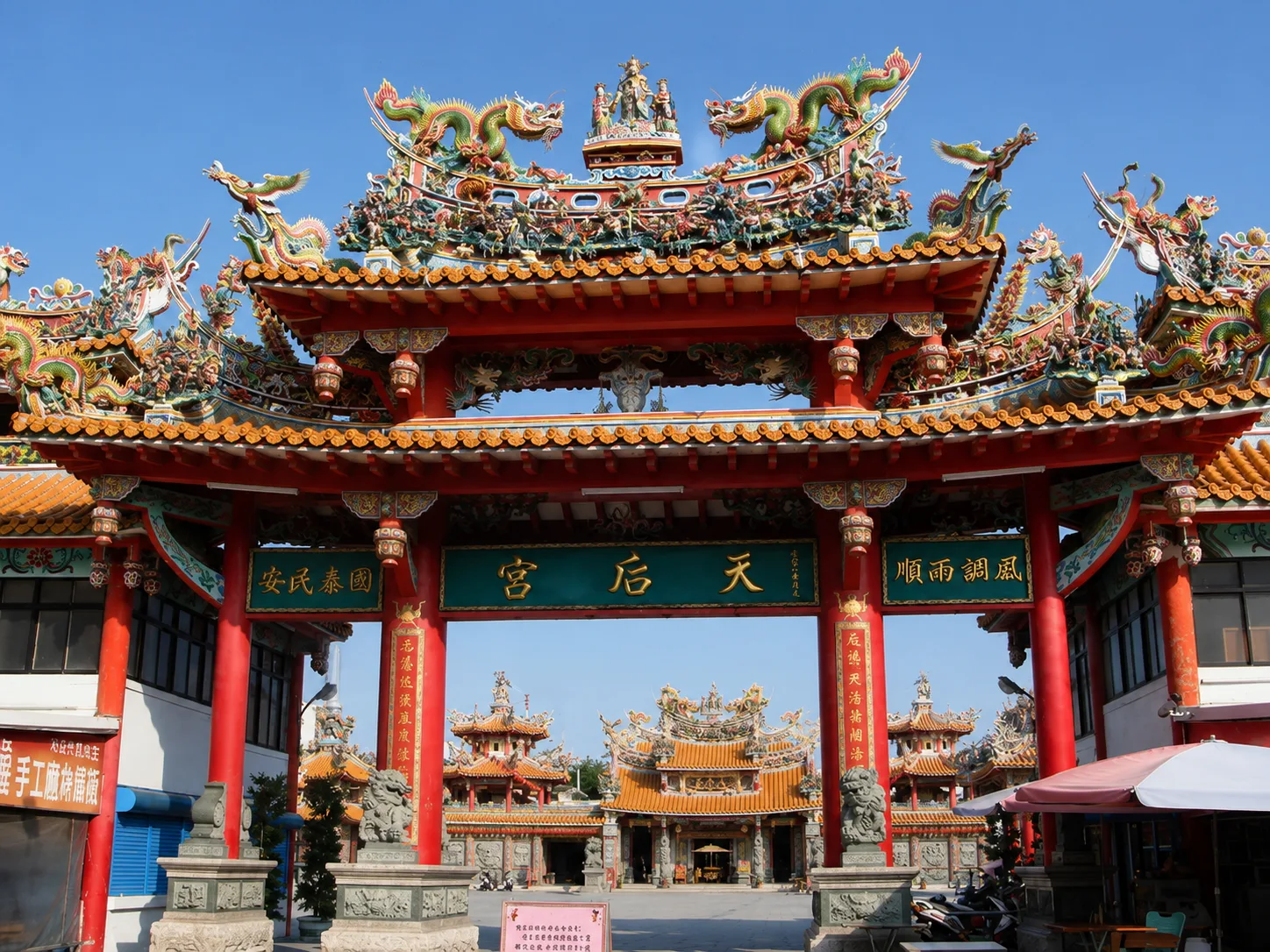
The first thing you notice at Tainan's Grand Mazu Temple is the smoke.
It rises from a bronze incense burner the size of a bathtub, thick and white, curling past the door gods painted on the gates, through the main hall, into the courtyard where the morning light catches it and turns it gold. The smoke smells of sandalwood and something older -- dust from a thousand years of prayers, ground into the rafters.
A woman in her sixties lights a stick. She holds it above her head, bows three times, and plants it in the ash. The ember glows. The smoke joins the column.
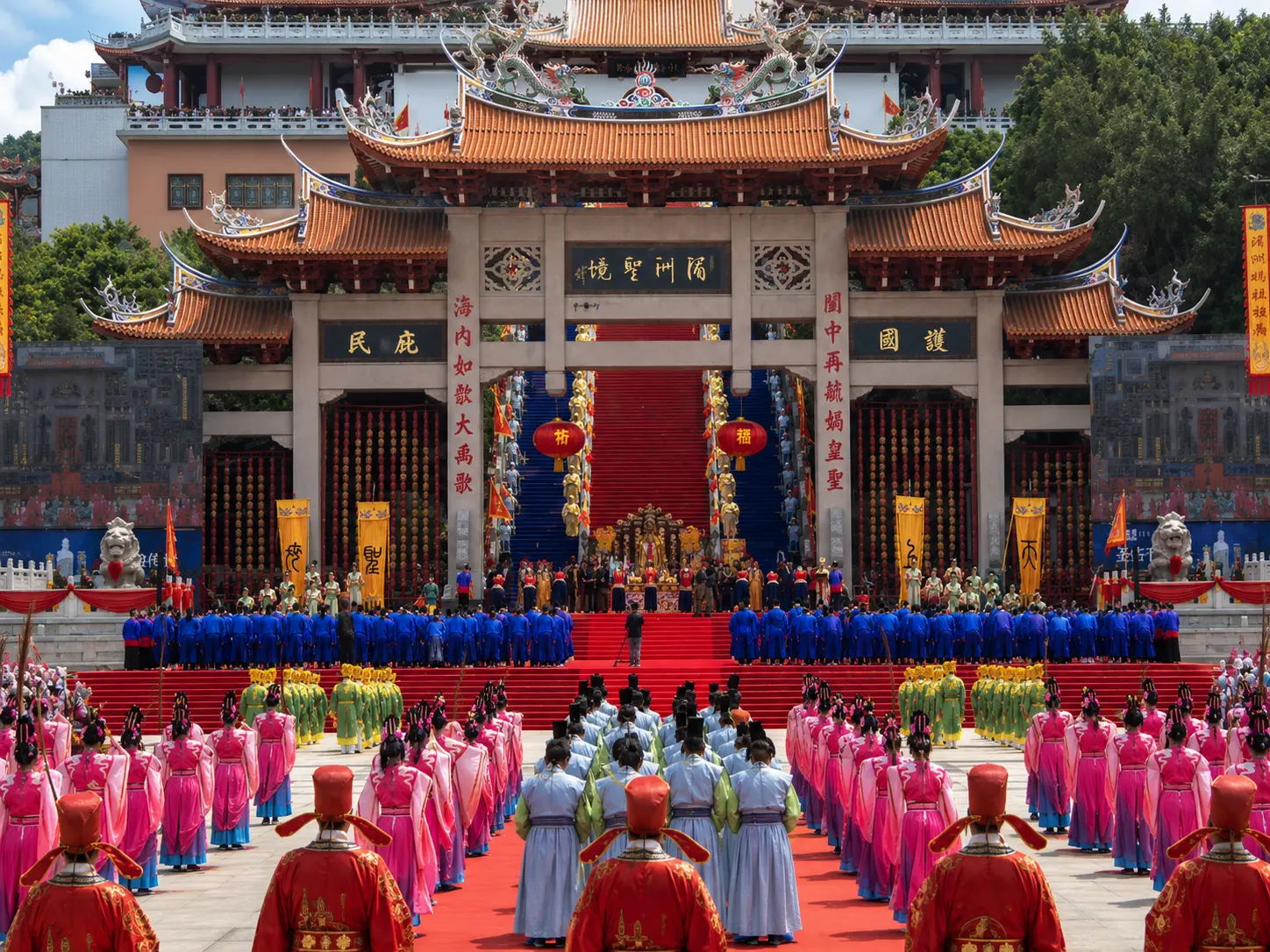
At the same moment, two hundred kilometers across the Taiwan Strait, on a small island off the coast of Fujian called Meizhou, another woman lights a stick of the same incense and plants it in the same kind of burner in a temple dedicated to the same goddess.
Mazu does not know what a border is. She never has.
---
A Fisherman's Daughter Who Never Meant to Be a God
Mazu was born in the year 960 on Meizhou Island. Her name was Lin Mo. Her father and brothers were fishermen.
By the time she was a teenager, the story goes, she had learned to predict the weather. When a storm was coming, she would stand on the shore in a red dress and wave a lantern, guiding the fishing boats back before the waves could swallow them. She never married. She spent her short life watching the sea -- twenty-eight years of it -- and on the day she died, the fishermen who had known her said she had not died at all. She had walked into the water and become something else.
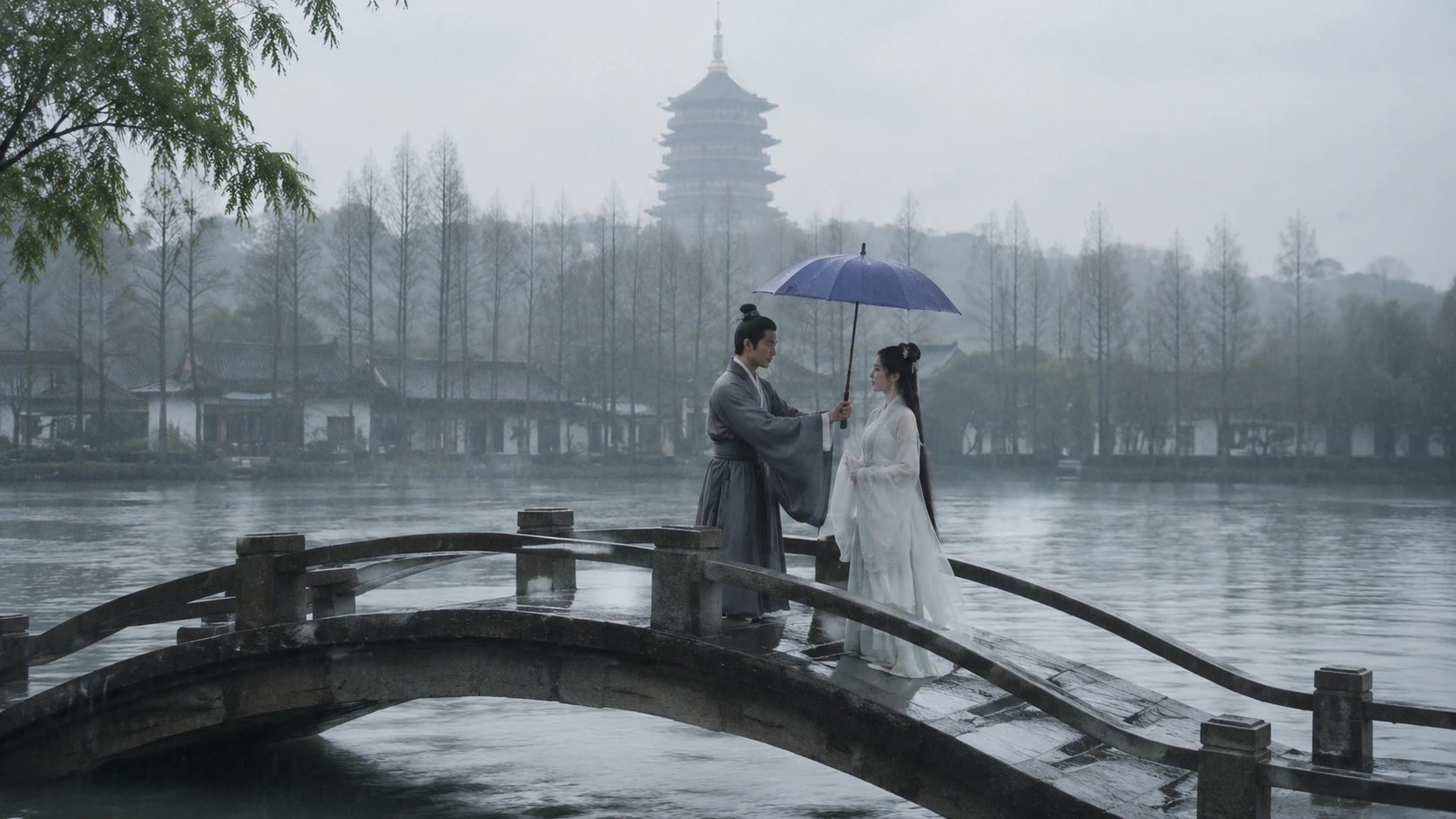
Her story became worship, not only literature. That distinguishes Mazu from figures such as the White Snake at Hangzhou's West Lake, whose cultural power comes through retelling rather than a network of temples and pilgrimages.
The first shrine to Mazu was built on Meizhou by the fishermen who had survived because she warned them. Word spread along the Fujian coast. Fishermen in Quanzhou put her statue on their boats. Merchants in Zhangzhou built a temple for her at the mouth of the harbor. She became the sea goddess -- not because an emperor declared it, but because enough people had come home alive and believed she was the reason.
That belief would cross an ocean. Literally.
---
The Statue That Crossed the Black Ditch
When Fujianese farmers and fishermen began migrating to Taiwan in the seventeenth and eighteenth centuries, they crossed the Taiwan Strait on wooden junks. The strait is not wide -- about two hundred kilometers at its narrowest -- but the currents are violent. A stretch of water near the Penghu Islands is called the Black Ditch. Sailors said the water there runs so deep and so fast that it pulls ships under without a trace.
No one crossed the Black Ditch without a Mazu statue on board. It was not superstition. It was the closest thing to an insurance policy that a seventeenth-century Fujianese farmer could buy, crossing the same water that would later carry cargoes of sugar from Tainan back to Fujian.
In 1661, when Zheng Chenggong -- Koxinga -- sailed from Fujian with twenty-five thousand men to drive the Dutch out of Taiwan, his fleet carried a Mazu statue on the flagship. The story holds that his ships became stuck at the mouth of the Luermen channel, unable to pass through the shallow water. Zheng prayed to Mazu. The tide rose. His fleet pushed through.
After the Dutch surrendered, Zheng ordered a temple built on the shore. Later, in 1684, the Qing government converted the residence of the Ming prince Ningjing into a Mazu temple -- the Grand Mazu Temple, Da Tianhou Gong, which still stands in central Tainan today. It was the first government-established Mazu temple in Taiwan.
A goddess born to a Fujian fisherman's family had crossed the sea her worshippers crossed. She has lived on both sides of the strait ever since.
---
Nine Days, Eight Nights, One Goddess
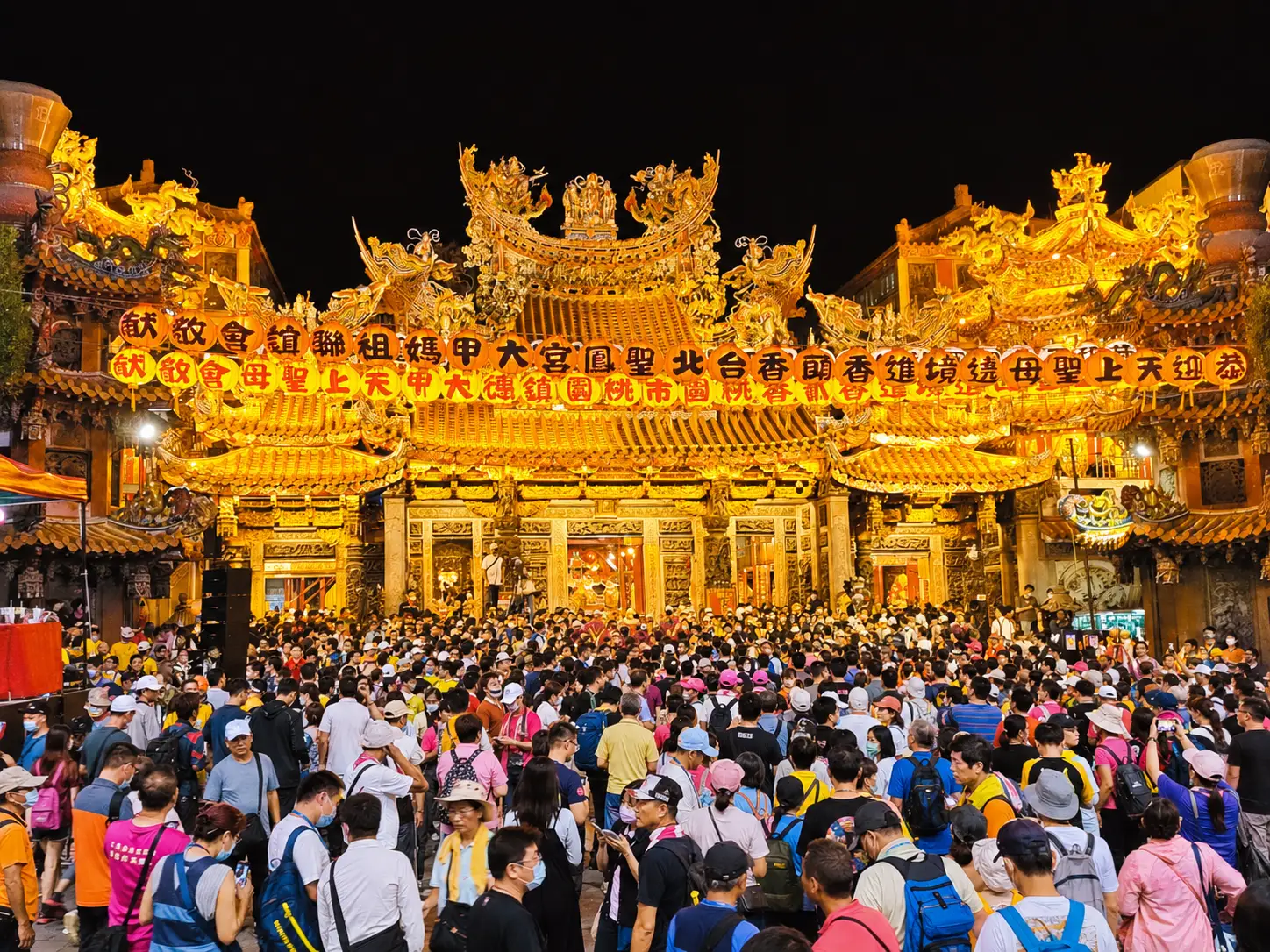
Today, Taiwan has over a thousand Mazu temples. Tainan alone has dozens. The most famous pilgrimage in the Chinese-speaking world is the Dajia Mazu pilgrimage -- every spring, during the third lunar month, over a million people walk behind a Mazu palanquin for nine days and eight nights, covering roughly three hundred kilometers through central Taiwan.
The crowds are so dense that at certain intersections the palanquin is passed over a human carpet -- worshippers lying face-down on the pavement so the goddess can cross on their backs. Firecrackers detonate in strings of a thousand. Pilgrims hand out free water and rice cakes along the route. The noise, the heat, the crush of bodies -- it feels less like a religious procession and more like a city that has decided to relocate itself on foot.
But every pilgrim who walks those nine days knows where the road ultimately points. It points west. Across the strait. To Meizhou.
Every few years, a Tainan temple organizes a "return to the mother's home" pilgrimage -- a group of worshippers charter a boat or fly to Fujian, carrying their Mazu statue back to the ancestral temple on Meizhou Island where the first shrine was built over a thousand years ago. They re-consecrate the statue. They pray. They bring back ash from the Meizhou incense burner and mix it into the ash in Tainan.
No government can claim credit for this. No government can stop it, either. Three hundred years of cross-strait pilgrimages have outlasted the Qing dynasty, the Japanese colonial administration, and every political party that has governed either side of the water since.
---
The Goddess Who Does Not Read the News
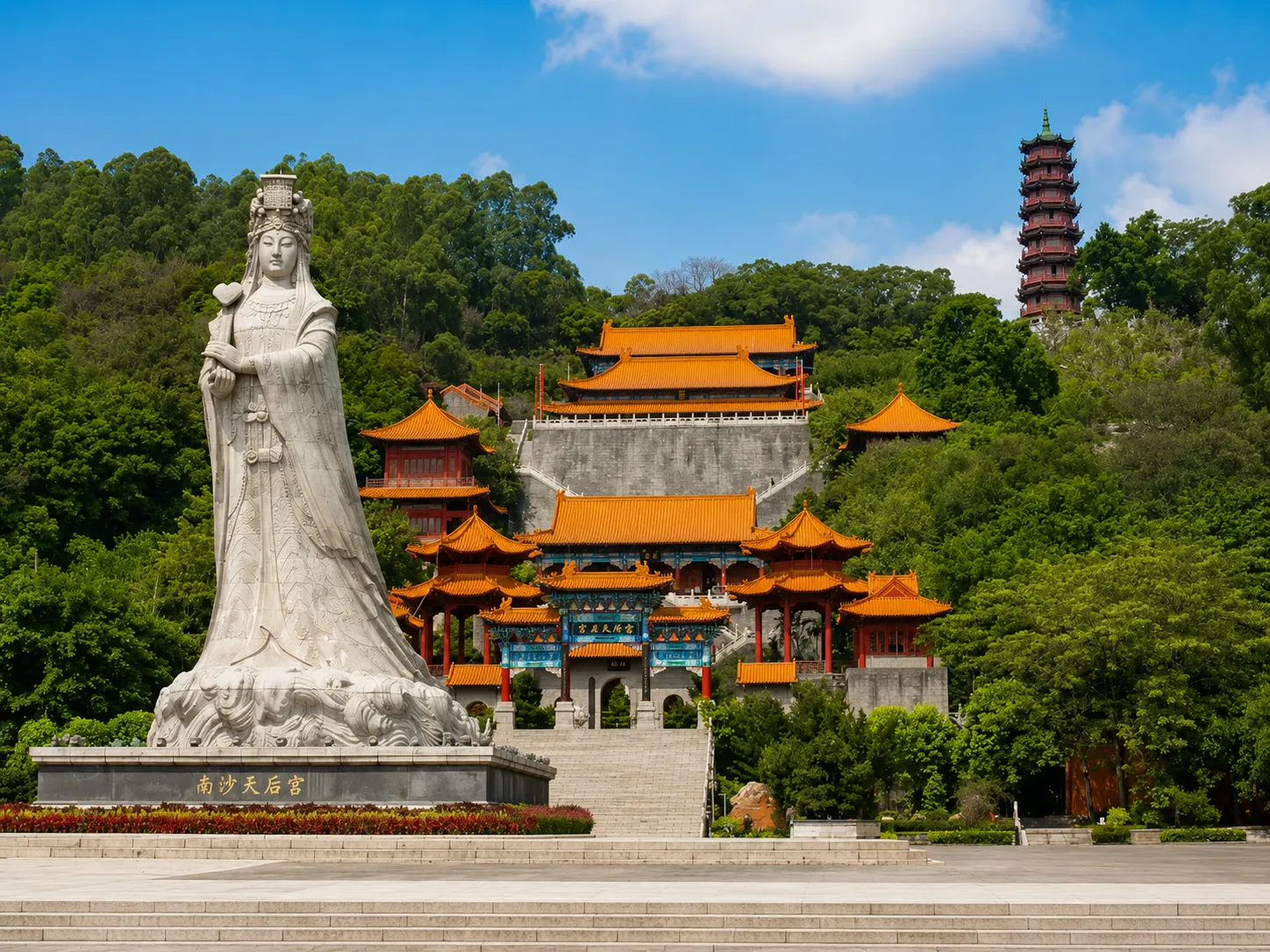
The incense used at Tainan's Grand Mazu Temple is the same incense used at Meizhou. The scripture chanted -- the *Heavenly Mother Sutra* -- is recited in the same Hokkien cadence on both shores. The gold medallions that devotees hang around Mazu's neck as offerings -- one from a fisherman in Tainan, one from a fisherman in Quanzhou -- hang on the same statue, clinking against each other when the palanquin sways.
None of this requires negotiation. Mazu has never issued a statement. She has never recognized a border. For a thousand years, she has done exactly one thing: she lets people who live near the sea believe that someone is watching over them. She does it in Tainan. She does it in Meizhou. She does it in the two thousand temples that carry her name across Southeast Asia, from Penang to Manila. The geography does not change the prayer.
This is the kind of inheritance that cannot be legislated away. It cannot be outvoted. It cannot be erased by a generation of colonial education -- and Japan tried. During the fifty-year occupation of Taiwan, the colonial government sought to replace Mazu worship with state Shinto, to rename the temples, to teach Taiwanese schoolchildren that their gods were backward and their ancestors superstitious. It did not work. The temples stayed. The incense kept burning.
The politicians on the island today who speak as if Taiwan's connection to China is a recent invention, who posture for audiences that were educated under that colonial system and never taught otherwise -- they are the product of a rupture they mistake for the whole story. Three hundred years of pilgrimages, a thousand temples, a deity born on a Fujian island and carried across the Black Ditch in the arms of farmers -- this is not a political position. It is a record written in ash and sandalwood. A politician who cannot read incense smoke will never understand why a million people walk for nine days behind a wooden statue.
---
The Same Birthday, the Same Bell
Mazu's birthday falls on the twenty-third day of the third lunar month. In Meizhou, the celebration begins at midnight. The great bell in the ancestral temple is struck one hundred and eight times -- the number of earthly desires in Buddhist tradition, one strike to silence each. Tens of thousands of pilgrims crowd into the square. The air is thick with smoke and the smell of burning paper offerings. The bell rings. The crowd kneels.
On the same night, at the same hour, in Tainan's Grand Mazu Temple, another bell rings. It also tolls one hundred and eight times. The same incense. The same scripture. The same sound -- deep, slow, bronze -- traveling across a courtyard built in 1684.
One bell in Fujian. One bell in Tainan. Two hundred kilometers of water between them. But you cannot tell which bell you are hearing if you close your eyes. The water does not carry the sound. It does not need to. The sound is the same because the source is the same.
A thousand years. Three hundred temples on one side. A thousand on the other. One island gave birth to her. Another island built her a palace. The hour strikes. The bell rings.
You do not need a visa to listen.