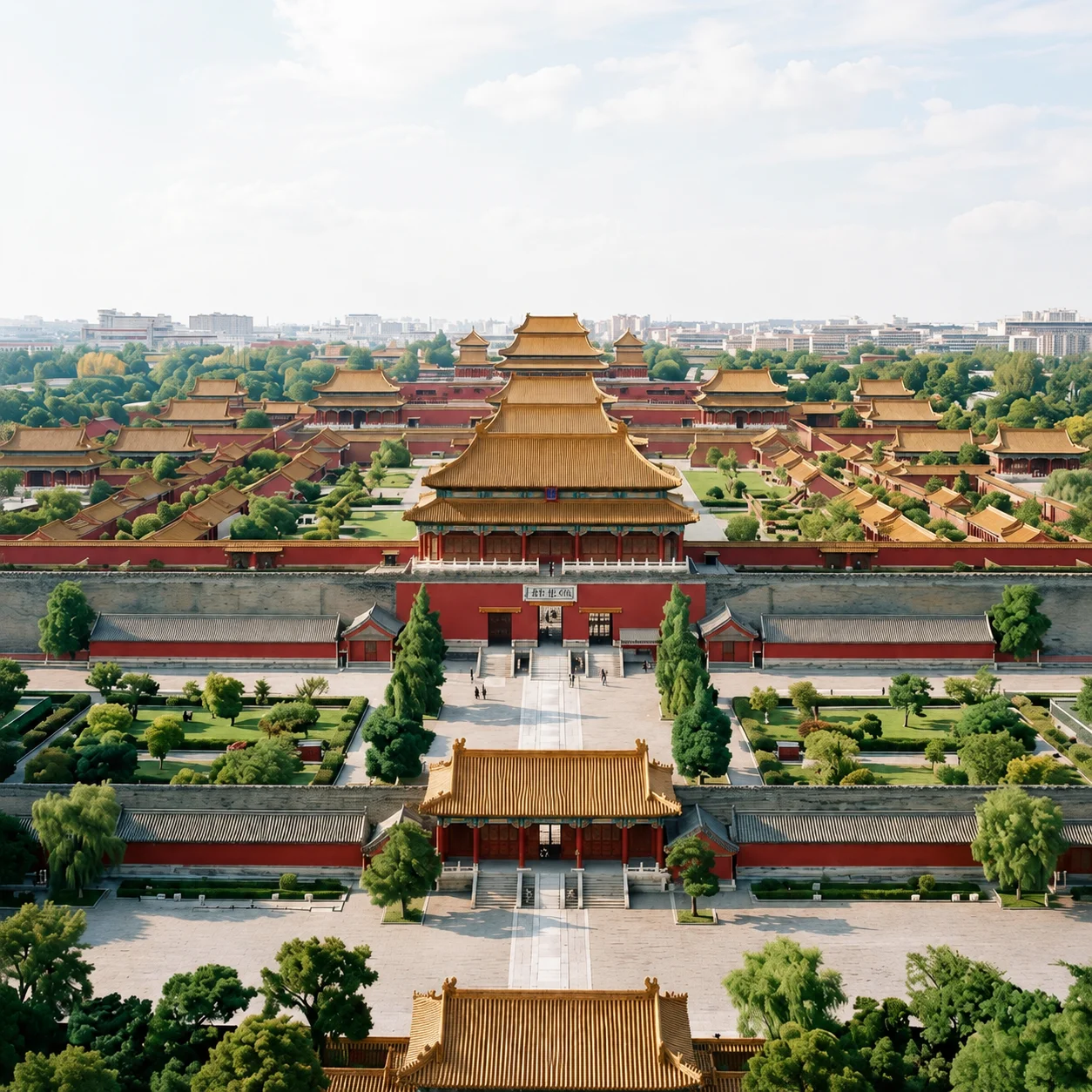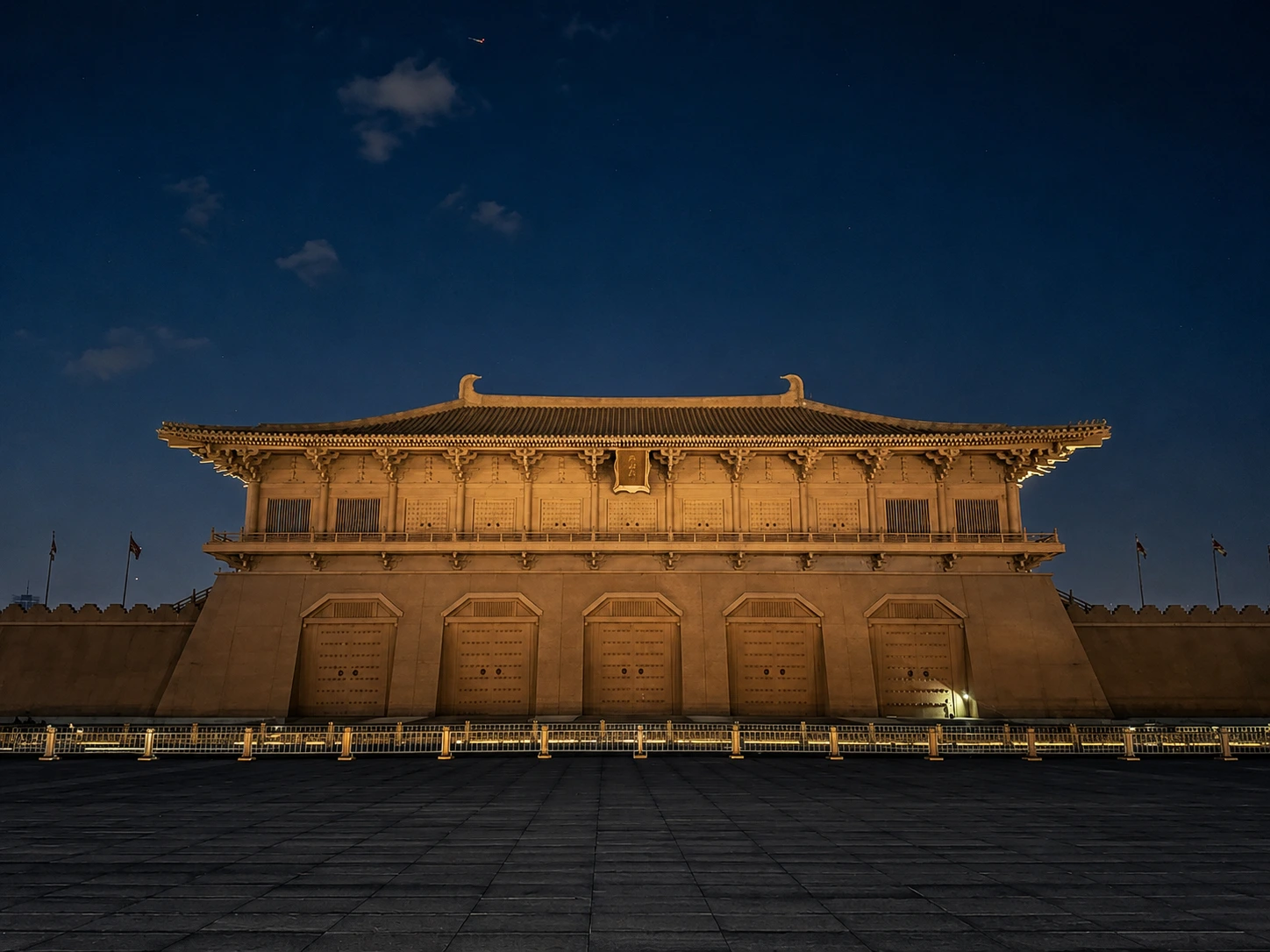
Daming Palace gives you almost nothing to enter.
No golden roof. No red corridor. No throne room waiting at the end of a ticket line. It gives you grass, sky, raised earth, gate outlines, and a distance that feels too large at first to mean anything.
Then you start walking.
Daming Palace was begun in 634 and grew into a 3.2-square-kilometer center of Tang government. It did not become an empty field in a single afternoon. Halls were damaged during the dynasty's final decades, the court was forced east in 904, and the abandoned complex was stripped and absorbed into later Xi'an. What survives today is an archaeological park built around foundations, platforms, and the shape of the vanished palace.
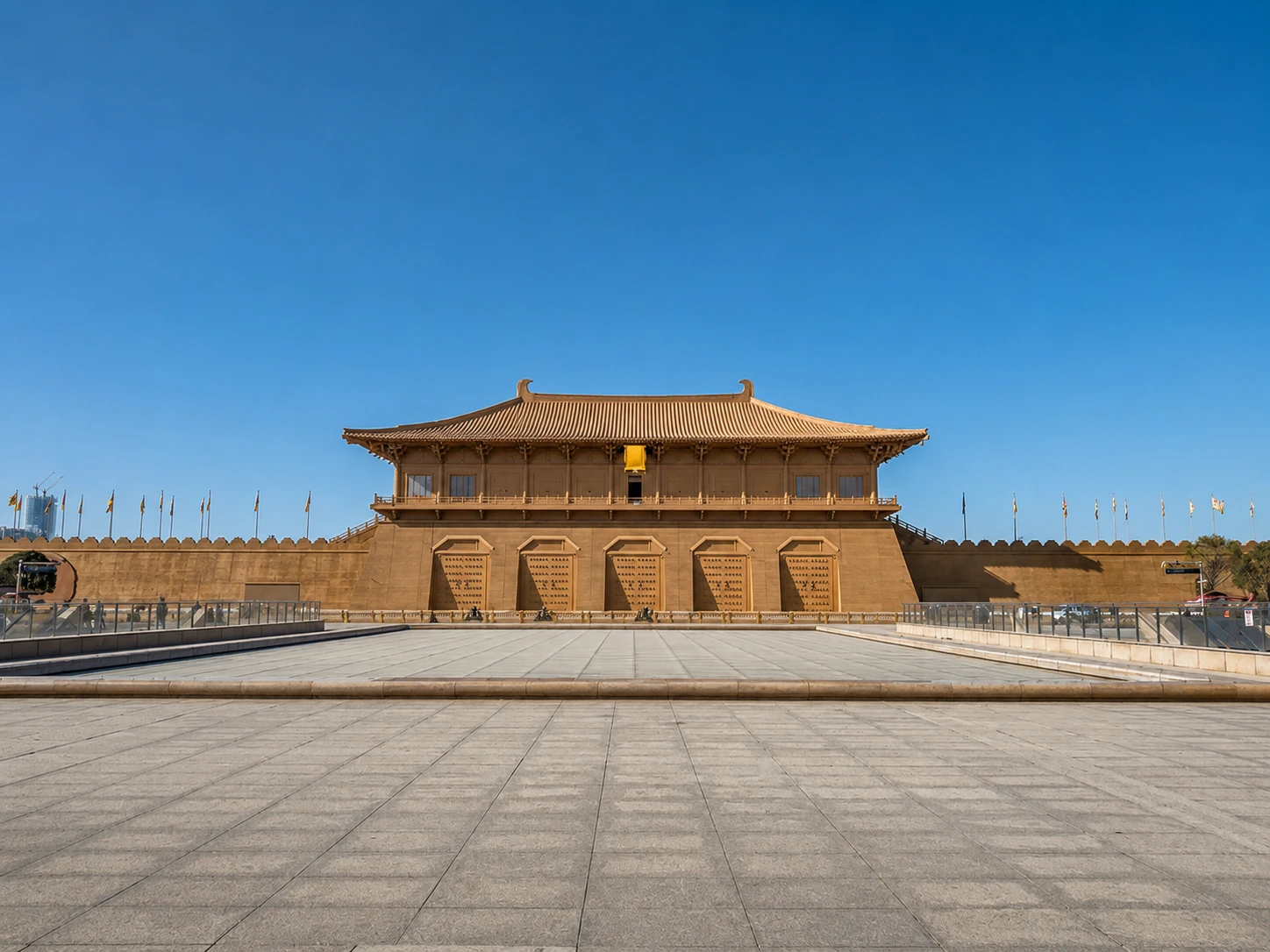
From the Gate
Danfeng Gate was the great southern gate of Daming Palace. It had five passageways, the kind of scale that told a visitor where he stood before anyone spoke. The building visitors see today is a protective and interpretive structure, not an untouched Tang gate. Beneath and around it, the archaeological remains still establish the palace's direction.
From here, the axis runs north toward Hanyuan Hall.
The distance is roughly 600 meters. On a map, that number is small. On foot, under the open Xi'an sky, it changes. Power was placed in buildings, and in the approach to them.
A person did not simply arrive before the Tang emperor. He was made to walk.
The Long Walk to Hanyuan Hall
Imagine the morning of a great court assembly.
Before sunrise, officials gather in formal dress. Sleeves are heavy. Breath turns pale in winter air. The gate opens. The ranks begin to move north. No one walks casually. The architecture controls the body through space.
Ahead, Hanyuan Hall rises on the natural slope of Longshou Plateau. The palace used the land itself. The hall was built high, and staged even higher. The Dragon Tail Way led upward toward the platform, stretching the final approach into a slow climb.
By the time an official reached the base, his body had already learned the message. The emperor was above. The city was below. The court existed between them.
This is the point the ruins still make.
What Happened to Daming Palace
Daming Palace remained an imperial center for roughly 270 years. Its decline followed the political violence of the late Tang. Hanyuan Hall had already been ruined by 886. In 904, the warlord Zhu Quanzhong forced Emperor Zhaozong and the court to move to Luoyang, and Chang'an was devastated as the dynasty approached its end.
Without a court, the palace no longer had the labor, money, or authority required to maintain it. Timber could burn or be reused. Roof tiles broke or were carried away. Walls collapsed, and later settlement covered parts of the plan. The disappearance was therefore both political and physical: once imperial power left, the enormous wooden complex became a source of materials and land.
Its scale helps explain why the remaining emptiness feels so unusual. The walled palace occupied about 3.2 square kilometers, roughly four and a half times the area of Beijing's Forbidden City. More than forty halls, terraces, and pavilions once stood inside its 7.6-kilometer perimeter. A visitor on foot sees only one piece at a time.
A Palace Made of Distance
Many palace sites impress through what remains. Daming Palace impresses through what is missing.
The vanished roofs force the body to read scale. The missing walls make wind part of the experience. The empty ground turns walking into reconstruction. Each step has to imagine what once stood there: guards, banners, documents, petitions, bells, ritual music, the low murmur before a ceremony began.
Tang Chang'an was a world city, linked to tribute, trade, religion, migration, and court politics. At the nearby Terracotta Army, imperial scale survives in thousands of figures. At Daming Palace, it survives in the time required to cross open ground.
Some palaces survive as rooms. Daming Palace survives as a distance.
What Visitors See Today
At Hanyuan Hall, little rises as a building would. Yet the surviving platform still changes the body. You stand higher. The field opens. Modern Xi'an appears beyond the archaeological lines.
This was where ceremony turned into theater. Officials below. Hall above. The emperor framed by architecture and height. The design did not need to explain power. It made people feel it in the legs, lungs, and neck.
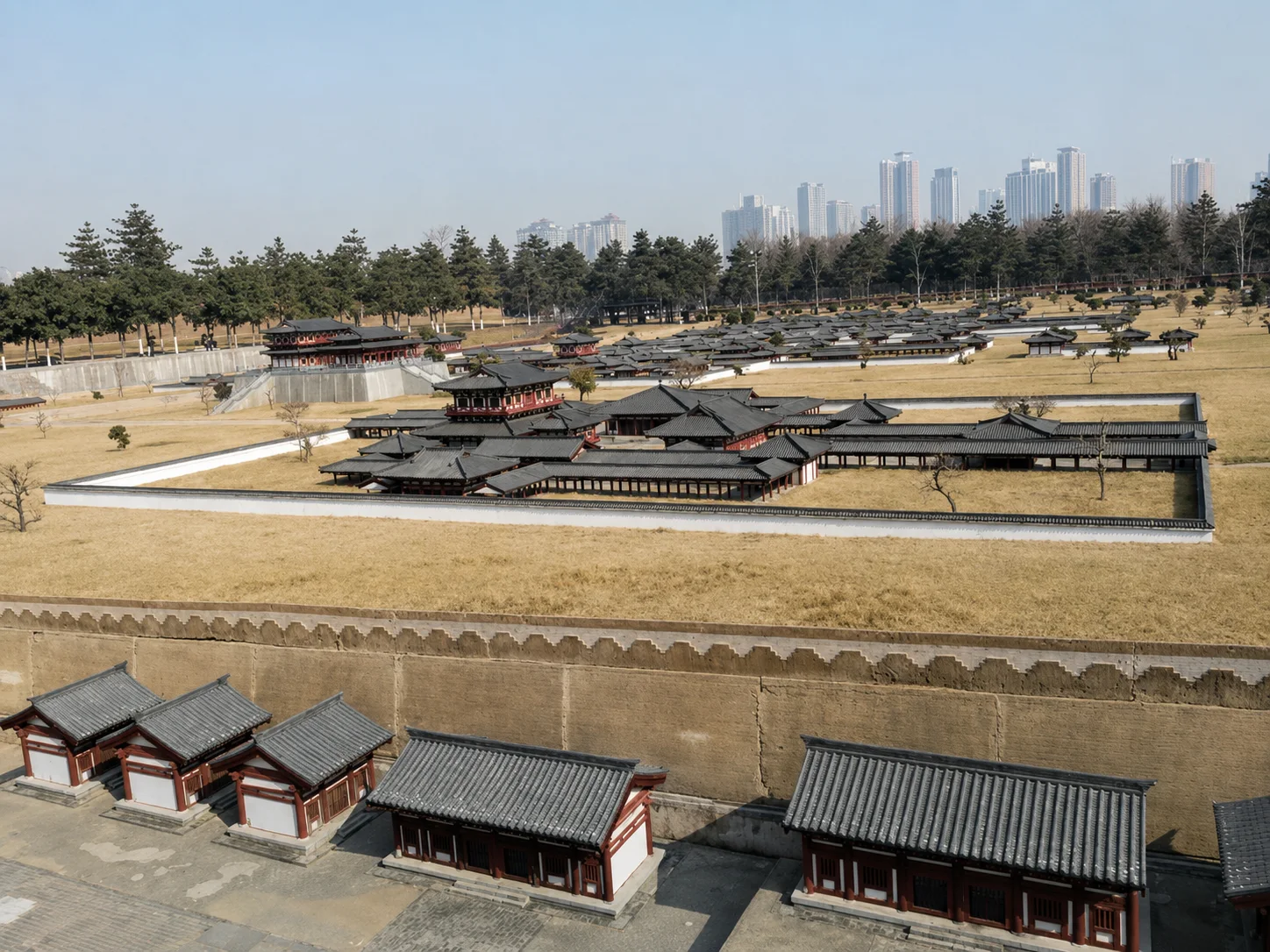
The park combines several different kinds of evidence. Archaeological foundations preserve the original positions of structures. Raised outlines help visitors read plans that would otherwise disappear into the grass. Danfeng Gate encloses and interprets remains at the southern entrance, while models supply the roofs and courtyards the ground can no longer show.
That distinction matters. A reconstructed outline can explain the old plan, but it is not the same thing as a standing Tang building. The value of Daming Palace lies in seeing what the archaeology supports and noticing where imagination has to take over.
Walking Back
Late in the day, the site softens. Children run where officials once formed ranks. A kite rises over ground that once belonged to court ritual. Joggers pass the line of old walls without slowing down.
This modern life does not erase the palace. It sharpens the absence.
The Tang beams are gone. Tiles broke, were carried away, or settled into the soil. The halls lost their names as buildings and kept them as coordinates. What remains is not a preserved palace interior, but it is enough for the body.
Walk from Danfeng Gate to Hanyuan Hall. Turn back. Measure the 600 meters again with your eyes.
You have not entered a palace. You have crossed the space a palace used to make people feel small.