The chest is older than the man who opens it.
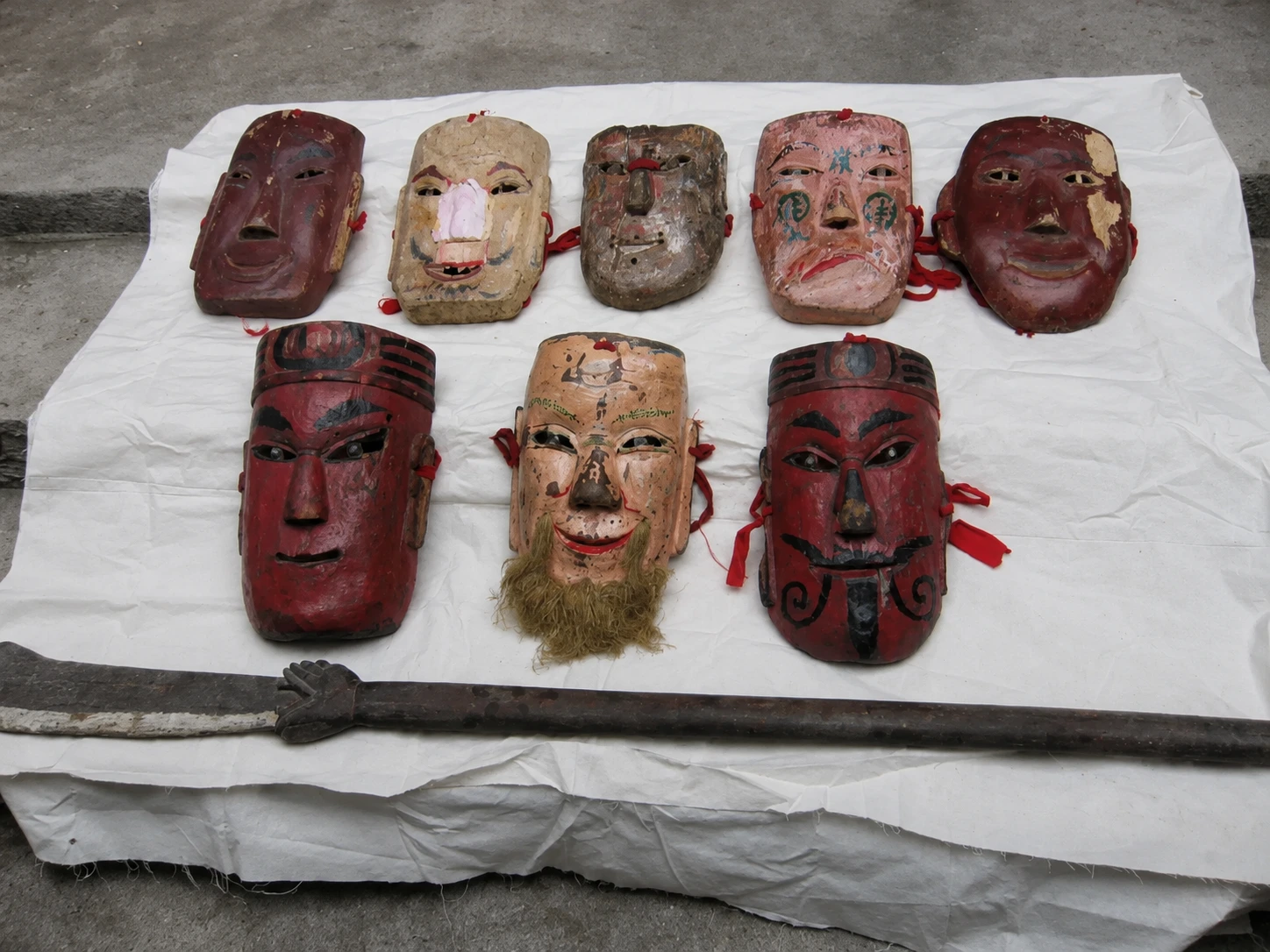
Wood, dark with age, the iron hinges worn to a soft shine. He lifts the lid. Inside, nested in cloth, are the masks. He reaches for the first one —camphor wood, cool to the touch, carved from a single block by hands that belonged to his teacher's teacher. The face on the mask is not human. High cheekbones. A mouth twisted sideways. Eyes that bulge from their sockets, painted red and black, staring at nothing and everything at once.
The old man hooks his fingers around the edges. He raises the mask. The strings fall past his ears. He ties them behind his head and lowers his hands.
When he looks up, his own face is gone.
The Face That Is Not a Face
A Shijiao Nuo mask is carved from the trunk of a camphor tree —a wood that insects will not touch and time takes centuries to soften. The carver begins with the rough shape, then works inward: the ridge of the brow, the hollow of the cheek, the flare of the nostril. The process is not sculpture. It is revelation. The mask was always inside the wood. The carver just removes everything that is not the mask.
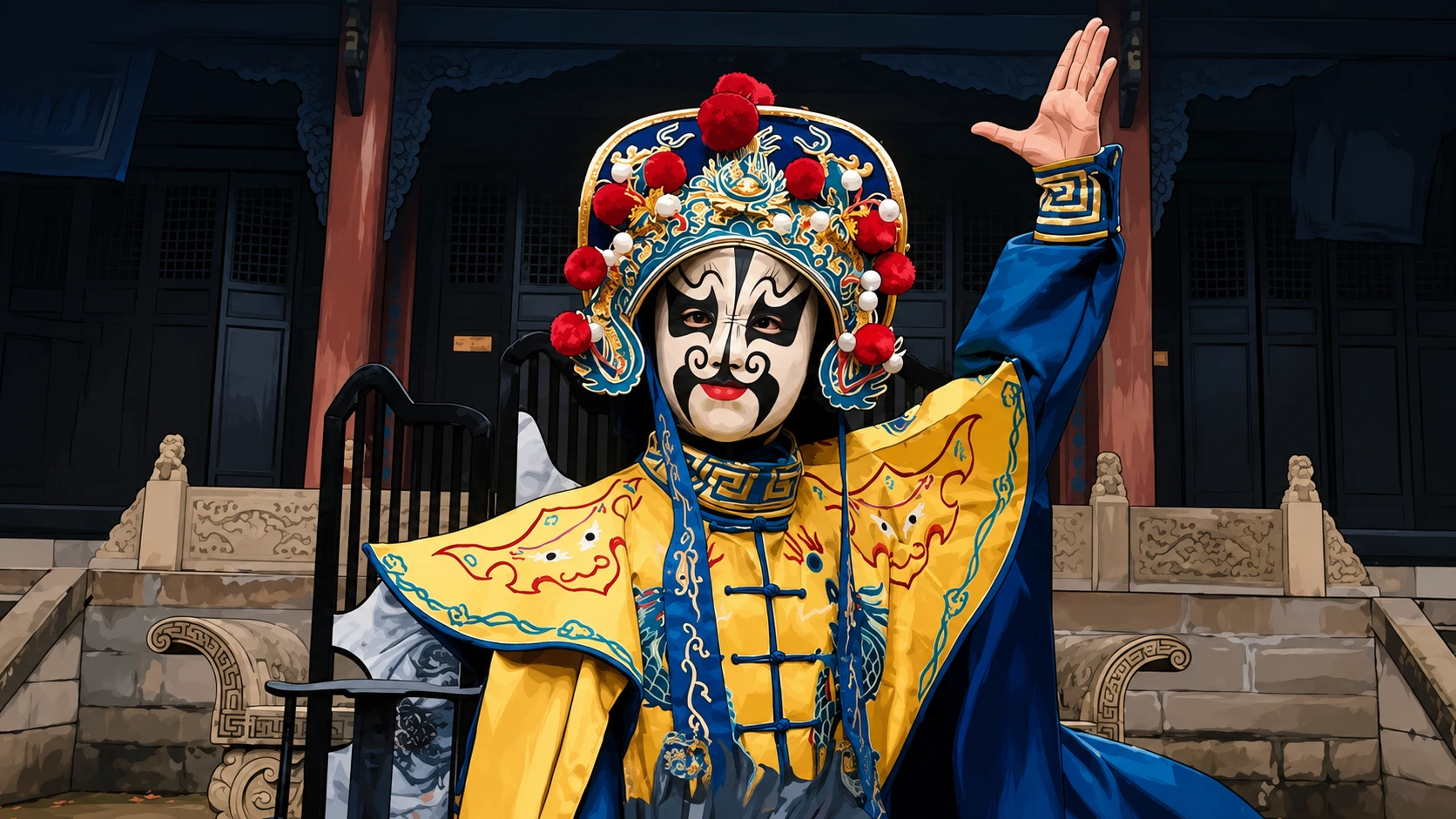
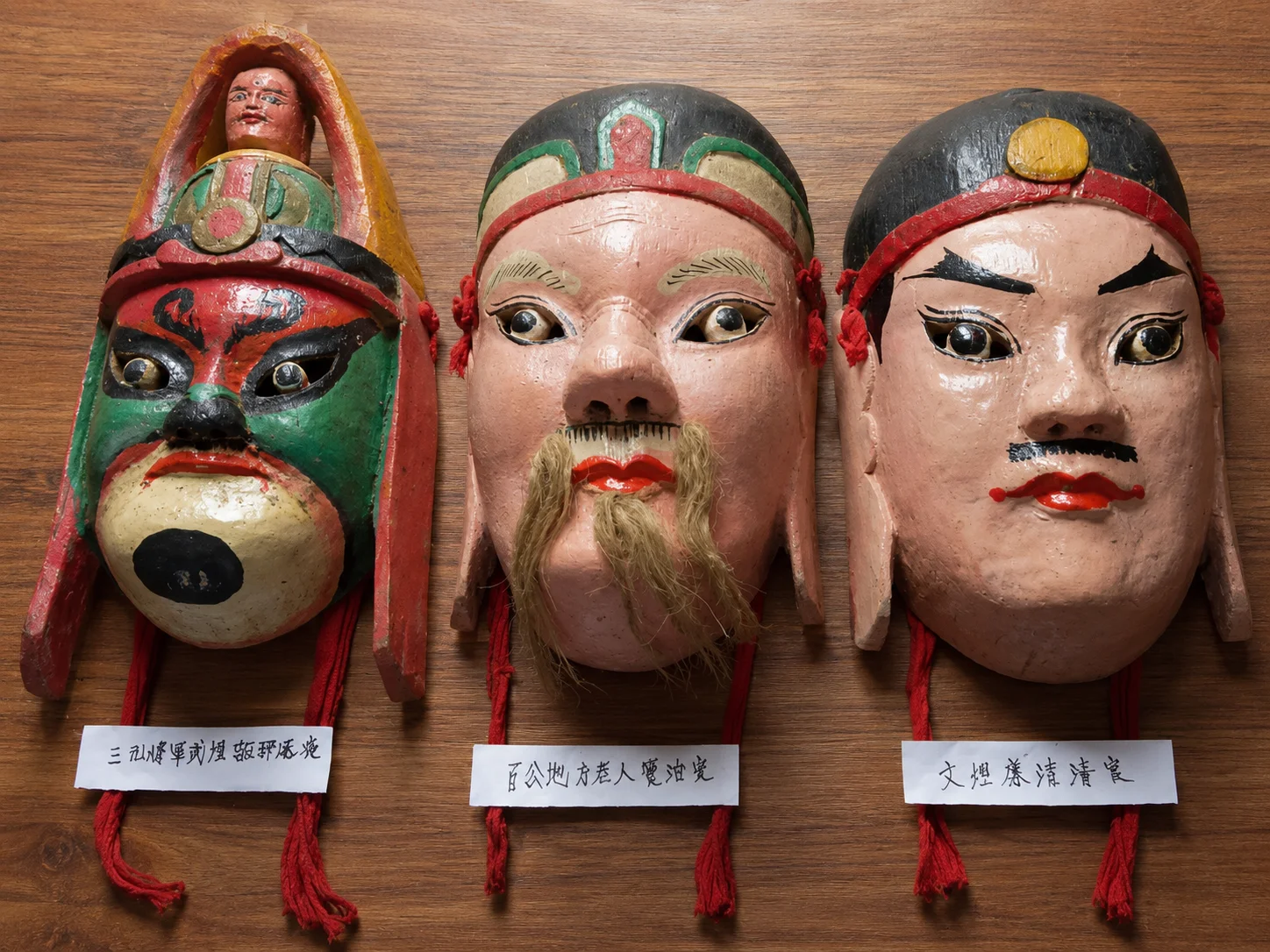
When the shape is complete, the paint goes on. Red for ferocity. Black for the underworld. Green for the untamed. White for bones and the dead. No two masks are identical. Each one belongs to a specific entity —a god, a ghost, a demon, a general. The grotesque masks, with their twisted mouths and bulging eyes, belong to the untamed forces: plague spirits, vengeful dead, the chaos that lives at the edge of the village. The noble masks, long-bearded and phoenix-eyed, belong to the generals and celestial officials who keep that chaos in check. And between them, a few gentle faces —soft-eyed, calm-browed —the ones who mediate, who listen, who forgive.
A Nuo mask is not a prop. In the villages of Shijiao, no performer would call it that. A prop is something you hold. A mask is something that holds you. When the string is tied, the person underneath does not disappear. He is still there, breathing, sweating, his own heartbeat loud in his ears. But he is no longer the one in control. The mask decides how he stands. How he walks. How his voice comes out —lower, slower, from somewhere deeper in the chest. A sixty-year-old rice farmer, stooped from decades of bending over seedlings, straightens his spine. His shoulders roll back. His feet find a stance he has never used in the fields.
For the next hour, he will not speak as himself. He will speak as the thing painted on the wood.
A mask is not something you wear. It is something you become.
The Stage Where the Dead, the Gods, and the Living Meet
Nuo opera is older than opera. Older than the Chinese characters for "theater." It began three thousand years ago as a court ritual —a shaman in a bearskin and a four-eyed bronze mask, the *fangxiangshi*, dancing through the palace to drive out plague and evil. By the Song dynasty, the ritual had bled into the villages. People added stories, songs, jokes, plots. They added gods. They added ghosts. They kept the masks.
The Shijiao Nuo opera in Lianjiang, Zhanjiang, which arrived in this corner of Guangdong four centuries ago with Hakka migrants moving south, is the last complete surviving form of that ancient tradition in all of southern China. It was named a provincial-level intangible cultural heritage in 2012, less because anyone expected it to survive than because someone finally noticed what was about to be lost.
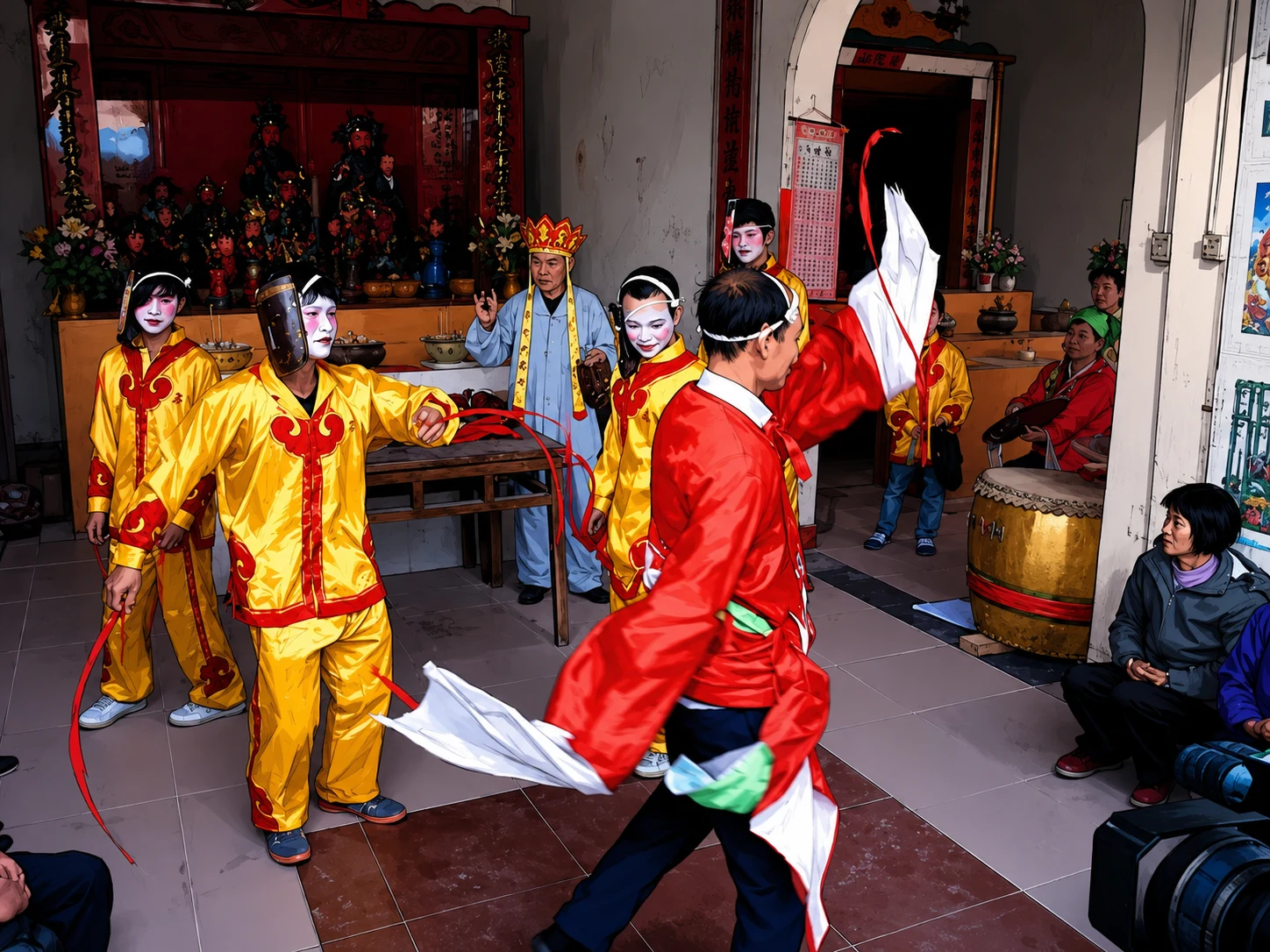
A Shijiao Nuo performance is built around the concept of *ren-gui-shen tongtai* —humans, ghosts, and gods sharing the same stage. This is not a metaphor. In a Nuo play, a living farmer wearing a general's mask may negotiate with a ghost wearing a demon's face while a god in white robes presides over the argument. The dispute could be anything: a family grievance, an unpaid debt, a plague that needs explaining, a harvest that failed for no reason anyone can see.
There are two formats. The civil altar, *wen tan*, is slow and solemn —chanting, bowing, the offering of incense, the recitation of names. It calls the spirits down. The martial altar, *wu tan*, is violent and loud —stomping, leaping, the flash of wooden swords, the crack of the drum. It drives the spirits away. Most performances combine both, moving through the evening like a tide: summon, confront, resolve, dismiss.
The plays have titles that read like instructions: *Preserving Fortune*. *Resolving Grievances*. *Celebrating the Lantern Festival*. They are not entertainment. They are transactions. A village hires a Nuo troupe the way another village might hire a doctor —because something is wrong, and speech alone cannot fix it. You need to talk to the source. And to talk to the source, you need a face the source will recognize.
The Farmer Who Becomes a God After Dark
The man who lifts the mask in Shijiao is not a professional actor. He is a rice farmer, or a carpenter, or a man who drives a three-wheeled cart to the morning market. He has no agent. He has no contract. He performs for free, or for whatever the village can scrape together —a few red envelopes, a chicken, a bottle of rice liquor.
He learned the masks the way his teacher learned them and his teacher's teacher before him: by watching, by doing, by being corrected in the dark after a performance when the village had gone to sleep and only the troupe remained, sitting on upturned buckets, the old master pointing at a foot that was an inch out of place, a wrist that turned too early, a voice that cracked on the wrong syllable. There is no manual. There are no written scores. The entire Nuo tradition in Shijiao is stored in the bodies of about a dozen people, most of them over sixty.
One of them —call him the old man with the chest —has been doing this for forty-three years. He started at seventeen, when his uncle, who had no son, pulled him aside after a Spring Festival dinner and said, "You are steady on your feet. Come." For the first ten years, he was not allowed to wear a mask. He carried the drum. He lit the incense. He watched. The day his uncle finally handed him the mask of a ghost-general, his hands shook so badly he could barely tie the string.
He is sixty now. His own son works in a factory in Shenzhen and comes home once a year. His grandson knows the mask only from photographs. When the old man tries to teach the younger men in the village, they are polite. They listen. They do not come back.
The transmission rules of Nuo are strict —master to disciple, face to face, with years of apprenticeship before the mask is permitted. The rules were designed for a world where sons followed fathers into the fields and stayed there. In that world, the mask always had someone waiting to wear it. In this world, the old man looks at the chest in the corner of his house and wonders, without drama, whether he is the last.
The Drum the Village Knows by Heart
Before the mask moves, the drum speaks.
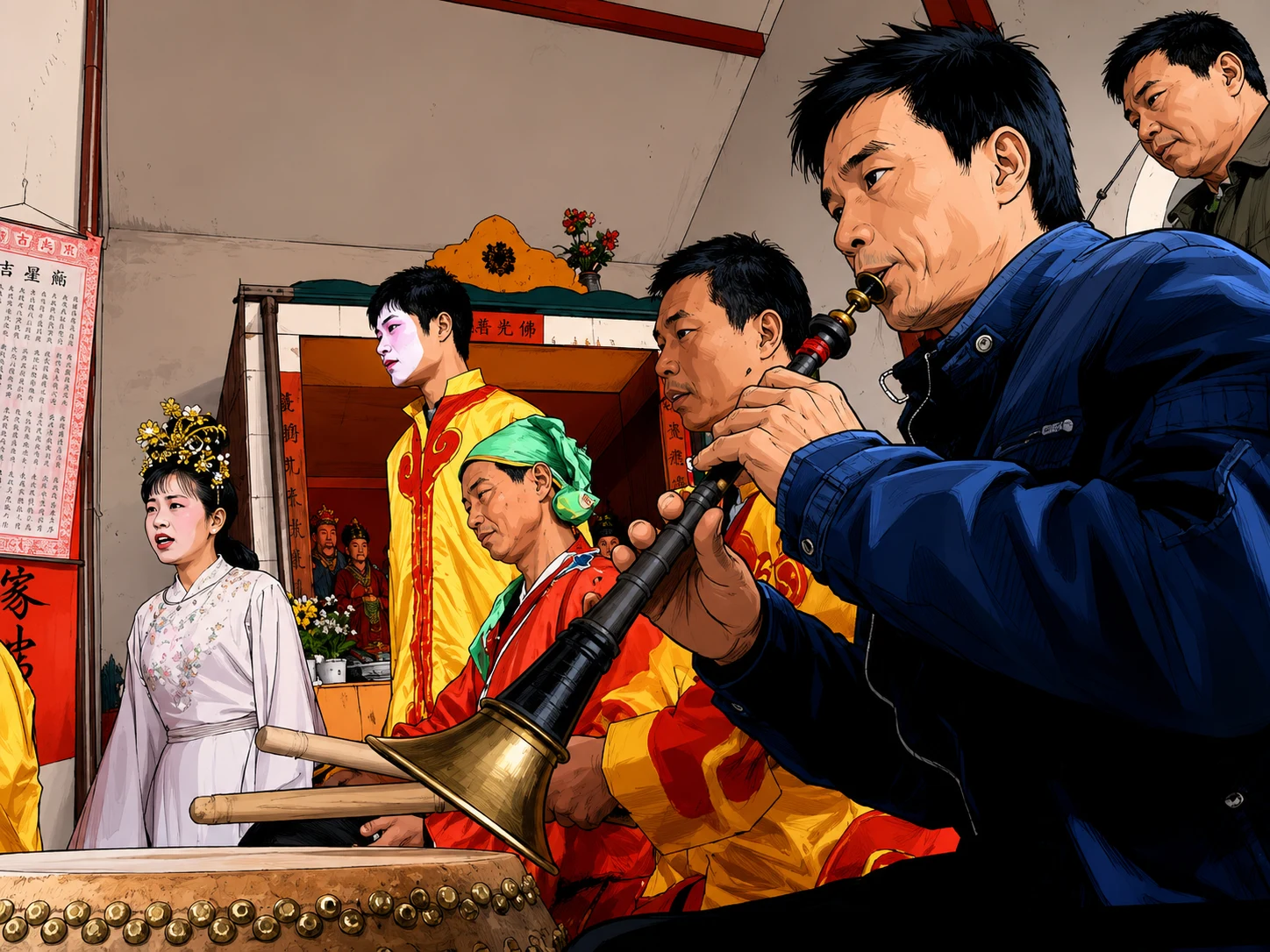
The instruments of Shijiao Nuo are not many: a large drum, a gong, a small gong, a pair of cymbals, a suona reed horn, and an ox horn so long and curved it looks like something pulled from the riverbed. The ox horn sounds first —a single, low, mournful note that travels across the rice paddies and into the village, telling everyone within earshot that the ritual has begun. The drum answers. Not fast. Not celebratory. The tempo is a heartbeat, or slightly slower: a pulse that pulls people toward the square without them realizing they are walking.
The melody is low and soft —minor-key, repetitive, hypnotic. It does not build to a climax. It circles. This is the music of a transaction, not a performance. The gods are being summoned, and gods do not respond to noise. They respond to patience.
The dance is older than the music. Head-shaking. Body-twisting. The squat-tremble —a deep knee bend held until the thighs burn, the whole body vibrating with the effort. Wrist-rotating. Stomping. Leaping from a standstill. The movements are not graceful. They are not meant to be. A Nuo performer dances the way a stalk of rice bends in a typhoon —not by choice, but because a force larger than himself is moving through him.
The singing comes last. Seven-character rhymed lines, spoken in a Hakka dialect so local that residents of the next county cannot follow it. The language is not a barrier. It is a wall. What happens on the Nuo stage in Shijiao is not for outsiders. It is for the village, and the village knows the words without needing to understand them. The drum tells them what they need to know.
What the Mask Remembers That We Are Forgetting
Nuo is the oldest continuous performance tradition in China. It predates Peking Opera by two and a half millennia. It predates the invention of the stage, the proscenium, the idea of an audience sitting in rows. When the *fangxiangshi* danced through the Shang palace in his bearskin, the people watching him were not an audience. They were participants. The plague was in the room with them. The dance was not a representation of an exorcism. It was an exorcism.
Most of China's Nuo traditions have been preserved in the mountains —in Guizhou, in Anhui, in Jiangxi —where distance and poverty kept them alive the way amber keeps insects. Shijiao is an outlier: a Nuo tradition that survived not in high mountains but on the coastal plain, at the border of Guangdong and Guangxi, in a Hakka-speaking pocket where the language itself is a kind of isolation. The Shijiao variant is the only complete Nuo tradition left in all of Guangdong. What makes it valuable to scholars —its isolation, its purity, its refusal to modernize —is exactly what is killing it.
The old man with the chest knows this. He does not expect the government to save his art. He does not expect his grandson to come home and learn the masks. He expects, with the clarity of someone who has spent forty-three years talking to gods he cannot see, that when he dies, the masks will die with him.
He is not angry. The gods, he says, do not need him. They were here before the Ming. They will be here after.
But for now, the chest is still in his house. The drum is still in the temple. And tonight —some night, when the village decides something is wrong and speech alone cannot fix it —he will open the lid. He will lift the mask. He will press it to his face, tie the strings, feel his spine straighten, and walk out into the square, not as a farmer, not as a grandfather, but as the thing painted on the wood.
The drum will sound. The ox horn will call across the paddies. Somewhere, in the dark beyond the lantern light, whatever has been troubling the village will hear its name spoken in a language older than words —and it will listen.
The lid of the chest will close again. But not tonight. Not yet.