# When a Typhoon Warning Reaches the Body
The suitcase leaves first.
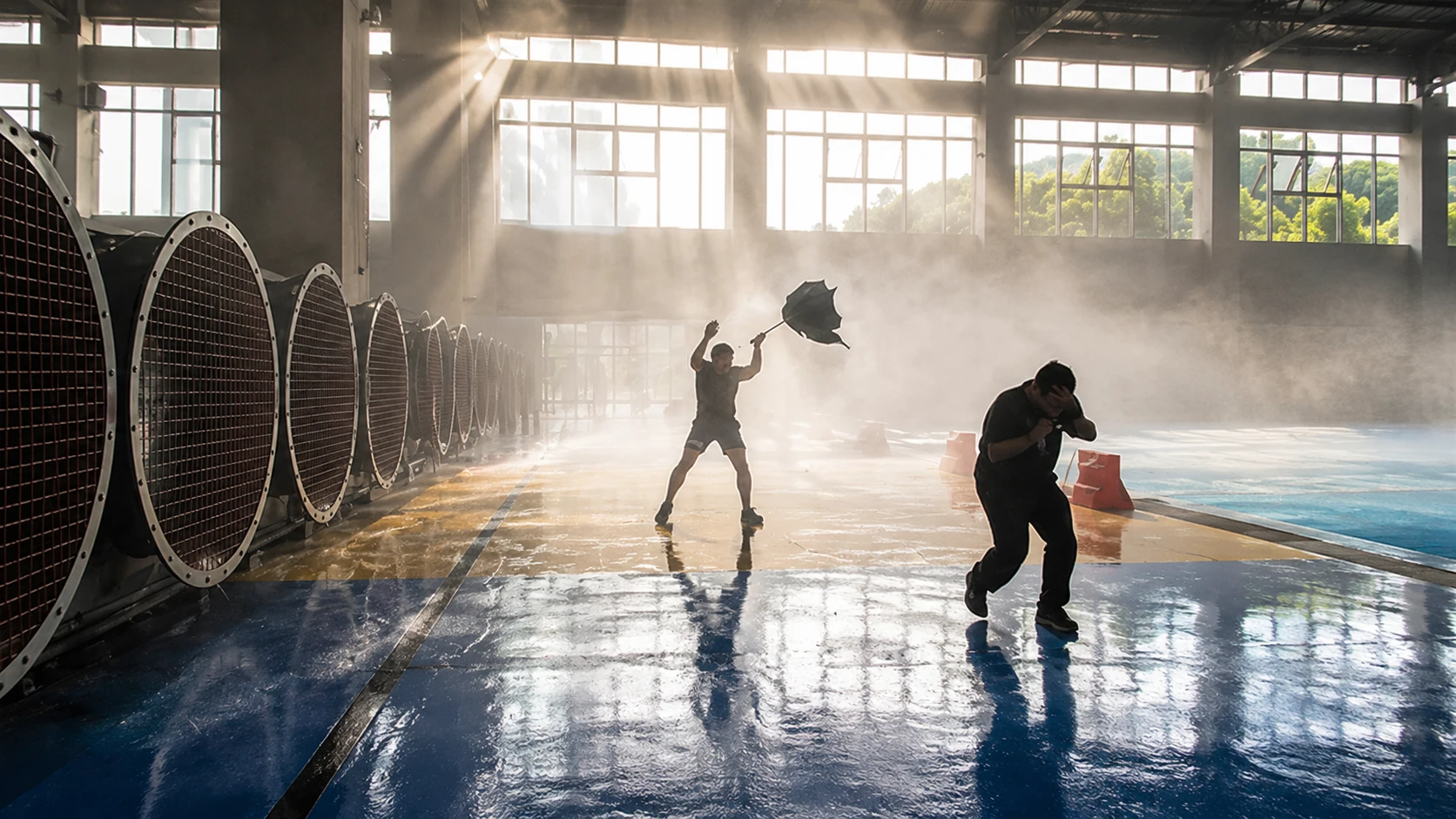
Inside a China typhoon simulator in Hangzhou, 34-year-old Huang Zhen leans into wind and rain. He is wearing a wetsuit and a helmet. A safety instructor is nearby. Even with that protection, the few steps ahead of him no longer resemble ordinary walking.
The wind rises toward 165 km/h. Rain crosses the room almost horizontally. The suitcase in Huang's hand slips away and tumbles across the floor.
Huang runs a cafe. In July 2026, he closed it for a day to join a training session at the Lvxing Disaster Simulation Training Center in eastern China. He had entered a controlled room, not a real storm. The fans could be stopped. The instructors could intervene. But for a few minutes, a number normally seen on a weather forecast began to pull against his arms and legs.
The Lvxing center is more than a wind tunnel. Its supervised disaster simulations also cover urban flooding, flash floods, submerged spaces, and evacuation practice. The typhoon room turns a warning into physical force; the other drills ask what happens after water enters a street, a building, or an underground passage. Together, they make Hangzhou's disaster simulator a training site rather than an amusement ride.
At 165 km/h, Ordinary Objects Change Sides
A suitcase is designed to follow a person. An umbrella is supposed to provide shelter. A stroller carries someone who cannot walk alone.
In the simulated typhoon, those relationships become unstable. The center places familiar objects in the training area because people do not meet dangerous weather empty-handed. They may be carrying luggage, holding an umbrella or trying to protect something that feels too important to leave behind.
At 165 km/h, or about 45.8 meters per second, the simulator reaches the range classified as Force 14 under China's extended wind scale. A Hangzhou newspaper reported that even a participant weighing about 95 kilograms could not remain standing at that level.
The spectacle can look like an endurance challenge: a person against a machine, trying to stay upright for as long as possible. Yet the objects reveal a different purpose. The useful question is not how long someone can keep walking. It is how quickly an ordinary plan - cross the street, protect the umbrella, hold onto the suitcase - stops making sense.
The room also has limits that matter. Participants wear protective equipment and work with instructors. A real typhoon may bring broken glass, falling branches, damaged buildings, power cuts and flying debris that no simulator can safely reproduce. Wang Kuanghan, the center's chief instructor, told Reuters that the most important response in a real typhoon is simpler than anything demonstrated in the room: stay indoors.
The gap between controlled practice and an unpredictable environment is not unique to disaster training. It is also why China's AI robots must learn in real rooms rather than only inside carefully arranged demonstrations.
A Warning Number Enters the Body
A forecast can name the wind speed. An alert can tell schools to close, workers to stay home or residents to evacuate. These systems are built to give people time before danger arrives.
But a number does not automatically explain how the body will behave inside it.
It does not show how hard rain makes a person narrow their field of vision, or how grabbing an object can pull their weight in the wrong direction. It does not recreate the moment when a familiar route becomes difficult to read. Written guidance can say that moving water is dangerous; the body still knows walking mainly from solid ground.
The Hangzhou simulator does not turn a controlled exercise into a real disaster. It makes the warning harder to dismiss.
That distinction keeps the training from becoming a substitute for forecasts, evacuation plans or official instructions. It is an addition to them. Inside the center, participants can discover that a habitual movement fails while an instructor is close enough to stop the exercise. The mistake remains small.
Huang said the experience gave him a clearer idea of what different levels of disaster might feel like. His words were cautious. He did not claim that one day of training had made him ready for every storm. He spoke instead about paying closer attention to forecasts and raising awareness.
Then the Water Begins to Move
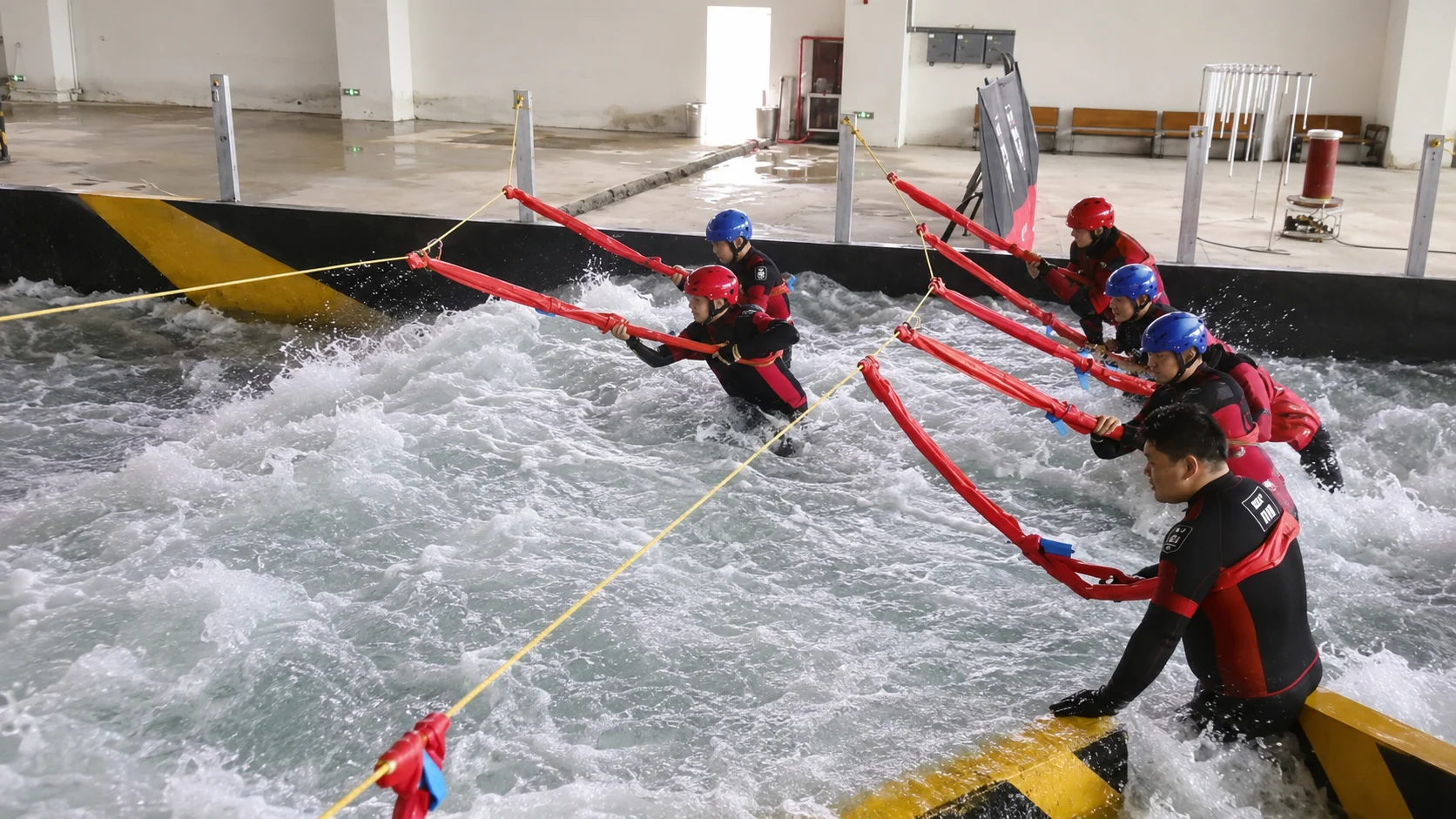
The wind room is only one part of the center. Elsewhere, the ground disappears beneath moving water.
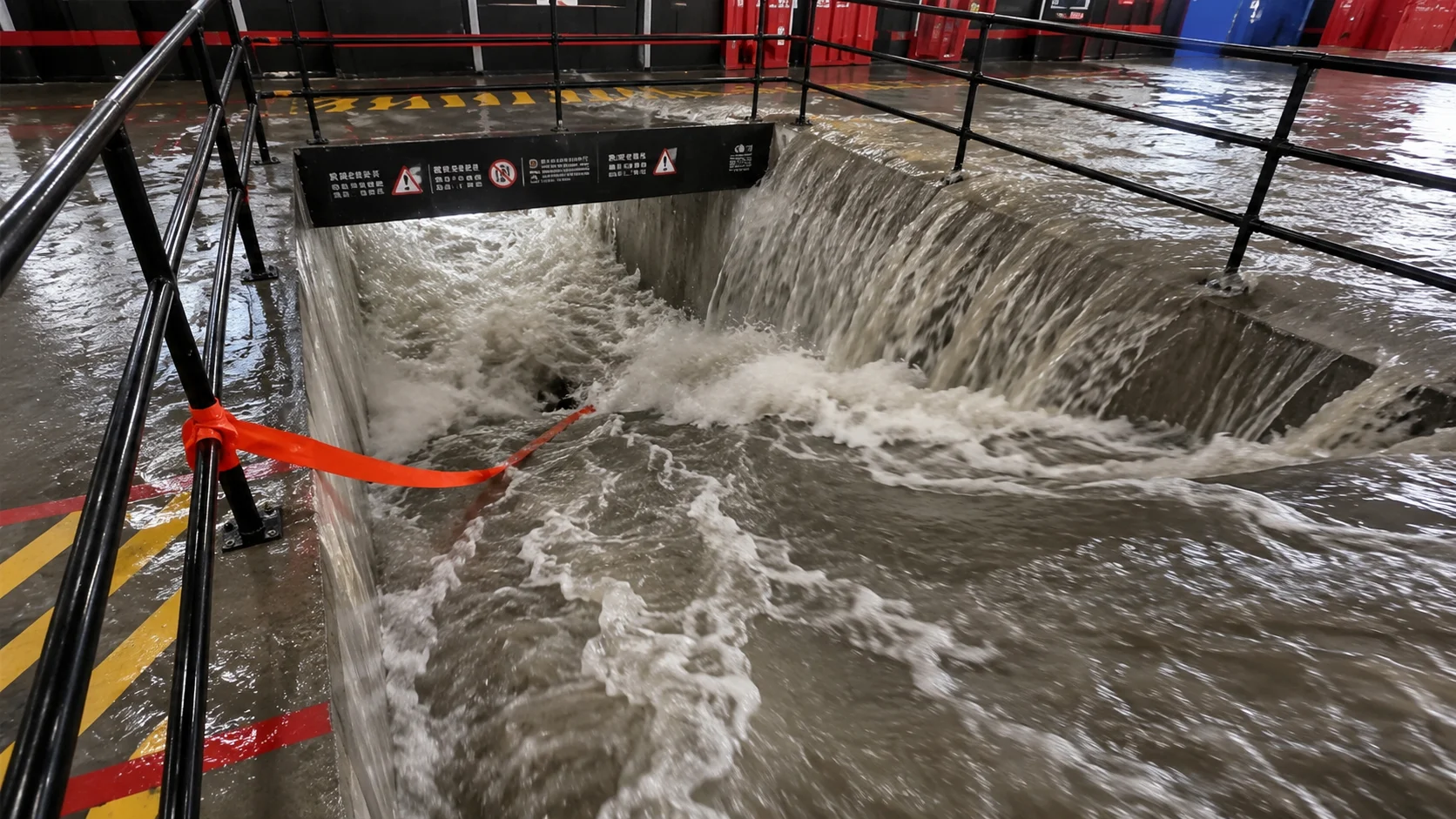
In a flash-flood simulation, the facility releases about 900 metric tons of water. Reuters footage shows a brown surge entering the course with enough force to knock a participant down and carry them along it. The number is large, but the more revealing detail is the change in pace. On dry ground, a few meters may require no thought. In moving water, each step becomes a negotiation with direction, balance and force.
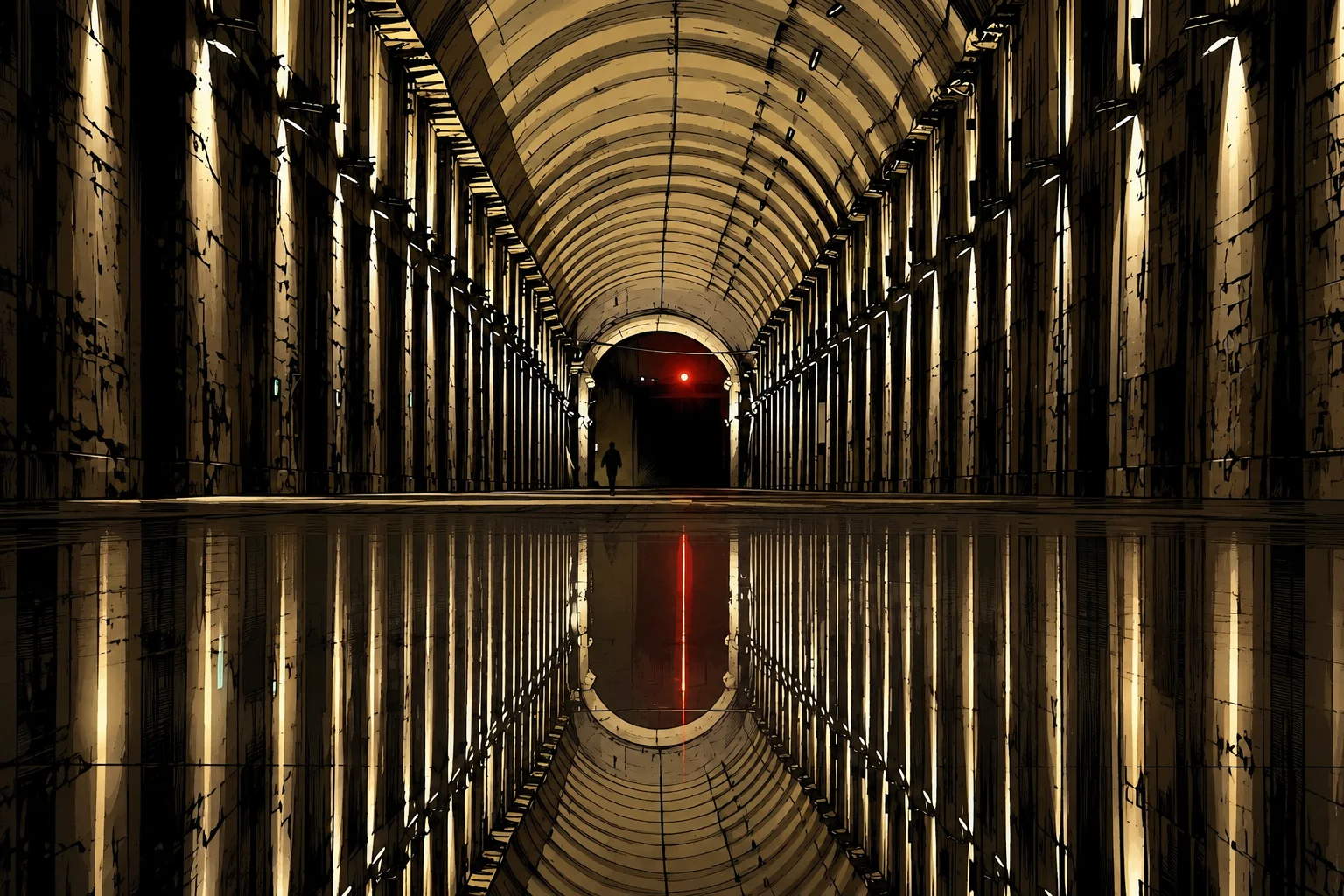
Another area resembles an urban underground space. Participants move through about 400 tons of water, at times thigh-deep and at times reaching their shoulders. They use a rope on a vehicle ramp and climb stairs while water pushes through the scene. Pressure sends water bursting upward from a manhole.
These are recognizable pieces of a city: a slope, a staircase, a passage below street level. None is frightening on an ordinary day. Once water enters, their meaning changes. A staircase becomes a route upward. A low passage becomes a place that may continue filling. A level surface no longer guarantees a steady step.
The center does not need to reproduce every condition of an actual flood to expose that change. Its controlled water is enough to make a dry-land assumption fail.
The Instructors Make Room for Small Mistakes
The participants are never alone with the machinery.
Instructors establish the safety boundary, watch how each person responds and intervene while an error can still be corrected. A participant can stop, listen and try a movement again. The wind can fall. The water course can end. Real disasters rarely allow the same pause.
The Lvxing center opened in May 2025. By July 2026, it said more than 160,000 people had taken part, including school students, rescue team members and other adults. A full day costs 1,599 yuan, about US$235 at the exchange rate Reuters used in its report.
That price introduces a question the dramatic footage does not answer. If supervised simulation becomes a serious form of disaster education, who gets access to it? Some participants may arrive through schools, rescue organizations or employers. Others must pay for the day themselves. The center has announced plans for five more locations within three years, with simulations of other disasters, but expansion alone does not establish how widely this kind of training can be made available.
For now, its clearest value lies in the controlled mistake. Someone holds the wrong object, chooses the wrong direction or waits too long. An instructor can point to the moment before the consequences become real.
Why Two Adventurers Brought Disaster Indoors
The center was founded by Zhang Xinyu and Liang Hong, a Chinese couple known for expeditions to places most people try to avoid. Since 2012, their journeys have taken them into extreme cold, near an active volcano and aboard an icebreaker bound for Antarctica.
According to Wang, who is also Zhang's nephew, years of preparation shaped the project more than the appetite for danger did. He told a Hangzhou newspaper that the couple's thinking had moved away from "challenging nature" toward respecting it. The idea for the training center emerged in 2018. Construction began in 2023, and equipment started arriving the following year.
That account comes from the people behind the center, not from an independent study of their motives. Still, the physical design reflects the change they describe. Their earlier journeys carried two adventurers toward extreme environments. In Hangzhou, they brought controlled fragments of those environments closer to ordinary people.
The difference is the ability to stop.
A real flood does not wait for a person to understand the current. A typhoon does not lower its wind because someone chose the wrong object to save. Inside the center, the instructor can pause the danger, explain the mistake and begin again.
Before Anyone Opens the Door
Huang's suitcase can be retrieved after the fans slow. Wet clothes can be changed. The cafe can reopen.
Nothing in the room proves that a participant can withstand a real typhoon, and that is not the point. The more useful knowledge arrives earlier, before anyone steps into the wind believing that an umbrella, a suitcase or a few familiar meters will behave as they always have.
Outside the simulator, the wind cannot be switched off. The lesson may begin before the door is opened.