Before Guangzhou wakes, before the first commuters trickle onto Line 1, there is already a sound cutting through the dark. It is not a bell or a horn. It is the steady, rhythmic thud of a heavy cleaver meeting a wooden chopping block. Thunk. Thunk. Thunk. The blade has been landing on the same cross-section of tree trunk for thirty years. The wood is worn concave, polished by fat and time.
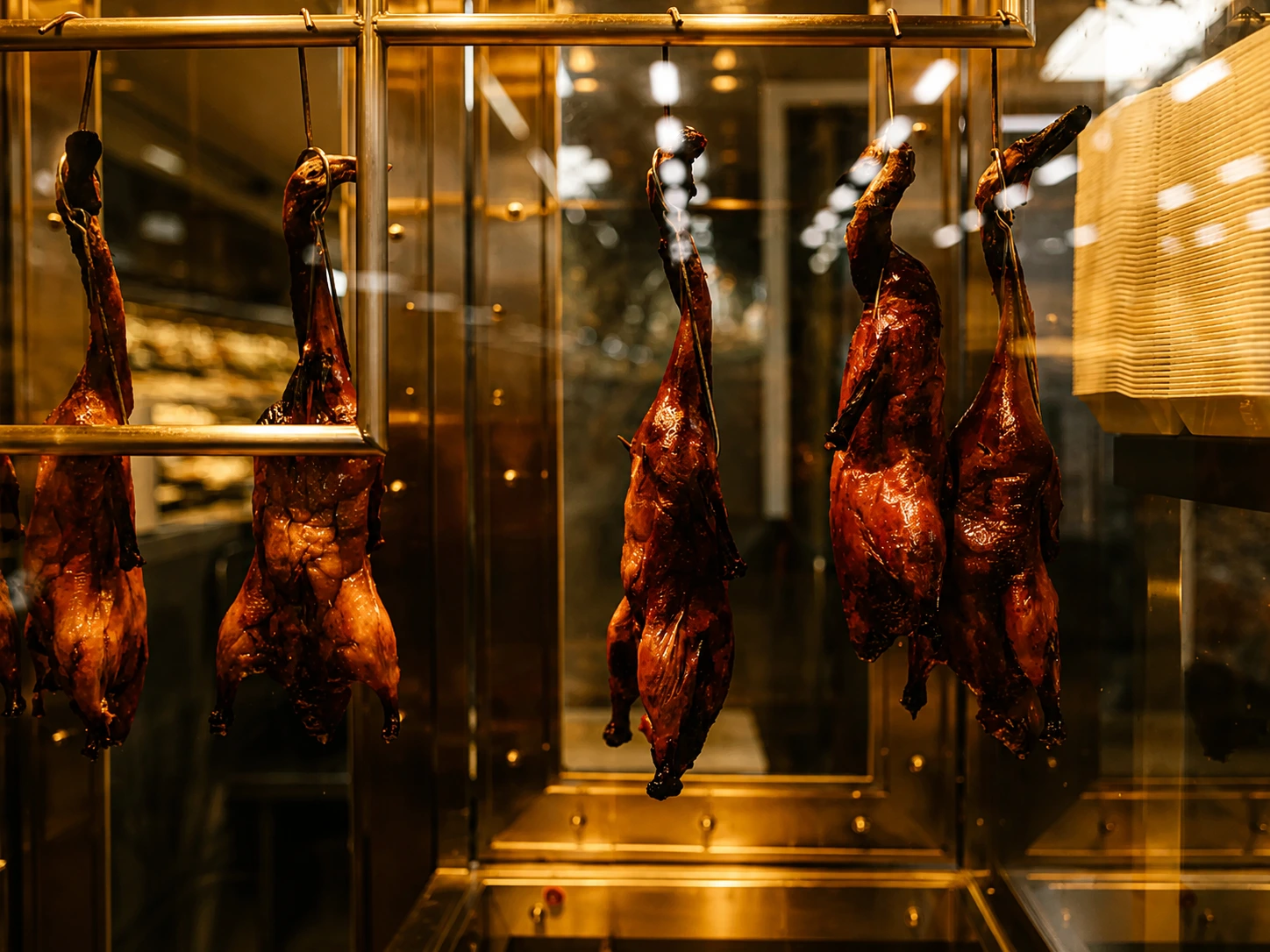
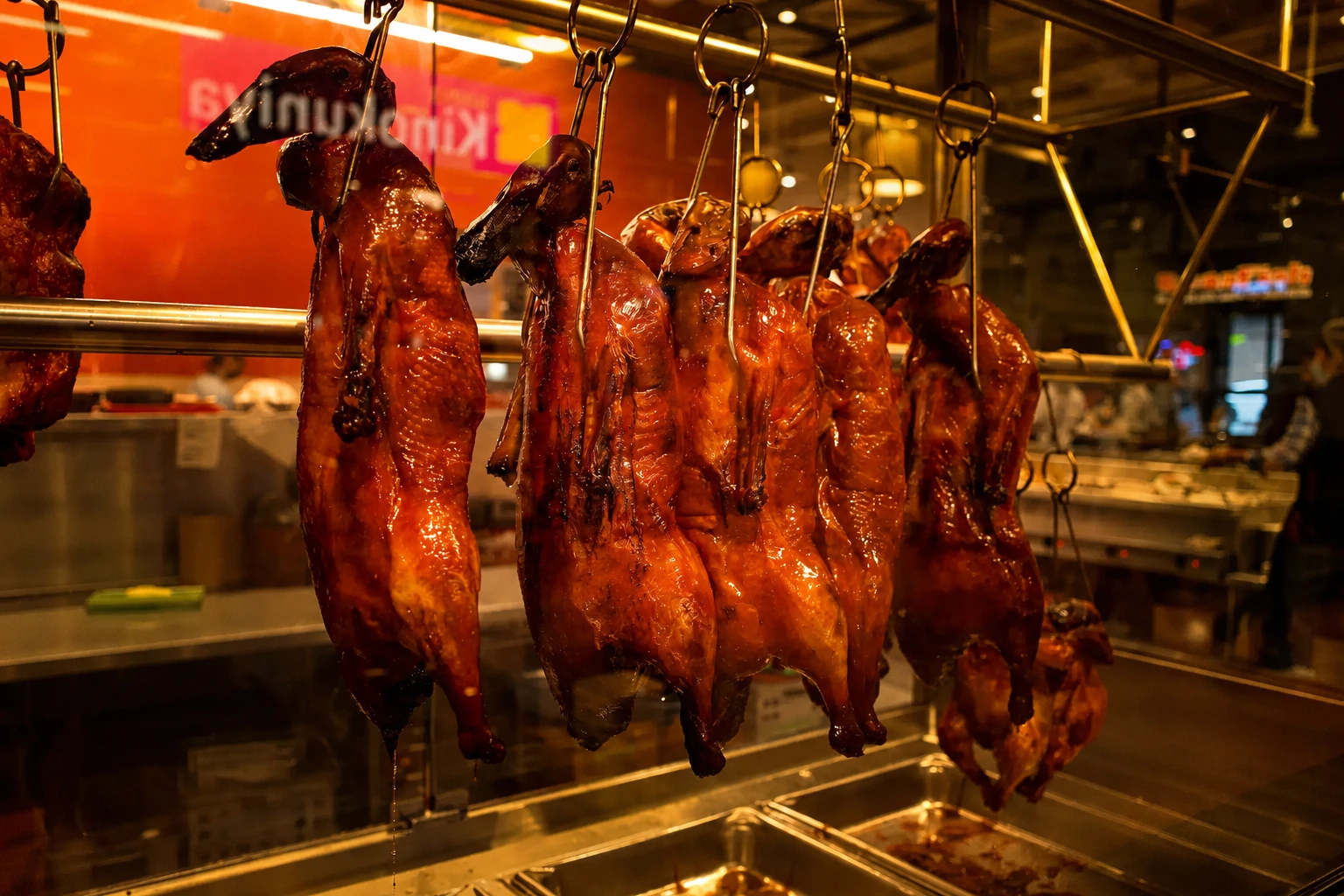
The shop is no wider than three men standing shoulder to shoulder. Fluorescent light spills onto the pavement. Behind the glass, row after row of meat hangs from steel hooks: ducks the color of polished mahogany, strips of pork glazed to a deep ruby, slabs of crispy-skinned belly with crackling that catches the light like shattered amber. This is a siu mei shop, a Cantonese roast meat shop, and at five in the morning, it is already halfway through its day.
The Fire Starts Before the Sun
The roast master arrived at three. He is a man of few words and fewer wasted movements. His hands move across the kitchen with the economy of someone who has performed the same sequence ten thousand times. First, the ovens. The temperature must climb past two hundred degrees Celsius before the first batch goes in. While the steel warms, he works the marinade.
Char siu, the barbecued pork that outsiders call "Chinese BBQ," begins long before the fire. The marinade is the speech of the dish, and every shop speaks a slightly different dialect. There is fermented red bean curd, which gives the meat its signature crimson blush. There is maltose, a thick barley sugar that will caramelize into a lacquer. There is soy sauce, five-spice powder, Shaoxing wine, and crushed garlic. The pork shoulder, cut into long strips and scored along the grain, soaks in this mixture overnight. By morning, the meat has drunk deep. It is the color of damp brick.
The master threads each strip onto a metal fork —the cha, or fork, that gives char siu its name: "fork-roasted." The forks slot into the oven like oars into a boat. Below, a shallow pan catches the fat as it renders. The first drops hit hot metal and the kitchen fills with a smell that is part caramel, part smoke, part something older than either.
The Glaze Is a Clock
Every fifteen minutes, the master opens the oven door. He pulls the rack forward with a hooked rod, and with a brush the size of a calligraphy tool —long-handled, flat-bristled —he paints the remaining marinade onto the meat. The liquid sizzles on contact. Each layer builds on the last. What emerges after forty minutes is not simply cooked pork. It is meat wearing a shell of candied umami. The edges are nearly burnt, blackened in places where the sugar caught extra heat. The master calls these edges wok nung, the Cantonese term for "slightly scorched." A customer will point to them. "Give me that one," she will say, "the one with more char."
The roast duck follows a different clock. It was prepared the night before: cleaned, blanched, its skin pricked all over with a needle so the fat can escape during roasting. Then it was inflated —air blown between the skin and the flesh —so the skin would separate and crisp. A coating of vinegar and maltose was brushed on, then the duck hung to dry. By morning, the skin felt like paper pulled tight across a drum.
Now it hangs in the oven by a hook through the neck. Over the next hour, the fat beneath the skin will render slowly, basting the meat from within, while the outside crisps to a shade somewhere between autumn leaf and burnt orange. When the master pulls it out, he holds it for a moment at the door of the oven so the fluorescent light can catch the skin. Satisfied, he hangs it in the window. The duck swings slightly. It glistens.
The Most Important Tool Is Not the Oven
For all the fire and glaze and marinade, the soul of a siu mei shop lives not in the kitchen but at the front counter, where the chopping block sits. It is a section of tree trunk, maybe half a meter across, cross-cut so the rings are visible. It has been there since the shop opened. In the center, where millions of cleaver strokes have landed, the wood has worn into a shallow bowl.
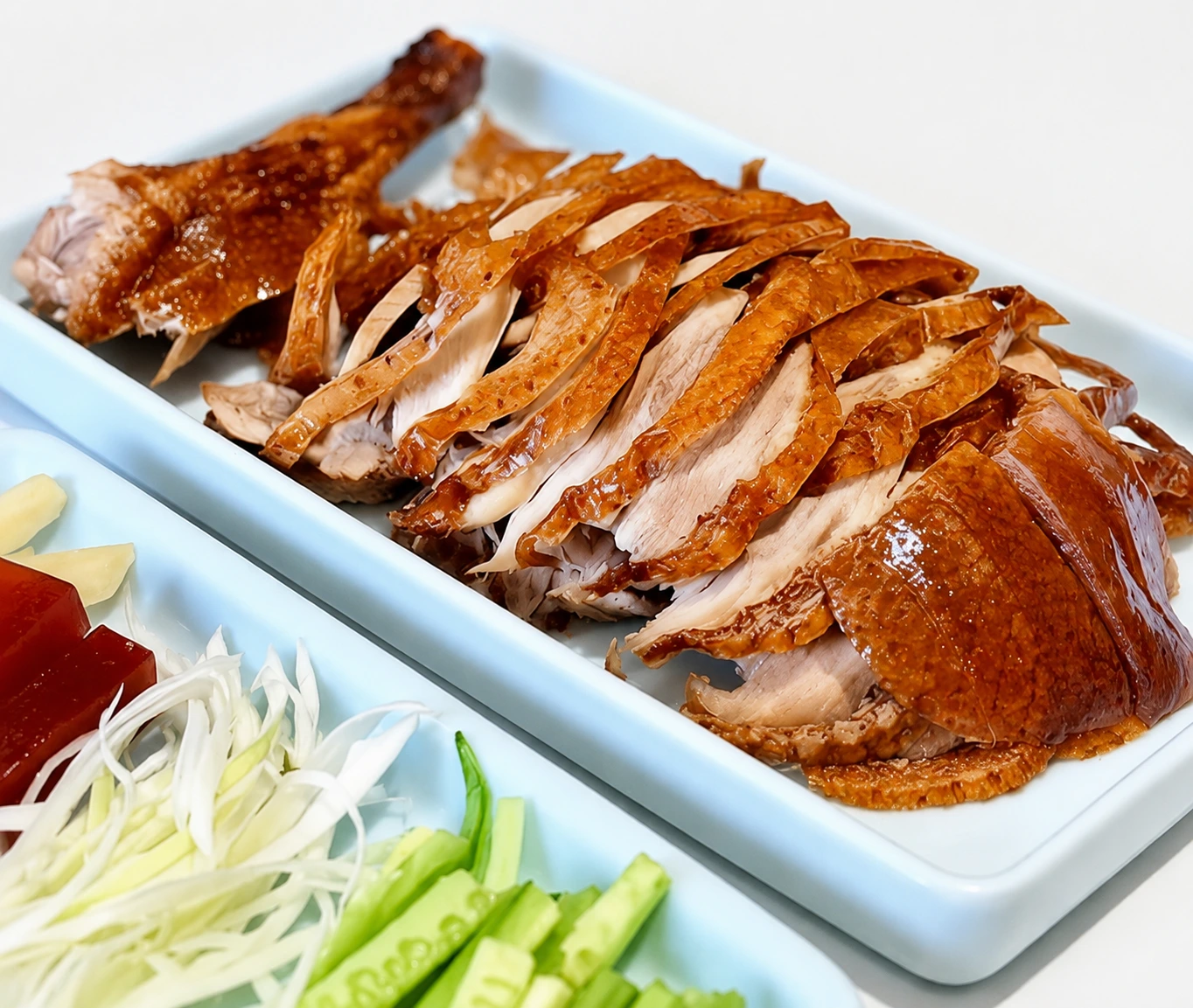
The person at the counter —sometimes the master, sometimes a family member who has been doing this since childhood —works the cleaver with a wrist motion so fluid it looks like a magic trick. A customer asks for half a duck, sliced. The duck is lifted from its hook, laid on the block. The cleaver rises and falls, rises and falls, each stroke a clean separation of flesh and bone. The blade never pauses. It knows exactly where the joints are, exactly how thick each slice should be. What lands on the plate is not hacked meat. It is an arrangement: a fan of breast slices, the drumstick whole beside them, the wing tucked at the edge.
Char siu is sliced differently. The strip is placed on the block and the cleaver moves across it at a slight angle, producing slices that are longer than they are wide, each showing the deep red outer edge and the paler pink interior. The sound is softer now —more shush than thunk —as the blade passes through the tender meat. A spoonful of the roasting juices, thickened with maltose and soy, is drizzled across the top. It pools in the spaces between the slices.
A Plate of Rice, a Bowl of Soup
In Guangzhou, the most common order is siu mei fan: roasted meat over rice. A scoop of steamed white rice, a handful of chopped lettuce or blanched choy sum on the side, and your choice of meat laid across the top. Char siu with a stripe of roast duck. Or crispy pork belly with a soy-sauce chicken leg. Or all three, if you cannot decide —a combo that locals call "three treasures rice."
The shop window displays what fire, glaze, and time can add. Zhanjiang white-cut chicken makes the opposite Cantonese argument: when the bird is good enough, water, controlled heat, and a clean cut should be sufficient.
The rice is important. It must be the right texture: individual grains that hold their shape but yield to the tooth, moist enough to carry the roasting juices but never sticky. A good siu mei shop makes rice as carefully as it makes char siu. Alongside the plate comes a small bowl of clear soup —usually the water from blanching vegetables, with a few pieces of winter melon floating in it and perhaps a single pork bone for depth. It costs nothing. It is always refilled without asking.
An old man sits at the tiny table wedged between the counter and the wall. He is here every morning. He orders the same thing: char siu and roast duck over rice, extra sauce, and a bowl of that thin soup. The cleaver works. The plate arrives. He eats slowly, looking out the open door at the street coming to life. When he finishes, he pays with coins counted out from a leather coin purse, nods to the master, and leaves. The master nods back. They have exchanged maybe ten words total in twenty years.
When the Window Empties
By one in the afternoon, the hooks in the window are mostly bare. A few strips of char siu remain, a single duck, some pork belly. The master will keep the shop open until the last piece sells —that is the rule. Nothing carries over to tomorrow. A siu mei shop's reputation rests on freshness, and freshness means an empty window by evening.
The afternoon light comes in low through the glass, catching the last glints of glaze on the remaining meat. The cleaver rests on the block. The oven door is closed. Tomorrow it will all begin again at three in the morning, when the fire starts before the sun and the first thunk of the cleaver splits the dark.
Until then, the street outside fills with the ordinary noise of the city: buses, bicycles, voices, music from a shop selling mobile phones. Inside, the master wipes down the block one last time. The wood gleams. It smells faintly of pork fat and decades. An old woman walks past the window, glances at what remains, and keeps walking. She will be back tomorrow. She always is.