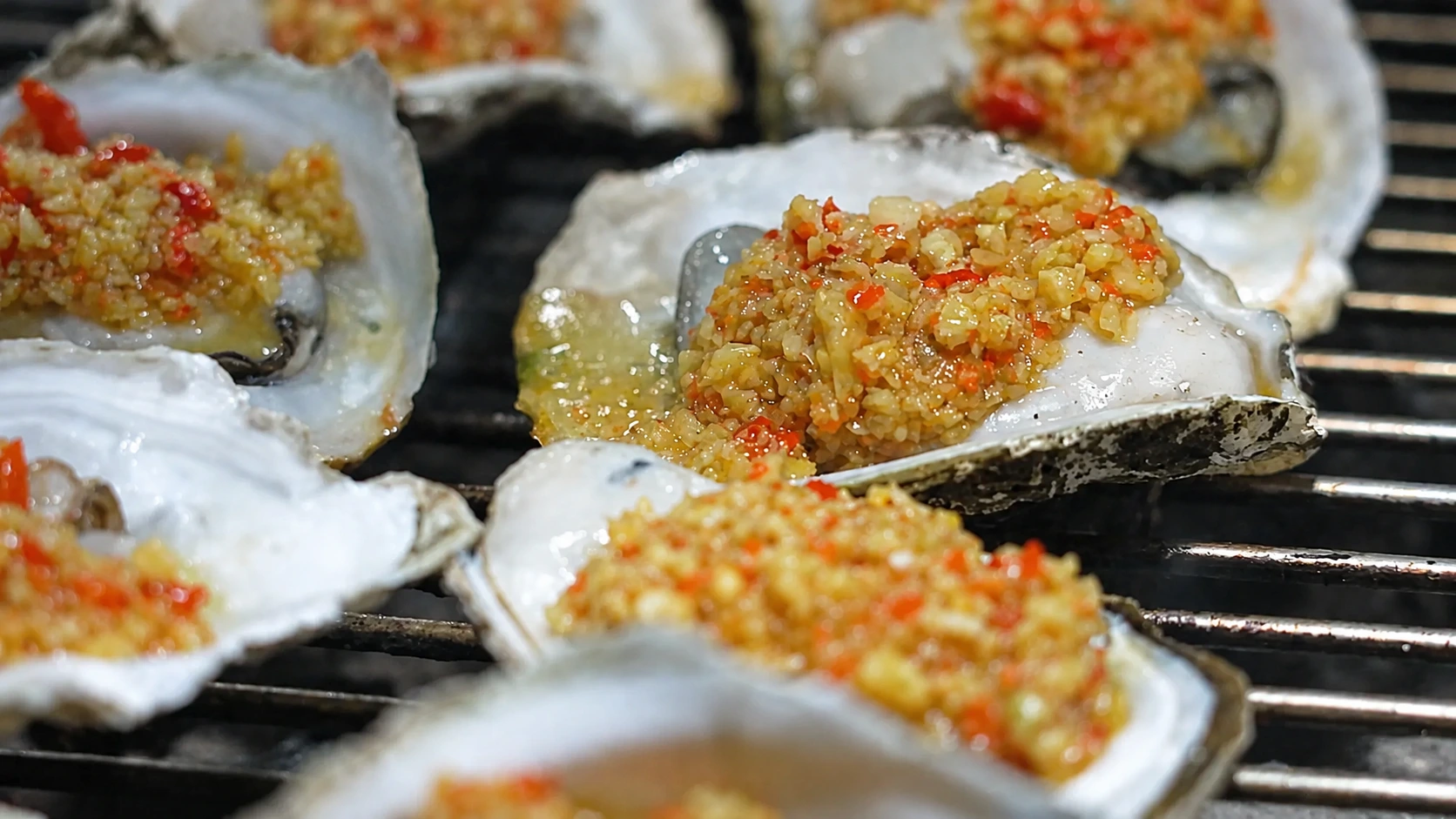
The smell comes first —charcoal smoke cut with garlic and brine. Then the sound: a wet sizzle as minced garlic hits hot oyster liquor, followed by the sharper crack of oil splashing against shell. Then the sight: rows of oyster shells lined up on a wire rack over glowing charcoal, each one a small cauldron, the gray-blue juice inside bubbling up to the rim, threatening to spill.
This is Zhanjiang after dark. A city of eight million people on the Leizhou Peninsula, facing the South China Sea on three sides. It holds an official title: China's Capital of Seafood. And the oyster that carries that title on its back comes from one place —a small bay in Potou District called Guandu.

The Oyster That Built a City's Name
If you order charcoal-grilled oysters anywhere in China —a street stall in Guangzhou, a beer garden in Chengdu, a rooftop in Shanghai —the menu will almost certainly say Zhanjiang before the dish.
This is not always true. Plenty of oysters sold as "Zhanjiang oysters" were raised in Fujian or Guangxi, trucked across the province line, and rebranded at the wholesale market. Nobody checks. The name itself is worth money, because Zhanjiang means one thing to Chinese diners: the best oysters in the country.
Within Zhanjiang, the hierarchy has another layer. The oysters everyone agrees are the finest come from Guandu —a bay, a town, a name that functions like an appellation in wine. Say "Guandu oysters" to a Zhanjiang local and you might receive a small nod. Say "oysters from somewhere else" and you might receive a patient smile.
At the top of the Zhanjiang seafood food chain, above the grouper, above the mantis shrimp, above the abalone, sits the Guandu oyster. Charcoal-grilled, shell gaping, garlic and vermicelli piled on top like a crown.
Four Ways to Eat the Sea
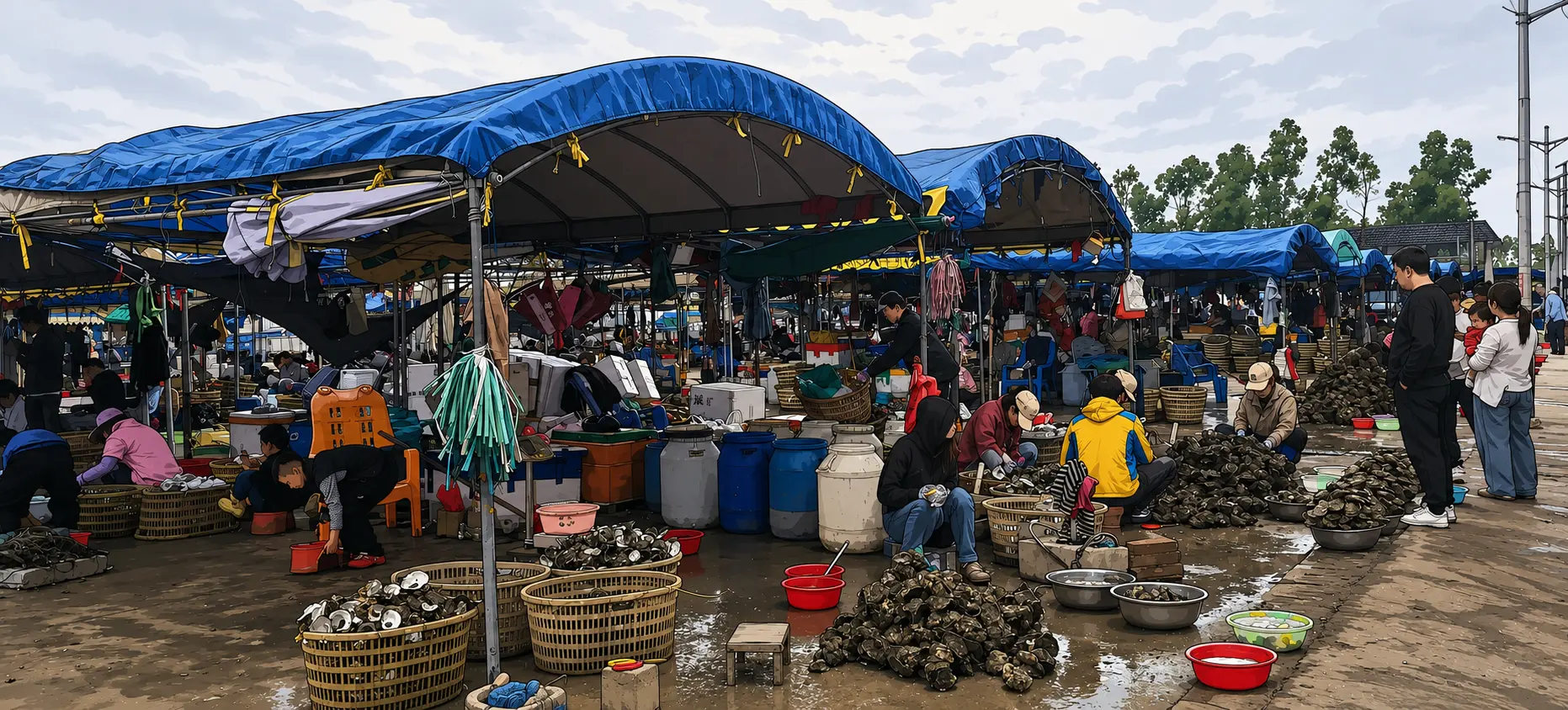
The purist's method requires nothing but a knife and a lime. An oyster pulled straight from the water, pried open on the bow of a boat, the meat still shivering from the shock of air. Squeeze the lime. Tip the shell. The oyster slides into the mouth in one motion —not chewed, exactly, but pressed once between the teeth to release the liquor. The brine hits first, sharp and cold, then the flesh gives way with a slight spring, then the aftertaste settles in: a mineral sweetness that tastes like the bay it came from. A Zhanjiang fisherman will tell you the flavor begins to fade ten minutes after the shell is opened. He is not exaggerating.
The charcoal grill is where Guandu oysters become famous. The shells are placed directly over glowing coals, flat side down, cupped side up, like a row of shallow bowls. The heat pushes the oyster liquor to a boil —the gray-blue liquid turns pale, then frothy, then reduces by half into a concentrated pool of seawater essence. That is the moment to act. A spoonful of minced garlic, a nest of mung bean vermicelli, a drizzle of hot oil that hits the garlic and explodes into fragrance. The oyster finishes cooking in its own reduced liquor, the vermicelli absorbing what the shell cannot hold. You eat it with chopsticks —lifting the whole tangle of noodle, garlic, and oyster together, blowing once because the shell is still hot enough to burn your lip.
The steamer offers a gentler path, the garlic and vermicelli laid on top, the lid closed. Steam mingles with the oyster's own juice. The margin between perfect and ruined is measured in heartbeats —three seconds too long and the flesh turns from springy to rubber. A good steam chef does not use a timer. He watches the shell. When the oyster meat trembles once through the garlic, it is done.
Raw, grilled, steamed: three ways to eat the same oyster, three different oysters on the tongue. If you ask a Zhanjiang local which one is the real one, the answer is always the charcoal.
The Bay That Feeds the Oyster
Guandu oysters are not made. They are grown. And the bay does most of the work.
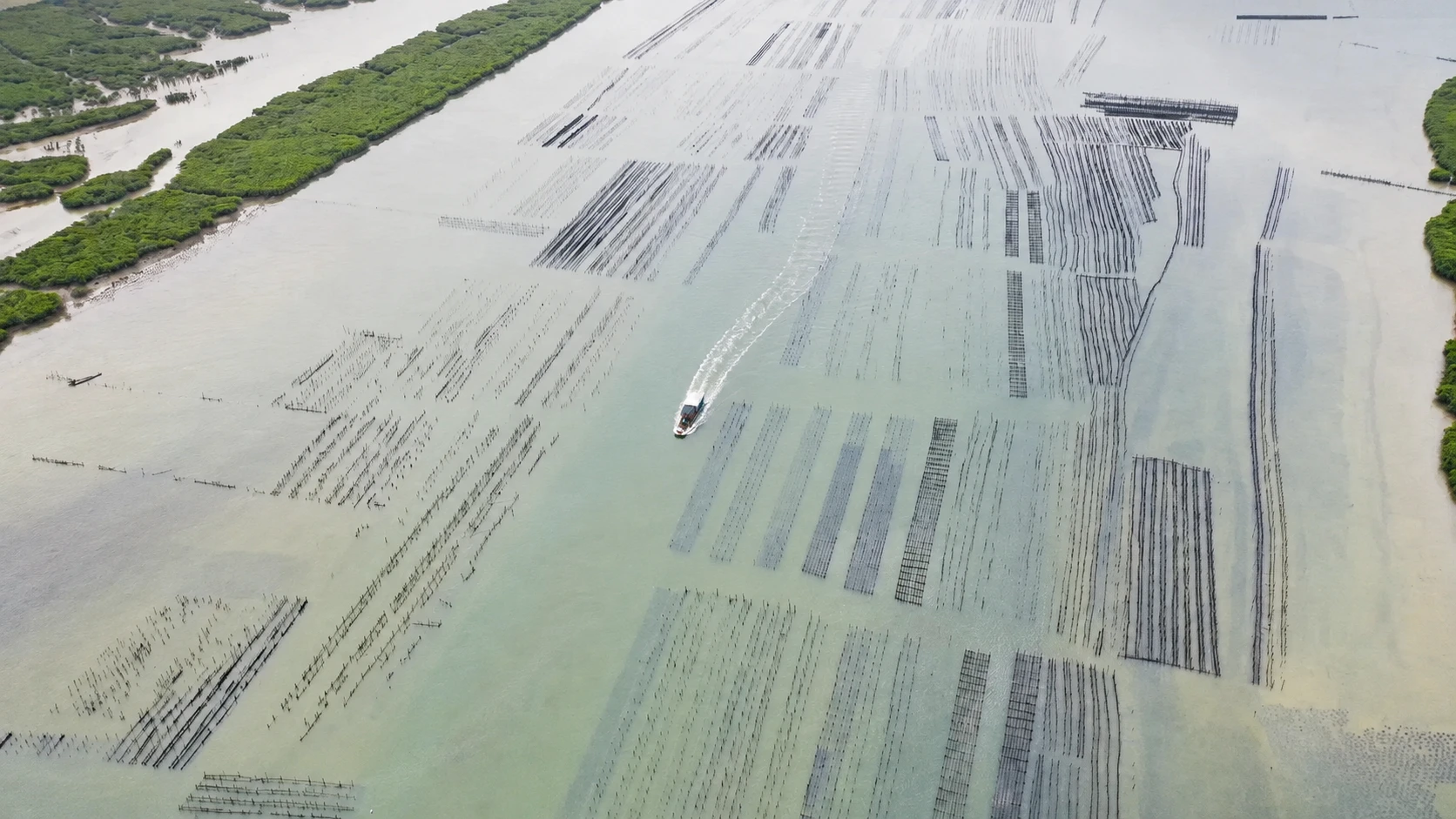
Guandu sits where the Shimen River empties into the South China Sea, a meeting point of freshwater and salt that creates a salinity of roughly fifteen to twenty-five parts per thousand —about half the saltiness of the open ocean. Pure seawater makes an oyster salty and lean. Pure freshwater kills it. The brackish middle ground makes an oyster sweet.
The river brings silt rich in minerals from the Leizhou Peninsula's volcanic soil. Mangrove forests fringe the bay, filtering that silt into a fine, nutrient-dense suspension where billions of microalgae —phytoplankton —drift. An adult Guandu oyster filters up to fifty liters of water a day, extracting everything it needs. It tastes like the water because it is made of the water.
The water rarely drops below fifteen degrees Celsius even in winter. An oyster in a cold Atlantic bay might take four years to reach market size. A Guandu oyster reaches the same size in under two. The warmth accelerates growth, but the bay's plankton supply is rich enough to keep pace —a fast-growing oyster in Guandu is not a thin-tasting oyster.
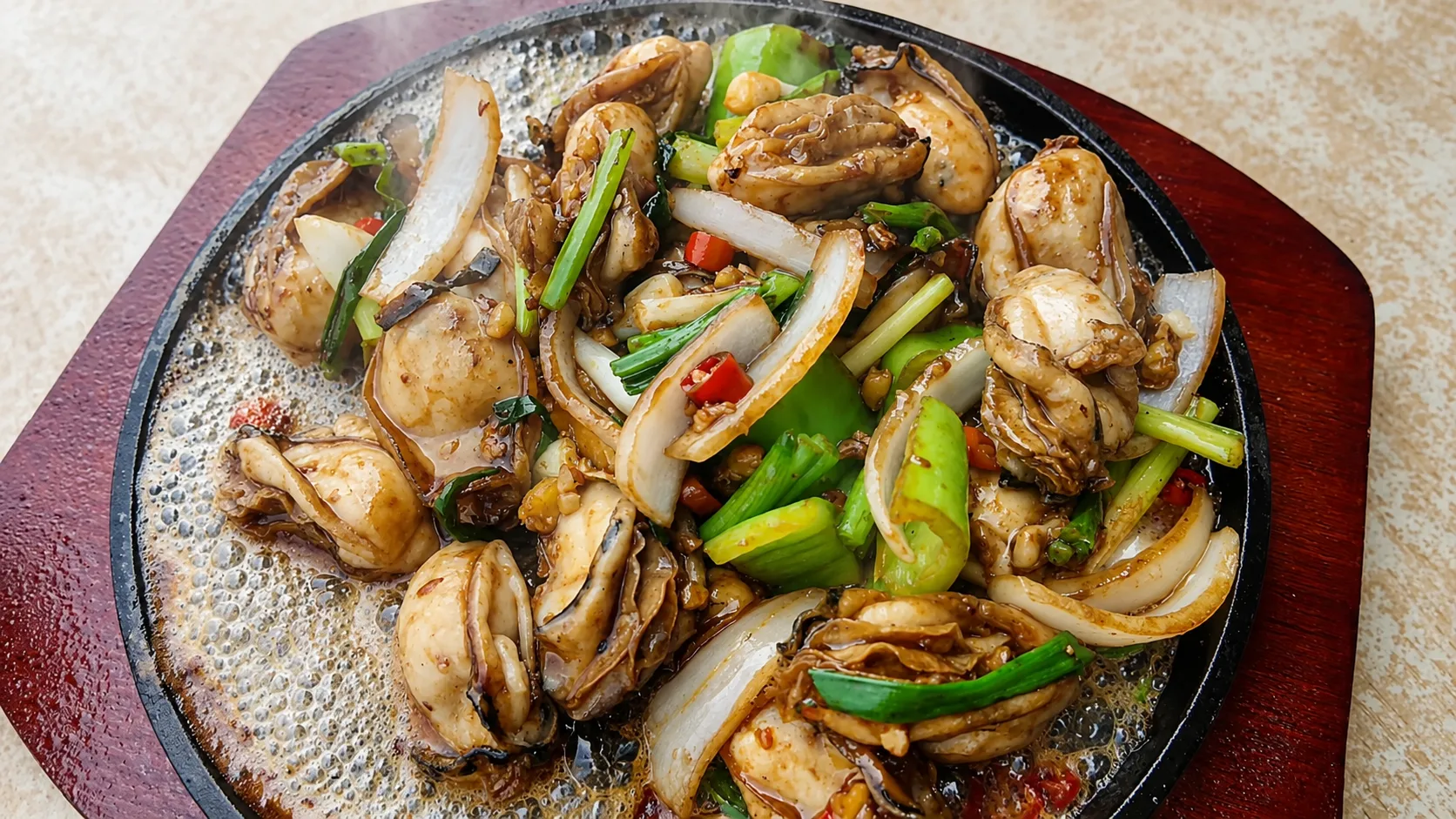
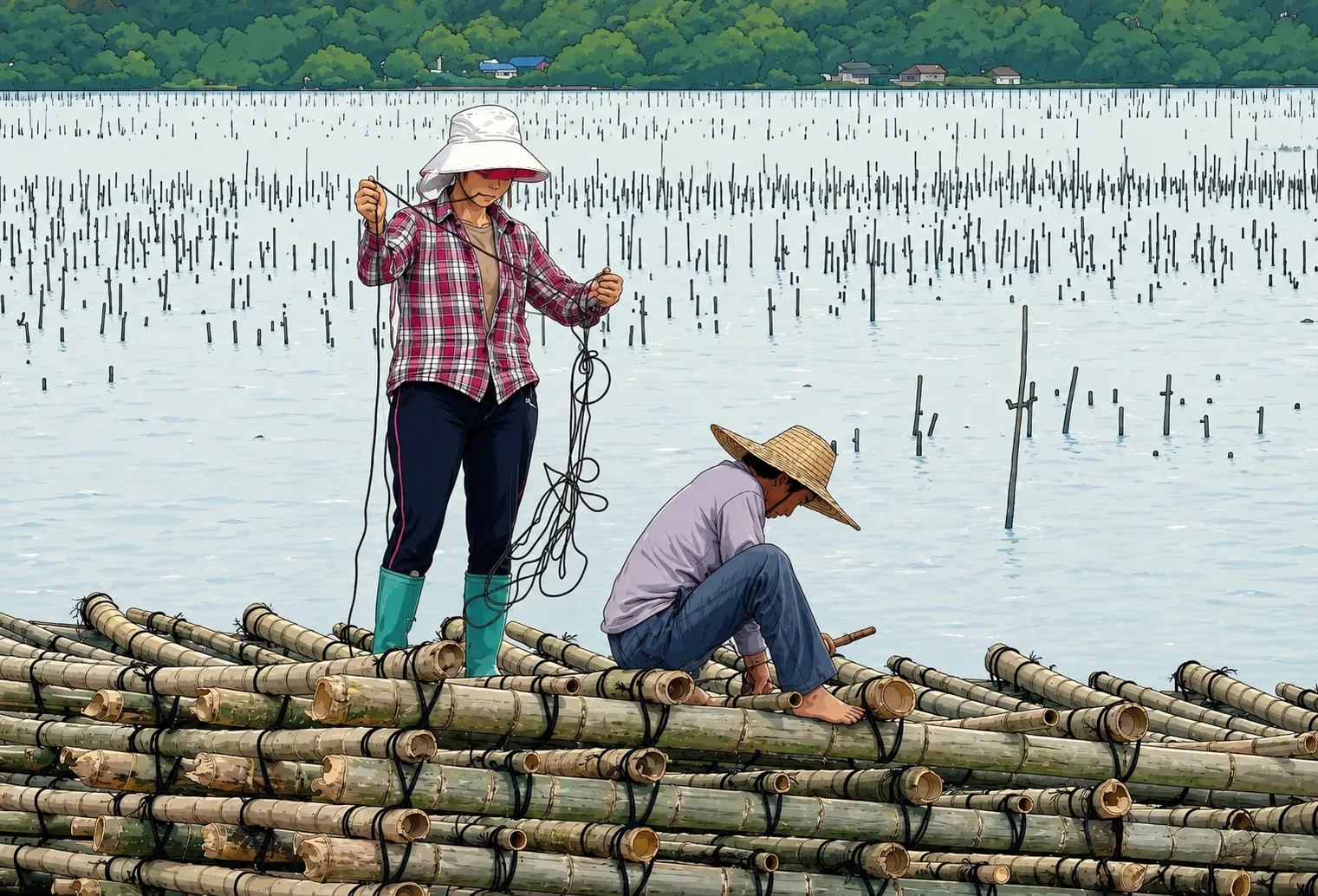
Across the bay, roughly two thousand acres of water is divided into oyster farms. Seven hundred households work them. From a distance, the farms look like a field of bamboo posts rising from the sea, each marking a submerged rope hung with oyster shells. A farmer drills holes through old shells, threads them onto rope at intervals —a hundred shells to a line —and lowers the ropes into the water, tied to bamboo rafts. This is the entire technology: rope, shell, raft, bay. The oyster spat —free-swimming larvae —find the hanging shells on their own, attach, and grow. No hatchery. No feed. Just a farmer who returns each day to check his lines.
The harvest happens by hand. At four in the morning, a farmer in rubber waders poles his flat-bottomed boat into the bay. He hauls up the ropes one by one —each carrying a hundred shells, each weighing up to thirty kilos. He pulls seventy or eighty strings in a morning, forearms burning, hands raw even through his gloves. A farmer who has worked the same mudflat for thirty years reaches into the water and knows by the weight of the rope whether the harvest is good. He does not need to lift it all the way. He just needs to feel the pull.
An oyster farmer's hands can tell you more about the bay than any instrument can.
What the Shell Holds Inside
A Guandu oyster does not look like the oysters in a French seafood tower. Its shell is thick, irregular, often misshapen —armor for a creature raised in tidal currents, not calm bags. The colors are a patchwork of gray, white, green, and brown-yellow. The outer surface is rough, studded with small ridges. This shell fought for its place on the rope.
Then you pry it open, and the argument reverses.
Inside, the meat is a pale ivory curve that fills the shell so completely the liquor has almost nowhere to pool. The first taste is brine —not the sharp, iodine-heavy salt of a cold-water oyster, but a rounder, warmer salt, the kind that comes from a bay where freshwater dilutes the edge off the sea. The second is sweetness: clean, creamy, rising from the middle of the tongue. Oysters raised in pure seawater never develop it. The third is mineral, a faint metallic linger on the back of the tongue long after the oyster is gone.
The texture is what separates a Guandu oyster from others. It does not collapse. There is a brief, elastic resistance before the flesh yields —not chewiness, but presence. Pacific oysters slide down the throat like jelly. Guandu oysters make you notice.
The nutrition is real and measured: protein at just over six grams per hundred grams, zinc at two hundred and ninety milligrams per kilogram—nearly triple the concentration of standard farmed oysters—and iron at sixty-four milligrams per kilogram. The umami depth comes from natural glutamic acid and aspartic acid, the same amino acids that make Parmesan and ripe tomatoes taste the way they do. Nothing added. The oyster synthesized all of it from plankton. When Chinese cooks talk about *xian*, the savory freshness that sits somewhere between "umami" and "alive"—this oyster is what they mean.
A World of Oysters, a Taste of Home
A French Gillardeau oyster, raised in cold Atlantic waters off Normandy, tastes of hazelnut and cucumber —delicate, crisp, clean. The French eat it raw, and they are right to: heat would erase the delicacy that four years of slow growth in cold water built.
An Australian Sydney rock oyster hits the tongue like a wave against a cliff —intense iodine, sharp mineral, a flavor so concentrated it feels aggressive. Smaller than a Guandu oyster, harder to open, and worth every effort.
A Kumamoto oyster is the gentle one —tiny, deep-cupped, a honeydew sweetness with almost no brine. The beginner's oyster.
The Guandu oyster plays a different game. It is larger and creamier than a Gillardeau, sweeter and less punishing than a Sydney rock, more substantial than a Kumamoto. And unlike all three, it is not defined by how it tastes raw. A Guandu oyster changes with temperature —raw and cold, grilled and bubbling, steamed and plump —and in a Zhanjiang kitchen, all are valid. The oyster moves with the cooking method.
The difference is not quality but water, salinity, time. Cold water makes an oyster lean and tight. Warm brackish water makes it broad and generous. An oyster is the most honest food on earth —it tastes exactly like the place it came from. Every oyster is a map of its bay, and the only way to read the map is to eat it.
The Taste That Waits for You to Come Back
The last tray of oysters comes off the charcoal at two in the morning. The night market is thinning. Plastic stools are stacking up. A man wipes down his grill, and the water hisses against hot iron, sending up a last curl of steam smelling of garlic and the sea.
In Zhanjiang, charcoal-grilled oysters are not a special occasion. They are Tuesday night —the thing you eat with a cold beer after work, sitting on a low stool with friends, shell fragments piling up in a bowl at the center of the table, the conversation stretching past midnight because nobody wants to be the first to go home. A plate of grilled oysters costs less than a taxi ride. Not luxury. Life.
A Zhanjiang oyster farmer, finished with the morning harvest, will sometimes open one shell for himself on the boat, squeeze the lime, eat it standing up, looking out at the bay he has worked for thirty years. He does not think of it as a delicacy. He thinks of it as breakfast.
Years ago, a young man from Zhanjiang left for university in a northern city. On his first night there, he found a street stall with a hand-painted sign: "Zhanjiang Charcoal-Grilled Oysters." He sat down. The oysters came. They were not from Guandu. He knew from the first sip of the liquor —the sweetness was missing, the mineral finish wrong, the shell too thin. He ate them anyway. He went back to that stall once a week for four years. The oysters were never right. But the smell of garlic hitting charcoal was close enough.
That is what a Guandu oyster is, for the people who grew up eating it. Not a food. A coordinate. A way to locate yourself when you are far from the bay that shaped your tongue. Now, then, and after —the oyster will be there, hanging from its rope in the brown-green water, filtering the tide into meat, waiting for the knife.