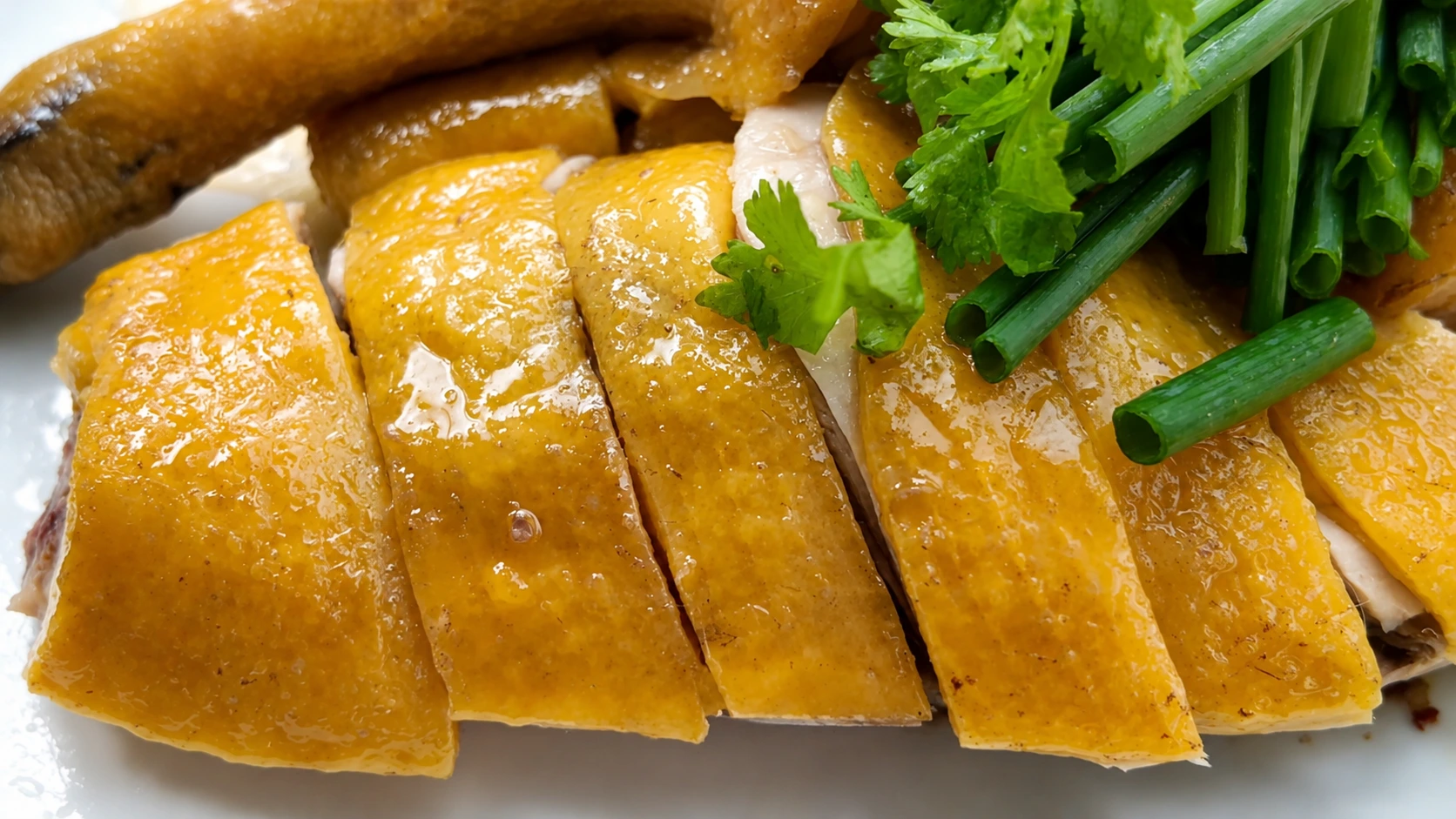
In Guangdong, people often say that a banquet is not complete without chicken. At a wedding, a New Year's dinner, or an ordinary family reunion, the whole bird arrives already chopped and carefully returned to its shape on the plate. The legs rest at the top, where everyone can see them and nobody reaches first.
In Zhanjiang, that plate is often described with two names that are related but not interchangeable. Zhanjiang chicken is the local bird and the food culture built around it. Sanhuang, or "three yellow," describes the yellow traits associated with the chicken. White-cut chicken is the restrained cooking method that brings the bird to the table. One is a regional identity, one describes the chicken, and one describes what the cook does with it.
The Three Yellows Behind the Name
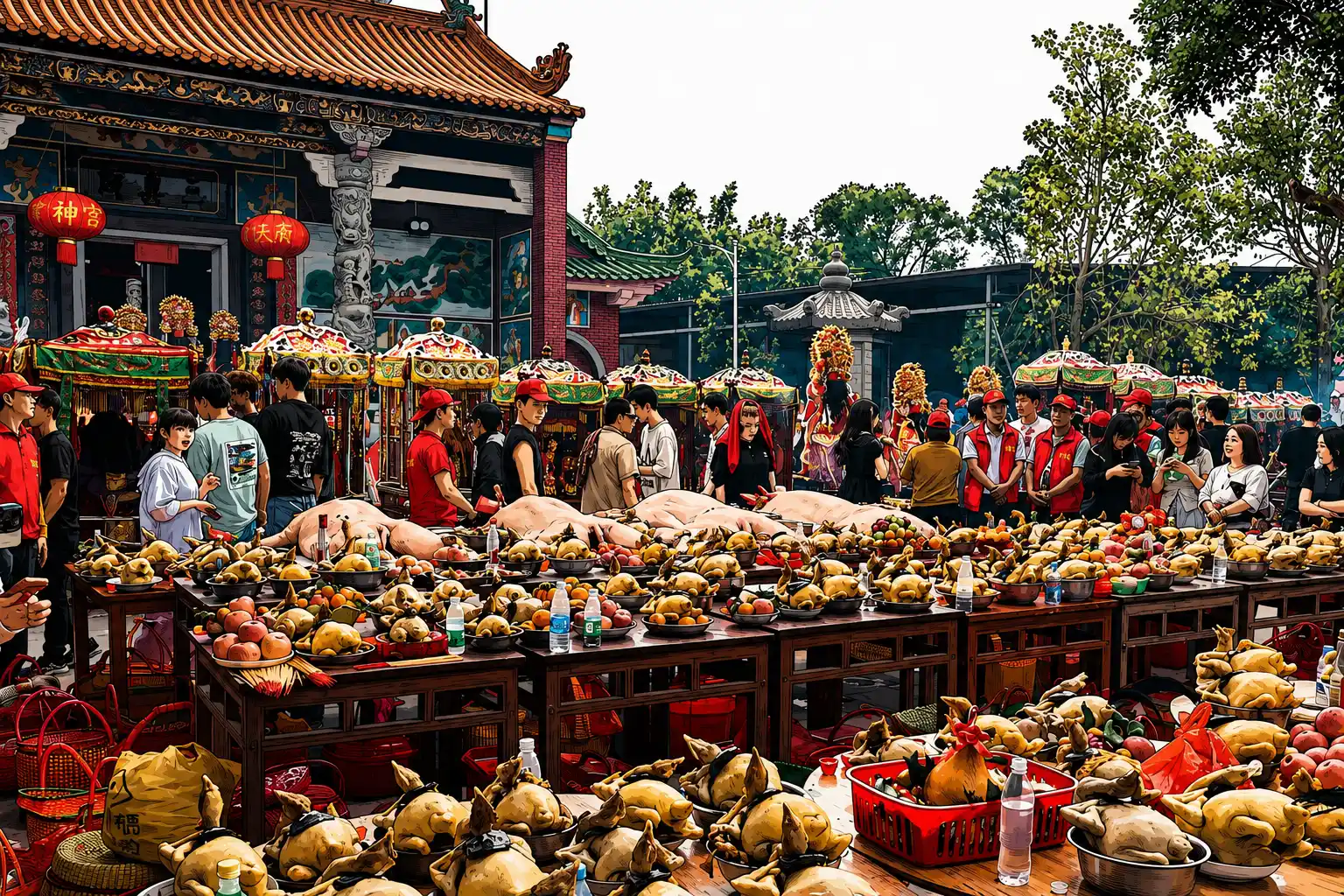
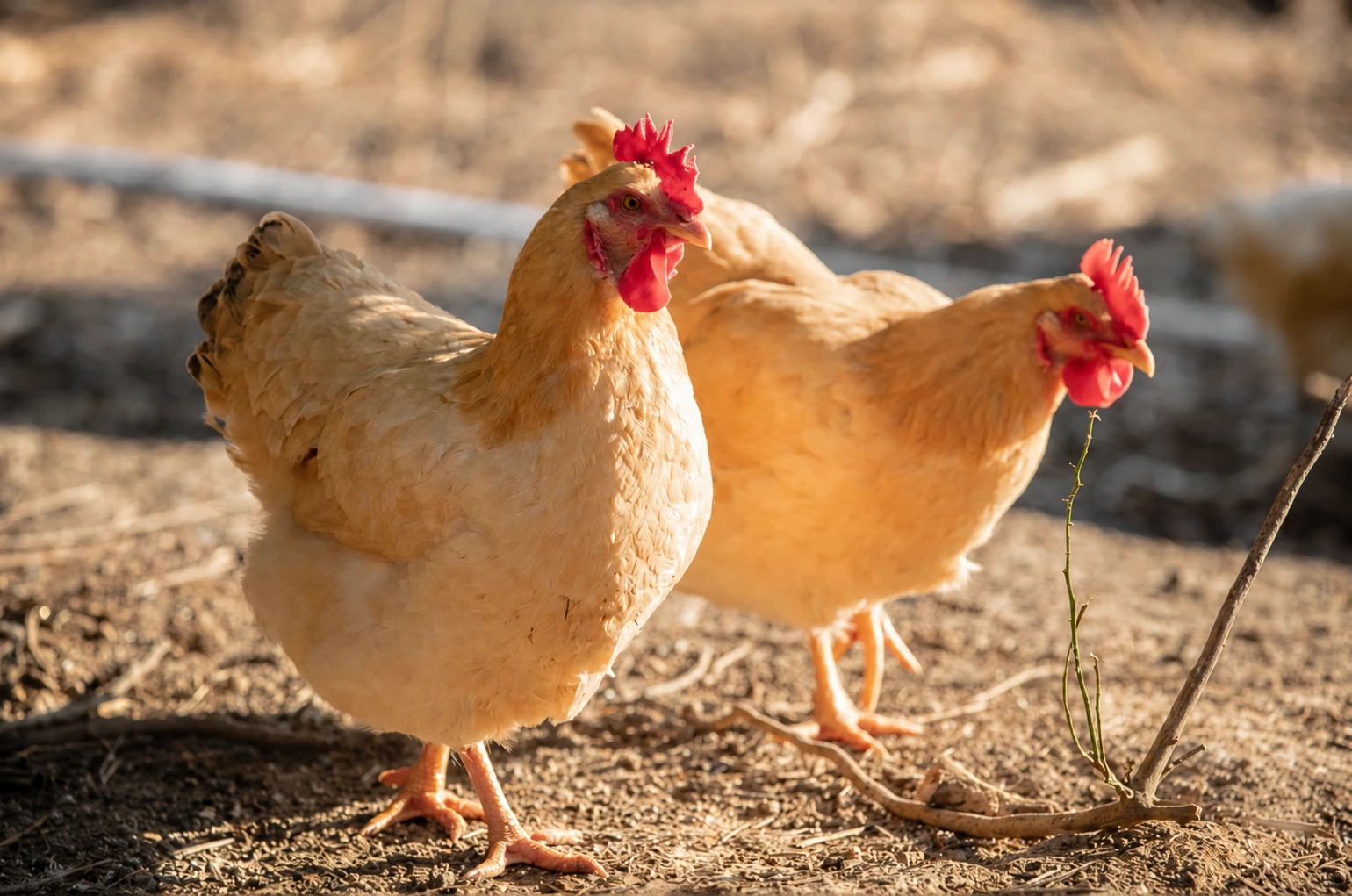
The Leizhou Peninsula is a landscape shaped by old volcanoes, but the chicken does not need a legend about drinking from mangrove streams to be distinctive. Current material from Wuchuan's municipal government describes Zhanjiang chicken by yellow feathers, yellow feet, and yellow skin, as well as by local breeding and free-range production traditions. Older local accounts sometimes describe the three yellows differently, which is a useful warning: Sanhuang is a familiar label across several Chinese chicken populations, not a single definition that should be applied to every bird in the same way.
Local government sources also place Zhanjiang chicken alongside Qingyuan chicken and Huizhou bearded chicken among Guangdong's well-known regional chickens. That comparison is about origin and reputation. Qingyuan chicken is not another name for Zhanjiang chicken, and neither name tells you how the bird was cooked.
At the table, diners judge something more immediate: whether the skin is smooth, the meat still has texture, and the flavour of the chicken remains clear beneath the dipping sauce. Cantonese speakers sometimes call that quality "gai mei" -- chicken that still tastes recognisably of chicken. The phrase is less a scientific claim about soil or sea air than a cook's standard for an ingredient that has not been buried under seasoning.
That is why the most revealing preparation is often the quietest one.
Why Zhanjiang Chicken Is Often Served White-Cut
Cantonese cooks often express the same standard in a phrase: "gai yao gai mei" -- the chicken should taste of chicken.
Before you have tasted a proper white-cut chicken from Zhanjiang, you might wonder why anyone needs to say this. After you have, you understand. What Cantonese cooks mean is that the chicken should taste of itself, and nothing else. No spice. No marinade. No sauce cooked into the meat. Just the bird, and water, and a knife. Achieving this requires more technique than any spice blend.
That restraint is the opposite of Cantonese siu mei, where marinade, drying, glaze, and oven heat build flavor on the surface. White-cut chicken asks the cook to make technique disappear.
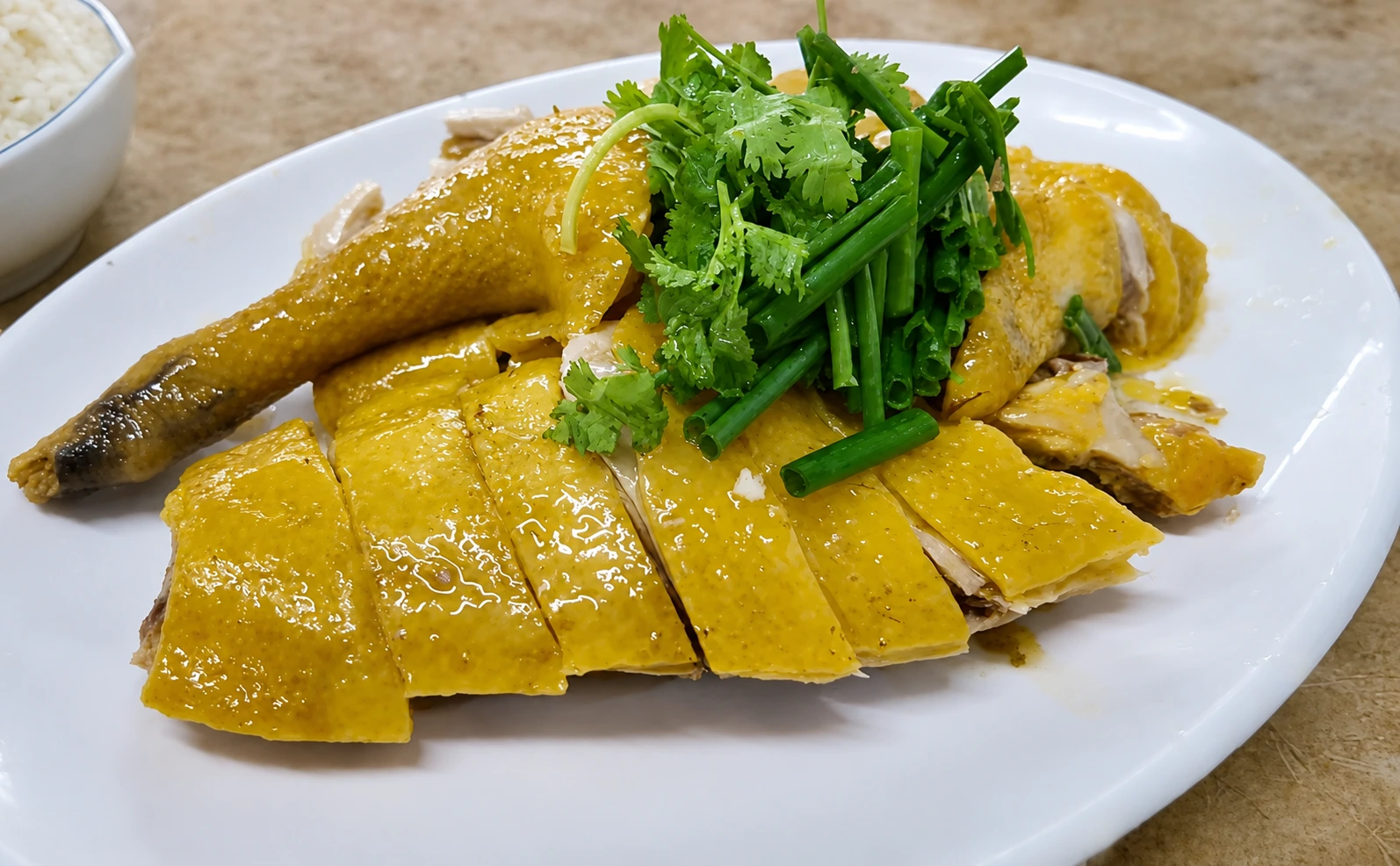
The bird is gently cooked rather than held at a hard boil, then cooled before chopping. Restaurants and families vary in the number of dips, resting time, and cooling method, so one kitchen's ritual should not be presented as the universal Zhanjiang recipe. What remains consistent is the aim: supple meat, intact skin, and a flavour that does not depend on a heavy marinade.
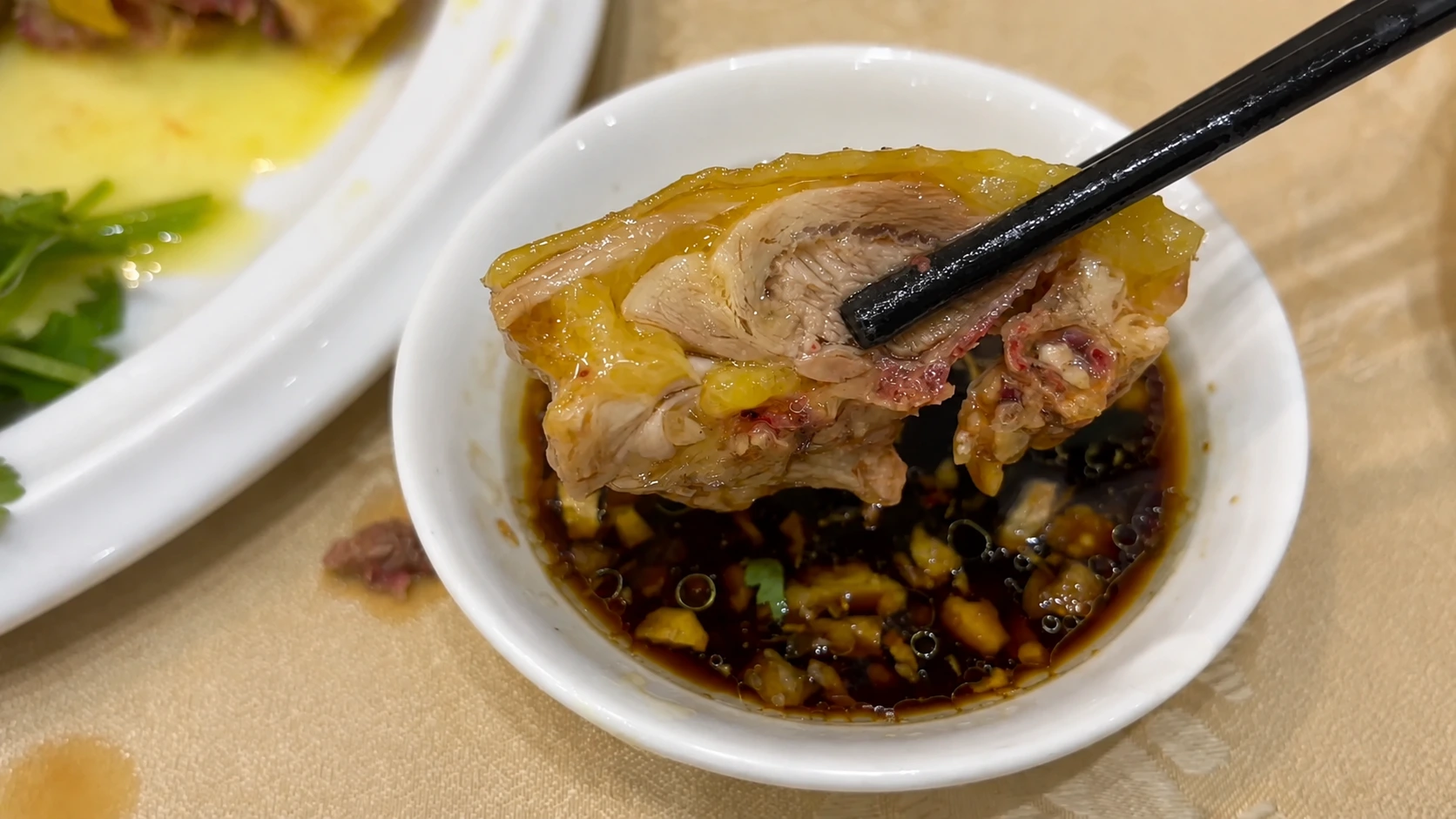
Cooling helps the skin firm before the cleaver comes down. Beside the platter sits a small dish of sand ginger, scallion, salt, and hot oil, although the exact mixture changes from table to table. The chicken is dipped, not drenched. The sauce sharpens what is already there.
Color alone cannot tell a home cook whether poultry is safe. A pink patch near a joint may occur in fully cooked chicken, but it is not proof that the meat is ready; food-safety guidance relies on internal temperature rather than appearance. That distinction matters more than reproducing the look of a restaurant plate.
Two Other Ways Zhanjiang Cooks Its Chicken
White-cut is the preparation most closely associated with Zhanjiang chicken, but it is not the only one. Two other Cantonese methods show how differently the same ingredient can reach the table.
The first is soy sauce chicken, "chi you gai." The whole bird is steeped just below a simmer in a dark, sweet braising liquid of light soy, dark soy, rock sugar, star anise, cinnamon, and ginger, turned every few minutes until the skin turns deep mahogany, glossy as lacquer. The meat absorbs the soy without losing itself. A good soy sauce chicken still tastes like chicken, but richer, with a caramel sweetness that lingers at the back of the throat. In Zhanjiang, this is the chicken for a weekend, a visiting relative, a table that does not need to impress but cannot afford to disappoint.
The second is salt-baked chicken, "yan ju gai." In a traditional version, the seasoned bird is wrapped and cooked inside hot coarse salt; modern kitchens may use other methods to create a similar dry, aromatic finish. When the wrapping opens, sand ginger reaches the table before the steam does. This is the chicken you make for someone you love but do not see often enough.
The Leg That Travels Across the Table
The chicken is on the platter —breast fanned across the center, wings tucked at the edges, dark meat in neat overlapping rows. At the top, untouched, the two legs.
No one reaches for them. Everyone knows who they belong to: the oldest person in the room. This is not a rule anyone speaks. It is simply what happens, the way water runs downhill. In a country where meat was scarce for most of living memory, the leg was the most precious thing on the table. You gave it to the people who had given you everything.
The grandmother at the head of the table reaches out. Her chopsticks pinch the drumstick below the joint. She lowers it into her own bowl. It rests there for one second —long enough for the rice beneath to absorb a single drop of chicken fat.
Then she picks it up again. She leans across the table. She drops the leg into the bowl of her grandson, who is four and has been staring at the chicken since it left the kitchen.
"Grandma doesn't like the leg," she says.
The child believes her. He is four. He does not know his grandmother has been saying this at every family dinner since her own grandmother said it to her, sixty years ago. He does not know the leg was never hers —that her bowl was never a destination, only a stop.
The table continues. Tea is refilled. Someone asks about school. The grandmother eats a few pieces of breast meat, the driest part of the bird, because someone has to eat it. The child has eaten half the leg and smeared the rest across his cheek.
This is the choreography of a Chinese family dinner. Respect moves upward —the leg goes to the elder without question. Love moves downward —the elder gives it away before anyone notices. The transaction is so smooth you would miss it if you blinked. If you asked anyone what happened, they would not know how to explain it. It is just what happens. It is just what a grandmother does.
The child will not understand for years. But one day he will be forty, sitting at his own table. A chicken will come out. The legs will wait at the top of the platter. His hand will move before his brain gives the instruction. He will pick one up, pause for one second, then reach across and drop it into his own child's bowl.
"Dad doesn't like the leg," he will say.
And for the first time, he will understand he is not lying.
What a Grandmother Eats for Dinner
The meal is over. Plates are empty except for bones, each picked clean, some bearing the small tooth marks of a four-year-old.
The grandmother's bowl is almost untouched. She ate a few mouthfuls of rice. The piece of breast meat no one else wanted. The wing tip —the tiny, bony end —because she cannot stand to see anything wasted.
What she consumed was not food. She consumed her grandson's face, glossy with chicken fat. Her son's voice, loosened by a full stomach, telling a story she has heard before. The evidence that the people she loves have been fed.
The chicken leg is gone. It was never on her plate long enough to leave a mark. It passed through her hands and landed where it was always meant to land —in the smallest bowl, held by the smallest hands.
In the kitchen, the cleaver is clean and hung back on its hook. The cutting board is dry. The poaching pot is scrubbed and upside down on the rack. Nothing left but bones. Nothing left but the quiet, full silence of a family that has eaten well.
Next time -- any time -- there will be another chicken. Same pot. Same white platter. The legs will wait at the top. The grandmother will reach for them. She will say the same five words.
The lie will pass, like the leg, from her bowl to his. The way it always has.
FAQ
What is Zhanjiang chicken?
Zhanjiang chicken refers both to a local chicken from western Guangdong and to the food tradition built around it. On the table, it is often gently cooked, chopped, and served with a sand-ginger or ginger-scallion dipping sauce.
The appeal is the clean chicken flavor, smooth skin, tender meat, and fresh texture rather than heavy seasoning.
Is Zhanjiang chicken the same as Sanhuang chicken?
Not exactly. Zhanjiang chicken is a regional chicken and culinary identity. Sanhuang means "three yellow" and is used for yellow-featured chickens in several parts of China; current Wuchuan material describes the local traits as yellow feathers, yellow feet, and yellow skin.
The terms overlap in Zhanjiang, but they are not universal substitutes for one another. White-cut chicken is different again: it names the cooking method, not the breed.
Why is Zhanjiang chicken usually served white-cut?
Zhanjiang chicken is often served white-cut because this method highlights the quality of the chicken itself. The chicken is gently cooked, cooled, chopped, and served with a simple dipping sauce.
Instead of frying, roasting, or covering the meat with a strong sauce, white-cut chicken keeps the taste clean and direct. It is a very Cantonese way of saying: if the ingredient is good enough, it does not need to be hidden.