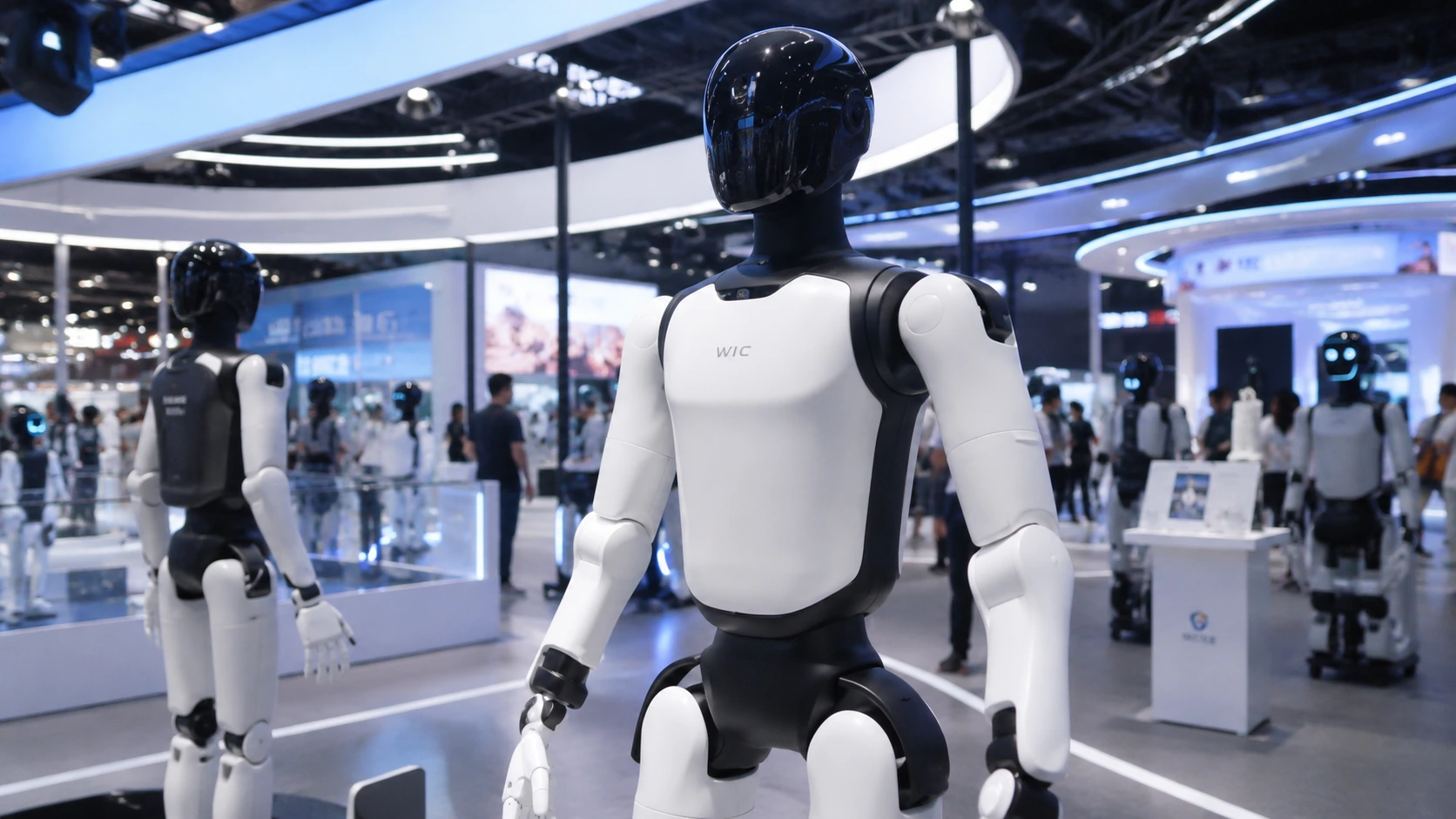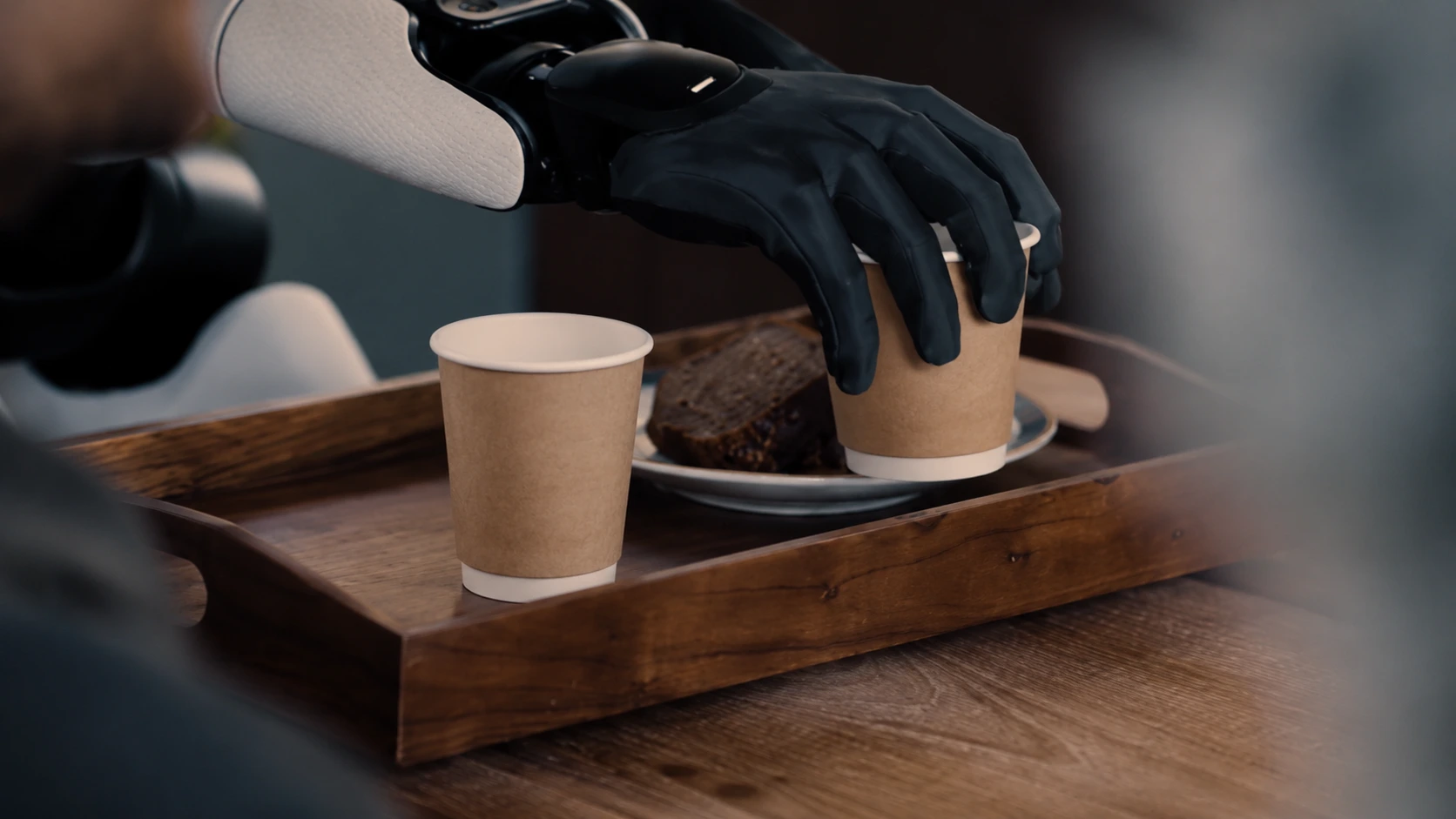
At a technology show in Fuzhou, the robots were doing what crowds have learned to expect. They danced. They played drums. They poured drinks. But one of the largest circles of spectators formed around a quieter performance: a worker wearing a virtual reality headset, teaching a robot to pick up a paper cup.
The worker moved first. Through the headset and motion-control equipment, that movement became an instruction. The robot reached toward the cup. Cameras and sensors watched the angle of its joints, the path of its hand and the pressure of its grip.
For a person, picking up a cup barely counts as a task. The hand finds it without measuring the distance. The fingers close without crushing it. If the cup has shifted, the hand shifts too.
For a robot, that last adjustment is the beginning of a different education.
A Paper Cup Never Lands the Same Way Twice
Many traditional industrial robots become dependable by working in a world built around them. A mechanical arm follows a fixed route. Parts arrive at a known height and angle. Fences keep people away from its swing. The surroundings stay steady so the machine can repeat one movement thousands of times.
Human life offers no such arrangement.
A paper cup rolls when someone brushes the table. A plastic bag collapses around whatever is inside it. A shirt has sleeves that fold under its own weight. Even a chair changes the room when somebody pulls it out and leaves it at an angle.
At Shanghai's humanoid robot training ground in Zhangjiang, the lessons can look almost domestic. One robot practices picking up shredded potatoes. Another holds a screwdriver to the back panel of a refrigerator. Two others face each other over a football.
The potato shreds do not form a solid object with a convenient handle. The screw must meet a small hole at the right angle. The football has already moved by the time a machine decides where it was. Each task asks the same question in a different form: can the robot notice that the scene has changed, then change with it?
This is why China's AI robots are learning to work in the real world. The first lesson is not simply how to complete a movement. It is how to continue when the next movement cannot be exactly the same.
The Hands Behind the Robot's Hands
The phrase "a robot learns" can make the process sound strangely solitary. Inside a training ground, it is anything but.
Human operators put on headsets and motion-control devices. They stack cups, sort objects, carry parts and wipe tables. Their movements are transferred to the machines while cameras record what the robot sees and sensors capture how its body moves. A gesture that normally disappears in a second becomes something to examine: how far the arm extended, when the wrist turned, how firmly the fingers closed.
Then other people take over. They label the result, check the equipment and help engineers understand where an action went wrong. A robot that appears to reach on its own may be carrying the traces of many human demonstrations in that single motion.
Text-based AI can learn from words and pictures that already exist in enormous quantities. Physical work leaves a thinner record. Most people do not document the precise pressure used to lift a cup or the small correction made when a plate begins to slip. Someone has to perform those actions again, this time slowly enough for a machine to follow.
That is the less visible side of robots in everyday life across China. Before a machine can seem natural in a shop or public hall, people have spent long hours teaching it movements that look natural only because humans stopped noticing them long ago.
Humans use controlled practice for the same reason. Inside Hangzhou's typhoon simulator, a supervised room exposes the difference between knowing a warning number and keeping balance when familiar objects begin to move.
The Room Has to Keep Changing
Shanghai's Zhangjiang facility was built to train more than one kind of humanoid robot at a time. They do not all have the same hands, height, balance or way of moving. Put them in one room and even the machines themselves become part of the room's variety.
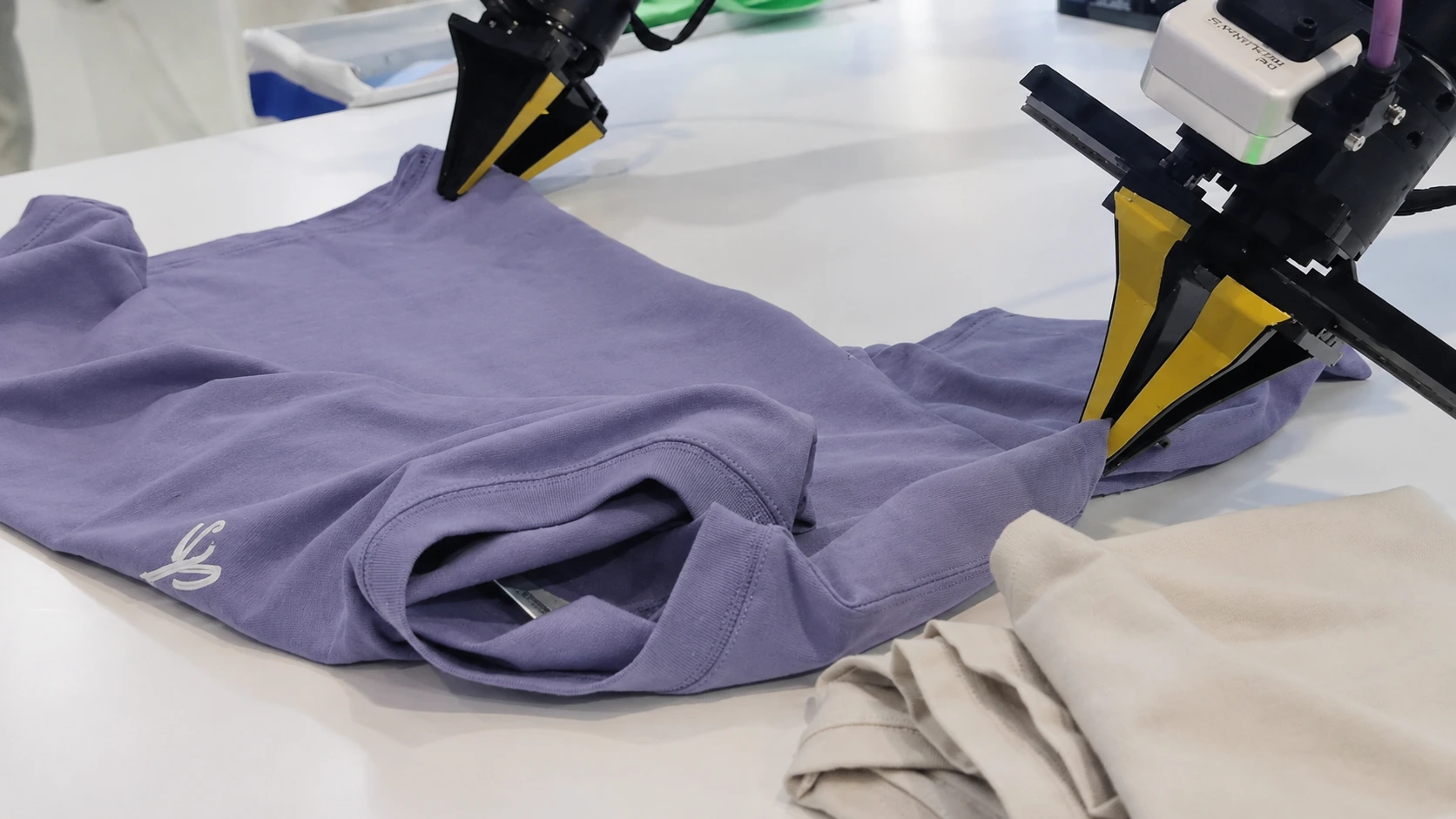
On one workbench, the lesson may be sorting objects. At another, it may be organizing a desk or operating a tool. An object moves a few centimeters. A different robot takes its place. The reach that worked yesterday is no longer quite right.
This variety matters because a skill learned in one carefully arranged corner is of limited use if it disappears when the table changes. More than 100 robots can train at the Zhangjiang facility, but the work is measured in much smaller changes. A trainer repositions an object. A robot reaches again. Its hand stops, corrects and closes.
The contrast with China's smart factories is important. Fixed industrial automation has transformed manufacturing by making tasks and surroundings more regular. The newer ambition is different: to build machines that can keep working when the surroundings cannot be made completely regular.
When Shanghai Walks Into the Lesson
During WAIC 2026, the lesson moved beyond laboratories and factory floors. The Shanghai AI City Walk connected technology spaces with shops, old neighborhoods and public venues, allowing ordinary visitors to stand on the other side of the machine. For a few days, the challenge appeared as part of modern Chinese life, not as a diagram at an industry conference.
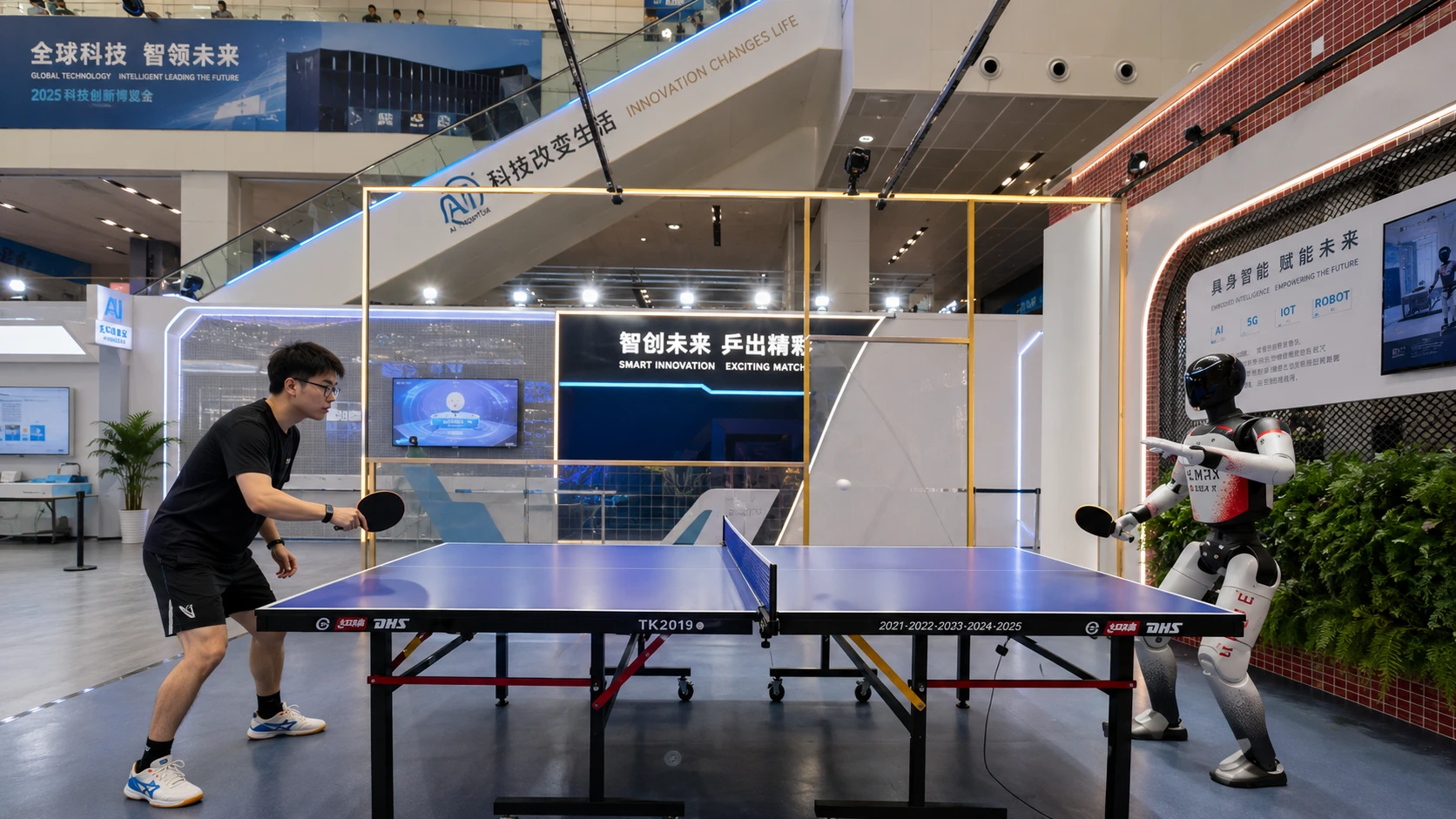
Visitors could try AI-assisted table tennis. The event did not establish that every system was learning live from every shot, but the table made the problem visible. The person holding the paddle decided what arrived. One shot came fast, another slow. Speed, spin and direction shifted with every return. A robot designed to rally without a preset sequence must watch the ball in real time, move into position and decide where to send it next.
At other stops, visitors stood close enough to speak to service machines, watch them work and receive what they handed over. People approached at different speeds, stood at different distances and used different gestures. In a public space, even standing still can mean something different from one person to the next.
These encounters do not necessarily mean that every visitor is directly training a model. Public demonstrations, testing, data collection and autonomous learning are not the same thing. What the City Walk did reveal was the variety a robot meets when its instructions are no longer coming only from an engineer.
For Shanghai's robot volunteers, serving people means more than arriving at the correct location. It means noticing who has stopped, who needs help and whether the space between them has changed.
The Conveyor Belt Does Not Wait
The stakes change again when the robot enters a real shift.
In 2026, Shanghai-made humanoid robots worked for eight continuous hours on an electronics production line. They picked products from a moving conveyor, placed them into testing boxes and separated items identified as abnormal. Those items were left at a window for human staff to retrieve.
There was nothing theatrical about the arrangement. The belt kept moving. The next product arrived. Workers farther along the process depended on each earlier action happening at the right time.
This is where the quiet practice with cups, tools and changing positions begins to matter. A demonstration can be restarted. A production line has a rhythm shared by machines and people. If the robot hesitates, the consequence does not remain inside the robot.
The goal is not to make life as regular as a machine. It is to let the machine enter a world that remains alive around it: a worker reaching through the window for an unusual product, a customer stepping closer, a ball arriving with a different spin.
Back at the training table, the paper cup is moved again. The distance is only a little different. A human hand would adjust without comment.
The robot reaches for it once more.