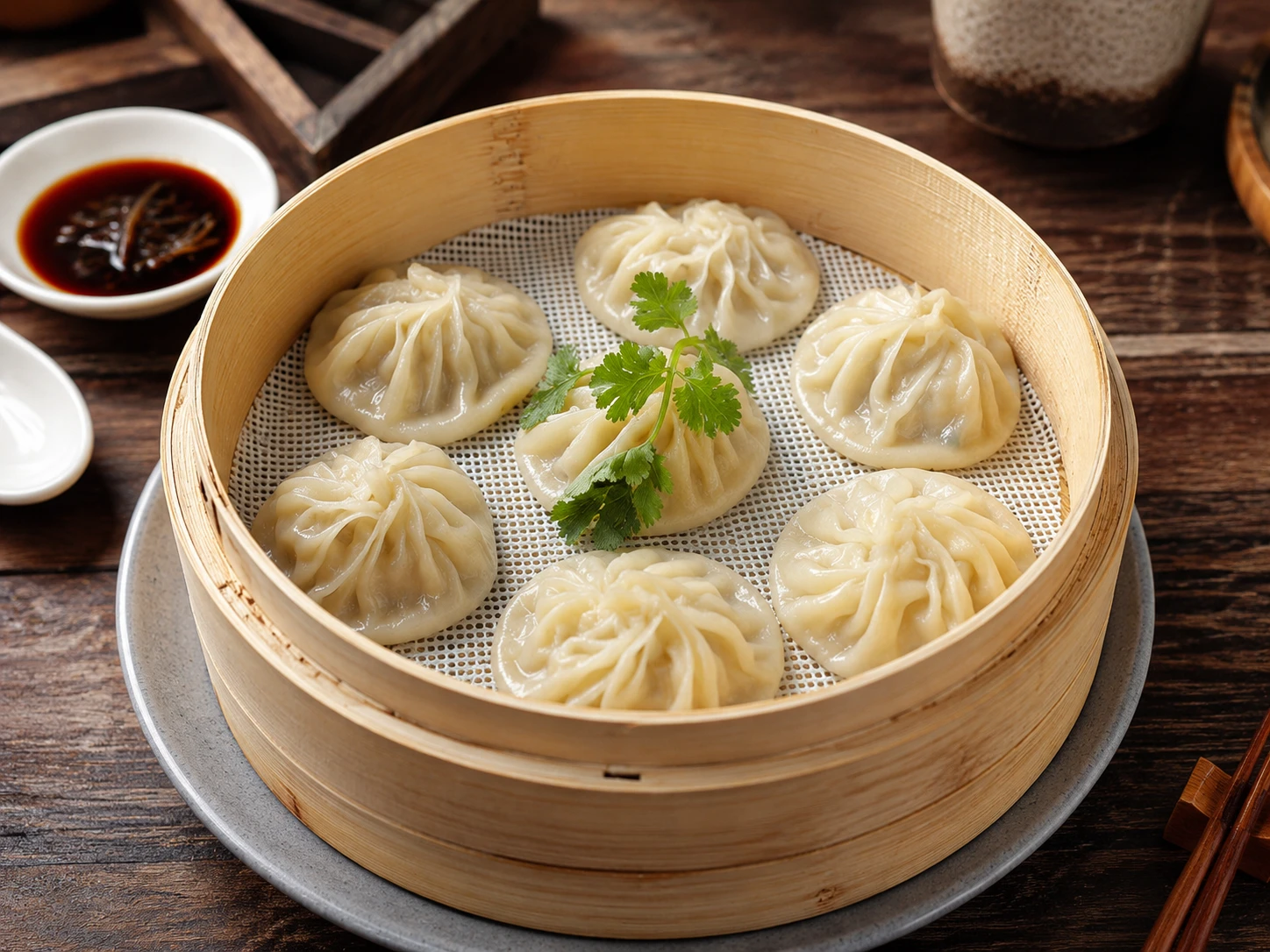
Six in the morning. An alley off Renmin Road. A fluorescent tube flickers on above a steel counter, and the first bamboo steamer of the day is pulled from the stack. The cook lifts the lid.
Steam bursts out — thick, white, smelling of pork and wheat and something faintly sweet that is not sugar but the gelatinised broth inside each dumpling already beginning to return to liquid. When the steam clears, six xiaolongbao sit in the basket, their skins so thin you can see the soup moving inside them. They quiver slightly, as if breathing.
The cook does not look at them. He has made forty thousand of these. He sets the basket on a tray and slides it across the counter to a man in a blue jacket who has been standing in this alley at six-fifteen every Tuesday for eleven years. The man picks up his chopsticks.
This is not a food tour. This is breakfast.
---
The Steam That Never Stops
Xiaolongbao were born in a town called Nanxiang, now a suburb of Shanghai, sometime in the 1870s. A man named Huang Mingxian ran a restaurant near the old Guyi Garden and wanted to make a dumpling that would stand out from every other dumpling sold within a five-minute walk of a Jiangnan canal town — which is to say, hundreds of competitors. His idea was to fold aspic into the pork filling. When the dumpling was steamed, the aspic melted. The customer bit in and got soup where no soup had been poured.
The name is not complicated. *Xiao* means small. *Long* means steamer basket. *Bao* means bun or dumpling. A small steamer basket dumpling. In English, it gets called a soup dumpling, which is accurate but misses the point — the soup is not added. It is created by heat, from solid to liquid, inside a sealed pouch of dough.
Nanxiang was a water town. The canals that carried its goods to Shanghai also carried its food. By the early twentieth century, xiaolongbao had moved from the suburb into the city proper, settling into the breakfast culture of a Shanghai that was growing faster than any city in China had ever grown. Today, a Shanghai morning without steam rising from a bamboo basket is not quite a Shanghai morning.
---
The Bite That Can Burn You
The man in the blue jacket does not put the xiaolongbao directly into his mouth. Nobody who has eaten xiaolongbao more than once does.
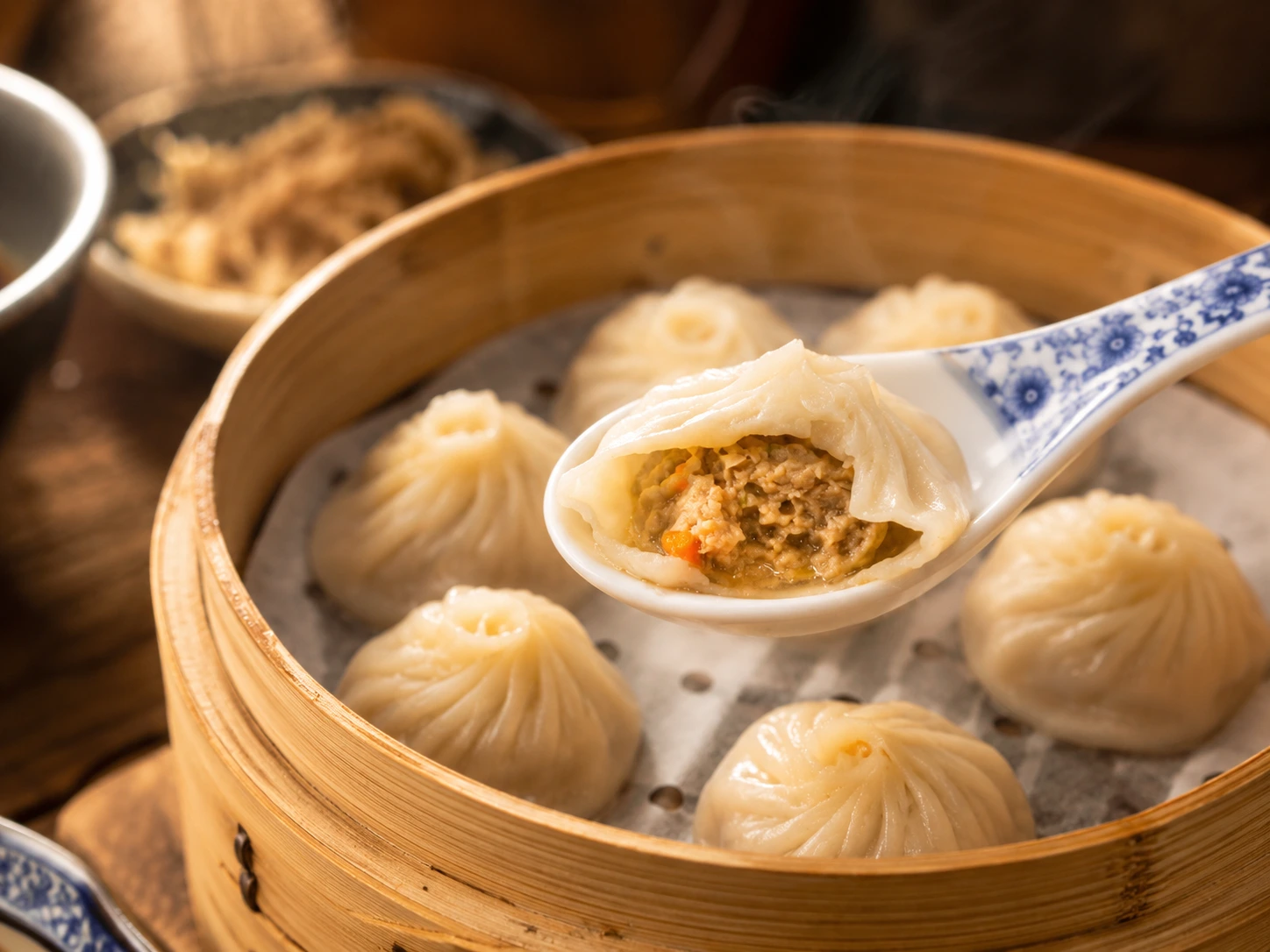
He picks up a dumpling with his chopsticks — a gentle pinch at the top, where the dough folds meet in a twist — and places it on a porcelain soup spoon. Then he bites a small hole in the side of the skin, near the base but not quite at the bottom. The hole is maybe four millimetres across. He pulls his face back slightly and lets the broth pour out onto the spoon. The liquid is pale gold, slightly cloudy, glistening with fat. He drinks it from the spoon like soup, which is what it is.
Then he dips what remains — the skin and the pork filling — into a dish of black Zhenjiang vinegar laced with slivers of ginger, and eats it in one bite.
The whole sequence takes about fifteen seconds. It looks casual, automatic, the way someone who grew up eating with chopsticks makes it look. But every step is defensive. The broth inside a freshly steamed xiaolongbao is close to boiling. Bite into it whole and you will scald the roof of your mouth so badly you will not taste anything else for the rest of the meal. Beginners learn this once. Locals learned it as children and never forgot.
---
Pork, Crab, and the One with a Straw
The classic xiaolongbao is pork. Ground pork shoulder, a little ginger, a little Shaoxing wine, aspic, a thin wheat-flour skin. At Jia Jia Tang Bao on Huanghe Road, they sell nothing else — just pork xiaolongbao and a few side dishes. The queue forms before opening and stretches down the pavement. The restaurant is small, fluorescent-lit, with laminated menus and tables that wobble. It is, by universal agreement among locals, the best xiaolongbao in Shanghai.
The crab version comes in two forms. Pork and crab — *xiefen xiaolongbao* — mixes crab meat and crab roe into the pork filling. It is sweeter, richer, and more expensive. Pure crab roe xiaolongbao — *xiehuang xiaolongbao* — uses only the golden roe, no pork at all. These are the most expensive ones on any menu, and they are worth it once. You will not want them every day. They are too rich, like eating butter wrapped in dough.
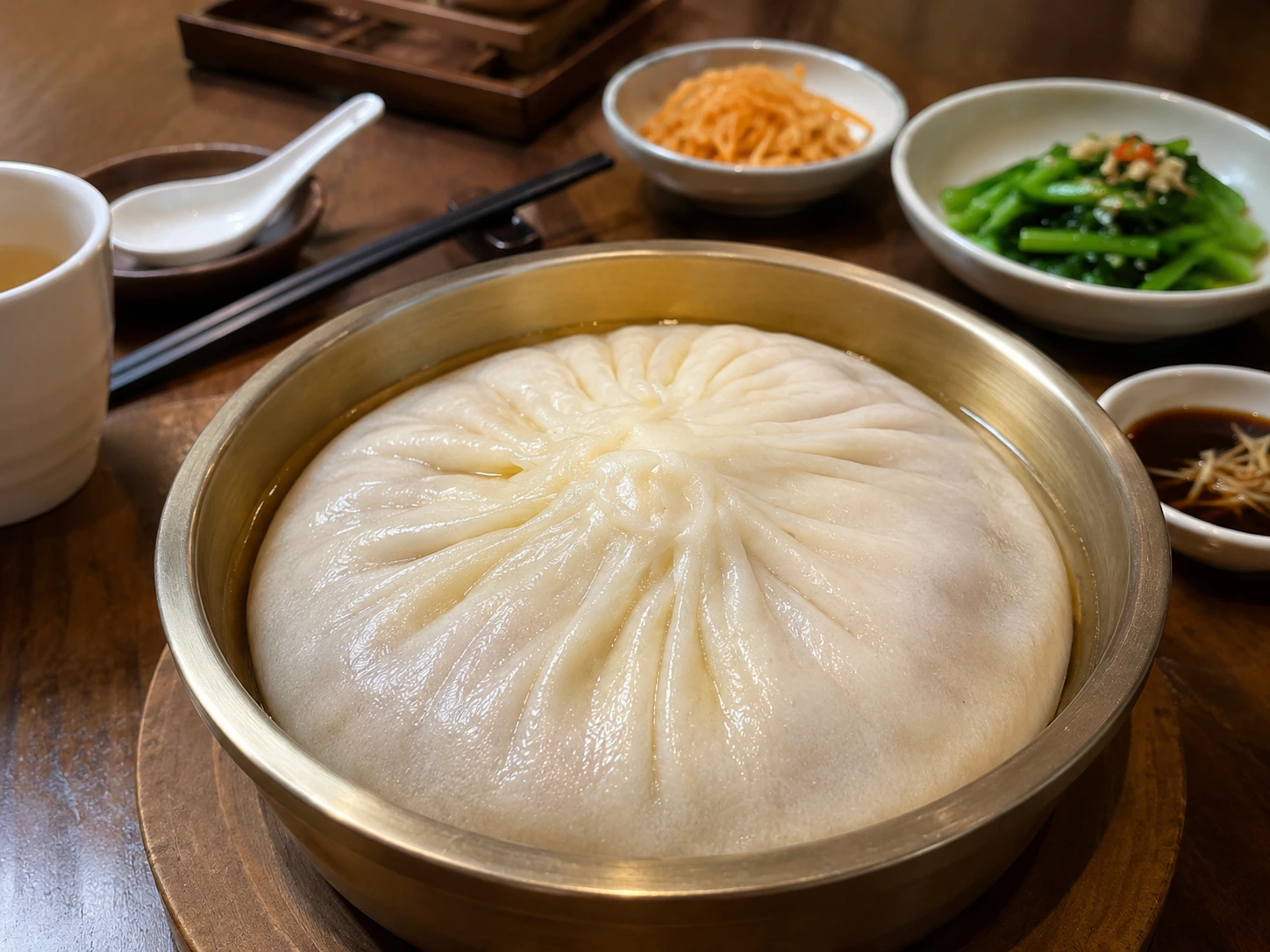
There is also the giant soup dumpling, served with a straw. It is a single dumpling the size of a fist, filled with broth and very little filling. You stab a straw through the skin, wait for the liquid to cool slightly, and drink it. It is a spectacle. It photographs well. It is not the best way to eat xiaolongbao. Order it once for the experience, then go back to the basket of six.
Nanxiang Mantou Dian near Yu Garden serves all of these. The queue is long, the room is loud, and the dumplings are good but not great — the kitchen serves too many people to treat each basket with the care it would get at Jia Jia Tang Bao. Din Tai Fung, the Taiwanese chain with branches worldwide, makes xiaolongbao with eighteen precise folds and a thinner skin than anywhere else. It is consistent, clean, and completely without the chaos of a Shanghai alley at dawn. It is the safe choice. It is not the Shanghai choice.
---
Don't Miss the Other Shanghai Dumpling
There is another sound in Shanghai's breakfast alleys, and it is not steam. It is the hiss of dough hitting a hot iron pan.
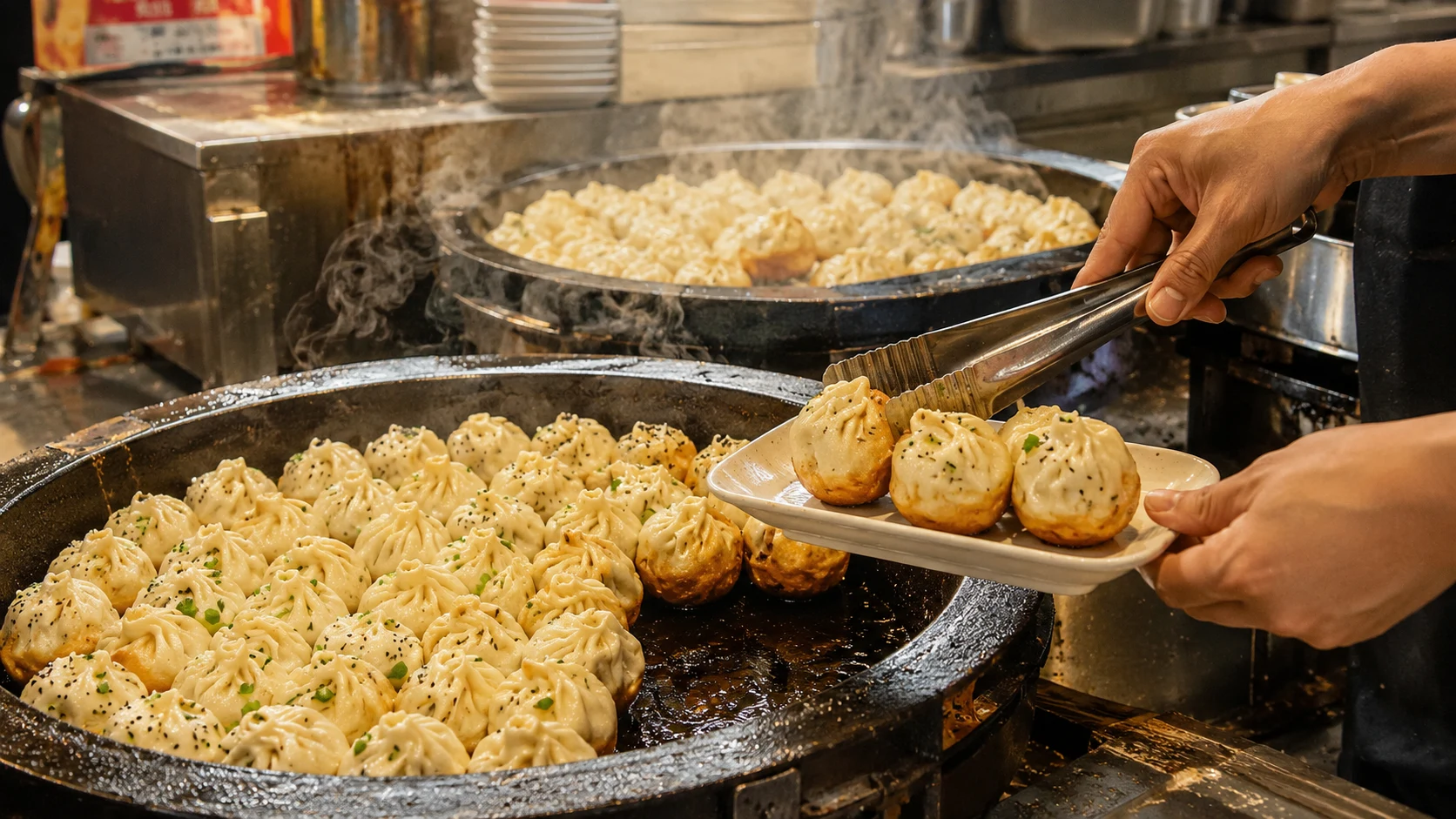
Shengjianbao are xiaolongbao's louder, crispier sibling. They are made with a thicker, yeasted dough. They are fried, not steamed — arranged in a large flat pan, oil poured over them, water splashed in to create steam, then a heavy wooden lid clamped down. When the lid comes off, the bottoms are golden and crisp, the tops are soft and puffy, and the broth inside is still liquid. The cook scrapes them off the pan with a metal spatula, flips them over into a paper bowl, and sprinkles sesame seeds and chopped scallions on top.
If xiaolongbao is the refined centre of a Shanghai breakfast, shengjianbao is the street-corner version — louder, greasier, better with cold soy milk. Eat them in the morning. Save xiaolongbao for lunch. Or do what locals do and have both, because nobody in Shanghai counts dumplings.
---
The Bamboo Basket That Outlasted Everything
Yu Garden is a tourist destination. The xiaolongbao at Nanxiang Mantou Dian inside the garden complex are not bad. They are simply not the best in the city. What they are is convenient — you are already at Yu Garden, you have seen the zigzag bridge and the rockery, and a basket of xiaolongbao fits the itinerary. Nothing wrong with that. The line will be long. The dumplings will be fine. You will have eaten xiaolongbao at the place where tourists eat xiaolongbao, and you will have a photograph of the basket with the garden in the background. It counts.
But if you want the version of this meal that a local would choose, walk fifteen minutes north to Huanghe Road. Jia Jia Tang Bao is there, and a block away is Fuchun, and a few streets further is Lin Long Fang. None of them have a view of a Ming dynasty garden. All of them have better dumplings.
This is not a secret. Locals do not hide their favourite restaurants from tourists — tourists simply do not walk that far. The bamboo basket at Jia Jia Tang Bao is the same bamboo basket at Nanxiang. The pork is the same cut of shoulder. The vinegar is the same brand. The difference is the queue — one is full of people holding selfie sticks, the other is full of people holding umbrellas because it looked like rain at six in the morning and they came anyway.
A xiaolongbao does not care which queue you stood in. It only cares that you bit a small hole, drank the soup first, and did not burn yourself. Get that right, and you ate it the way it was meant to be eaten — not as a tourist, not as a local, but as someone who understood that the best thing inside a bamboo basket is not the filling. It is the steam.