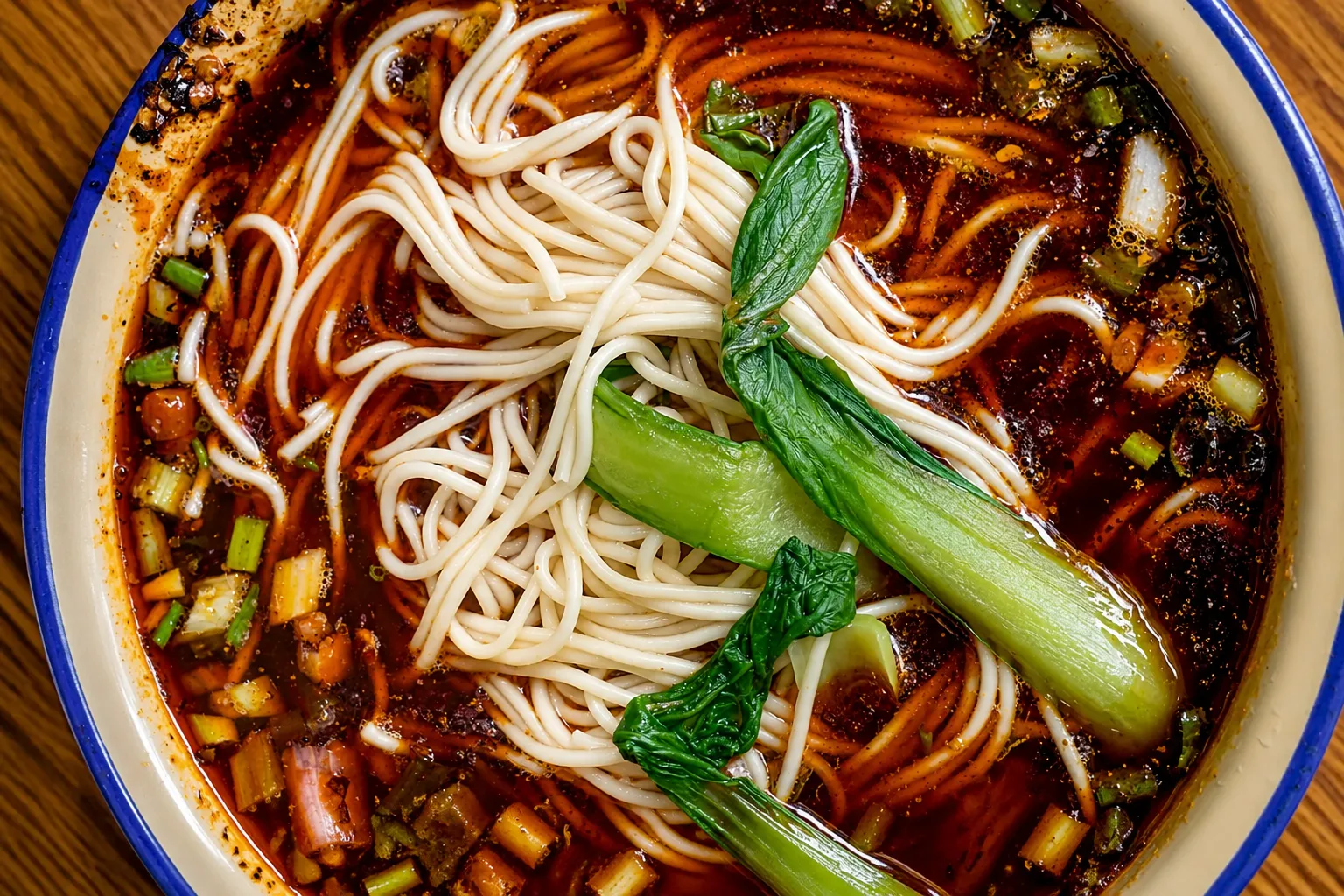
At 5:30 a.m., the Chongqing sky is still barely light. The street noodle shops have already turned on their lights; the boss puts the first pot of water on to boil, and fine white steam begins to rise from the edge of the iron wok. Outside the door, a few folding tables are set up, plastic stools inverted on top, waiting for the first customers to flip them over.
At six o'clock, the first person arrives. A middle-aged man in work clothes, still holding his hard hat. He does not need to look at the menu. He simply calls out: "Two liang of xiaomian, duo qing." (extra leafy greens). The boss does not even look up, grabs a handful of alkaline wheat noodles, drops them into a strainer, and bobs them up and down three times in the boiling water. At the same time, his other hand reaches for a porcelain bowl and begins assembling the seasoning.
This is the real start of a day in Chongqing. Not the rumble of the subway, not the honking of car horns, but the sound of noodles landing in a bowl.
Xiaomian Is No Small Matter
When Chongqing people say "xiaomian," they do not mean a small bowl—they mean a plain, meatless noodle. No toppings, no meat, just noodles and seasoning.
Sounds humble? On the contrary. Xiaomian is the foundation of Chongqing noodles, the real test of skill. Without slices of meat, without pork intestines, without beef to hide behind, whether a bowl is good or not depends entirely on whether the seasoning is done right. Like someone who looks good without makeup—true beauty needs no cover.
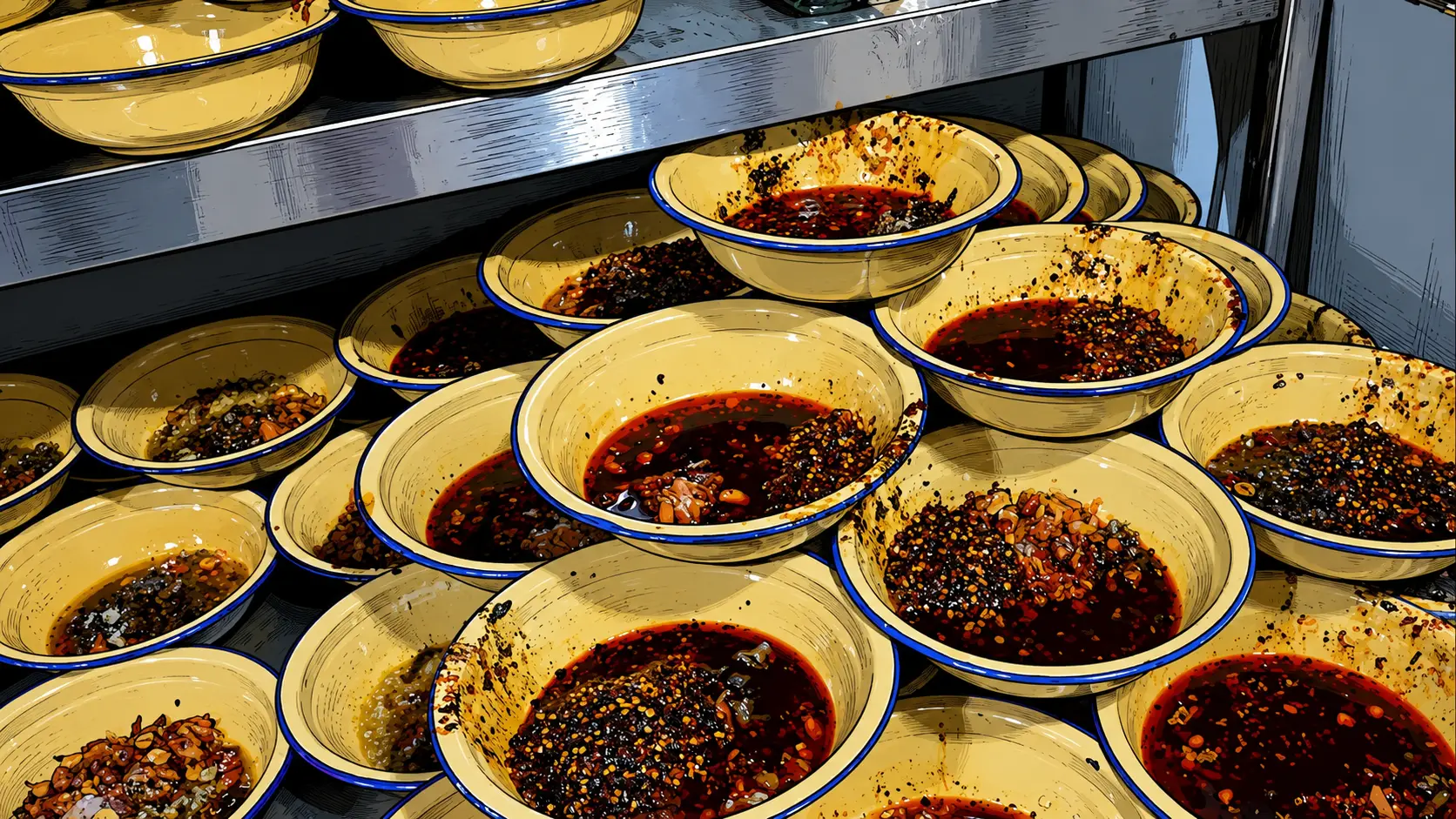
An authentic bowl of xiaomian starts with more than a dozen seasonings layered at the bottom of the bowl. Soy sauce, vinegar, minced garlic, ginger paste, Sichuan pepper powder, chili oil, lard, sesame paste, yacai (preserved mustard greens), crushed peanuts, scallions, cilantro... each has its place, neither too much nor too little, neither out of order. The boss's motions are like an old Chinese medicine doctor filling a prescription—a flick of the wrist, and the portion is just right.
The most critical element is the chili oil. Chongqing xiaomian chili oil is not simply spicy; it must be fragrant. Dried chilies—usually the local "er jing tiao" variety—are first slow-roasted over low heat until their skins turn crisp and their color deepens, then hand-pounded into coarse grains. Then smoking-hot rapeseed oil is poured over them—not all at once, but in three stages. The first pour releases the aroma, the second draws out the heat, the third sets the color. Finally, a handful of white sesame seeds is sprinkled on top, and the lid is left on overnight. The next morning when you open it, the whole room is filled with a complex scent—charred and slightly smoky, making your nose itch and your mouth water.
The soul of xiaomian lies at the bottom of the bowl. If you do not stir before eating, the first bite is ruined.
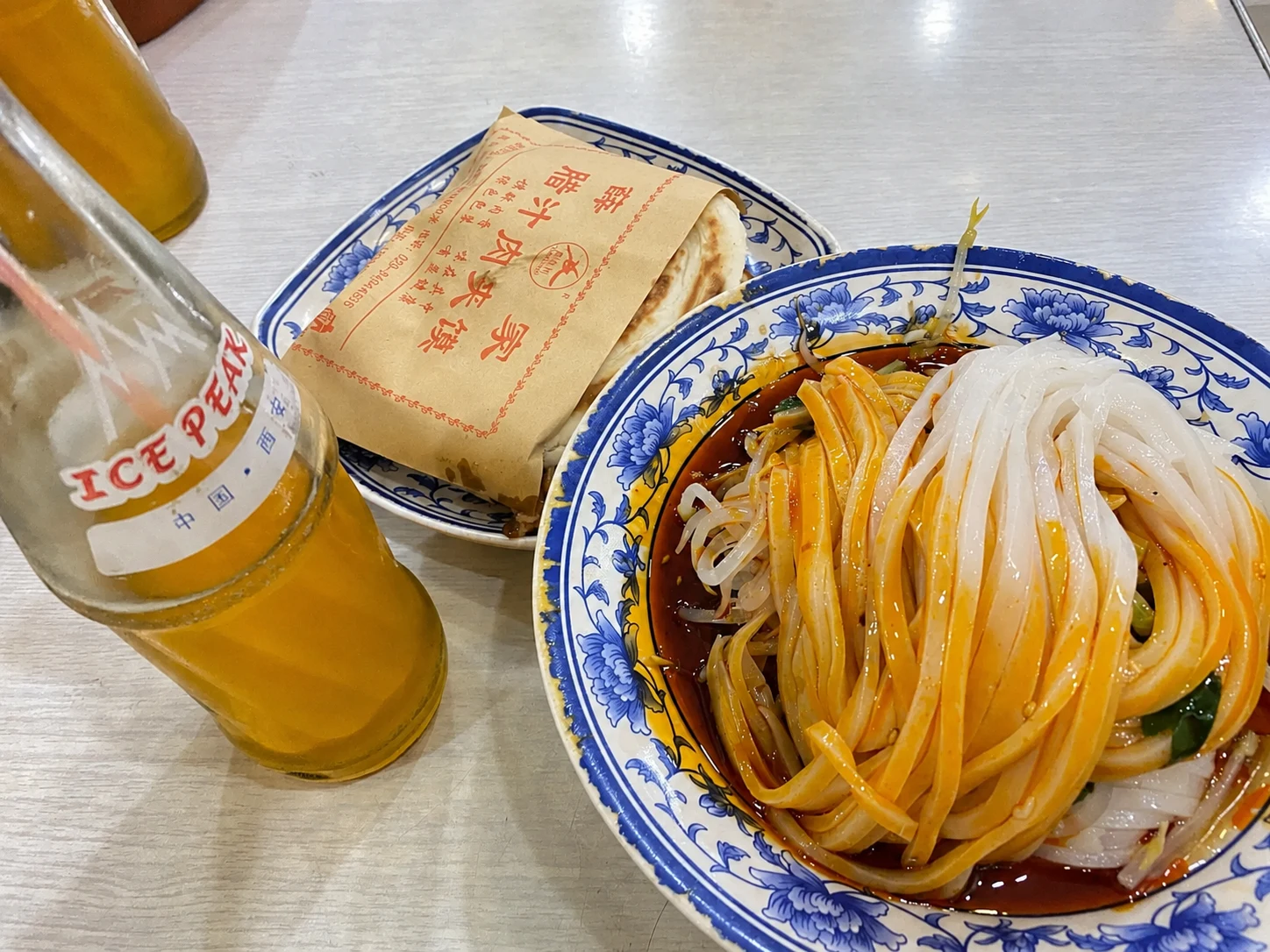
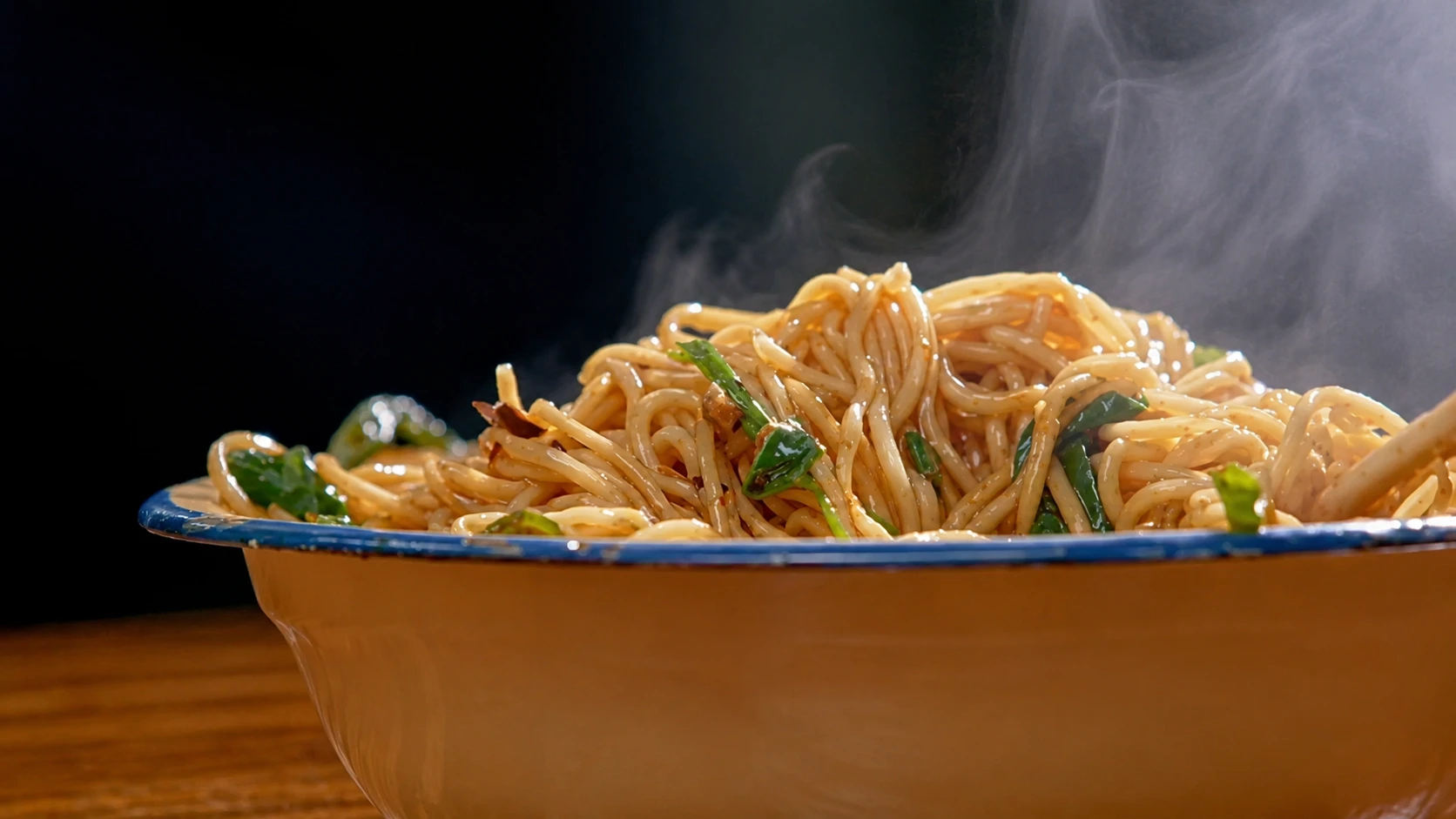
The noodles are cooked; the strainer is flipped over the bowl, and the noodles land on top of the seasonings. Now you must not rush to eat. Pick up your chopsticks and fold the noodles from the bottom up, letting every strand coat itself in red oil. As you fold, you will hear a "sizzle" from the bottom of the bowl—the sound of lard and chili oil being awakened by the hot noodles. Once evenly mixed, the noodles change from white to golden-red, as if wrapped in a layer of amber.
The first bite hits you with six flavors at once: numbing, spicy, savory, fragrant, sour, salty. The alkaline noodles are chewy and springy, the chili oil carries a roasted aroma, the Sichuan pepper powder tingles the tip of your tongue, and the yacai adds a bit of crunch and saltiness. There is no meat, yet it is more satisfying than meat.
Wan Za Mian: The Truce Between Beans and Meat
If xiaomian is going bare-faced, then wan za mian is light makeup.
"Wan" refers to peas; "za" refers to za jiang, or minced meat sauce. These two things—one vegetarian, one meat—usually go their separate ways, but in a Chongqing noodle bowl, they call a truce.
The peas are soaked in clean water overnight, then pressure-cooked until completely disintegrated. Not whole peas, but a mash—golden-yellow pea paste with a faint beaniness and a rich starchy aroma. The za jiang is made from fatty, marbled ground pork, slowly stir-fried with sweet bean sauce and Pixian doubanjiang (fermented fava-bean chili paste) until the oil separates and the meat turns dark brown, the sauce and meat aromas inseparable. One whiff can make you hungry enough for three bowls of rice.
The noodles are cooked, the seasonings are laid, and then a big spoonful of pea mash and a big spoonful of za jiang are piled on top. The pea mash is soft, the za jiang is fragrant, the noodles are springy—three textures wrestling in your mouth until they reach a strange balance. As you eat, the pea mash clings to the noodles, and the oil from the za jiang seeps into the bottom of the bowl; every bite is a different combination.
Wan za mian's status in Chongqing is equivalent to zhajiangmian in Beijing or hot dry noodles in Wuhan. But Chongqing people are more stubborn—outside Chongqing, you cannot find authentic wan za mian. It is not a technical problem; it is a terroir problem. Chongqing's water, Chongqing's chilies, Chongqing's lard, even Chongqing's humidity leave their mark in the bowl. Move to another place, use the same recipe, and the taste is simply wrong.
The Jianghu on Plastic Stools
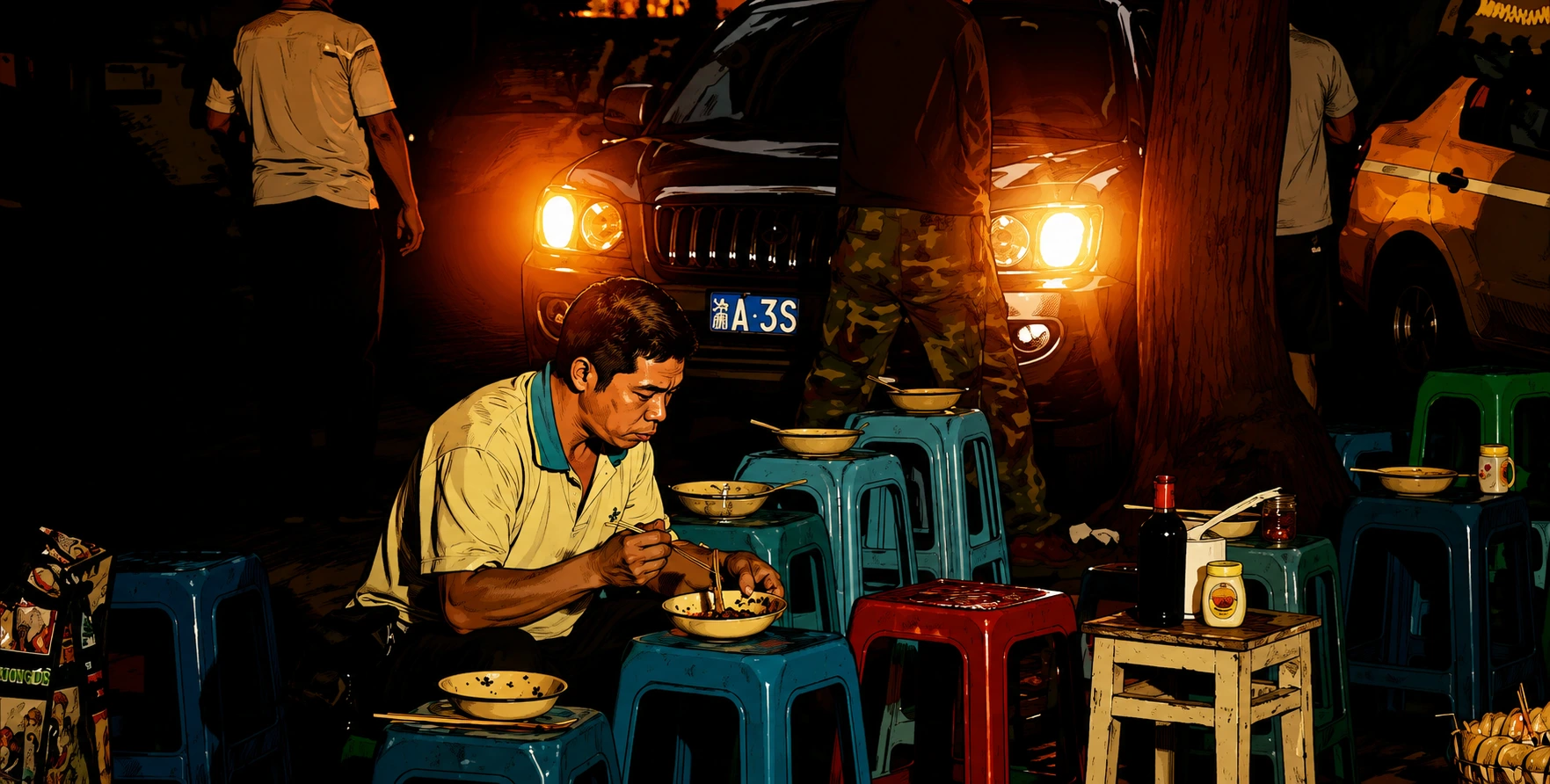
Chongqing noodle shops have no fancy decor. The best seats are not inside the shop, but under the sycamore tree outside, or on the edge of the sidewalk. A folding table, a few plastic stools—that is a "restaurant."
In summer, when Chongqing hits forty degrees Celsius, there is no air conditioning in the noodle shop, only a humming electric fan blowing hot air. Diners sit on plastic stools in tank tops and shorts, bowls of red-oil noodles in front of them, sweat pouring down their faces. When the spice gets too much, they grab the cool tea beside them and gulp it down, or peel a head of raw garlic, chew it up, swallow, and keep eating.
In winter, Chongqing's damp cold seeps into your bones. A plastic sheet hangs at the noodle shop door to block the wind. The wok is always boiling, filling the shop with steam. Diners hunch their shoulders, cupping the hot bowl, taking a sip of the noodle soup first, letting that heat travel from throat to stomach. One bowl down, sweat breaks out on their foreheads, and they can take off their jackets.
In Chongqing, eating noodles is a social activity. Two people sit on the same plastic stool, strangers, but they strike up a conversation over "Is yours wan za or beef?" The boss is the center of attention—whose chilies have changed variety, whose lard has lost its fragrance, whose noodles are too soft. The diners are more professional than food critics.
In Chongqing noodle shops, there are no VIP private rooms. The mayor and the porters sit at the same table, slurping from the same bowl.
The Noodle Family Tree
Chongqing's noodles are not limited to xiaomian and wan za. They form a vast family, each with its own devoted followers.
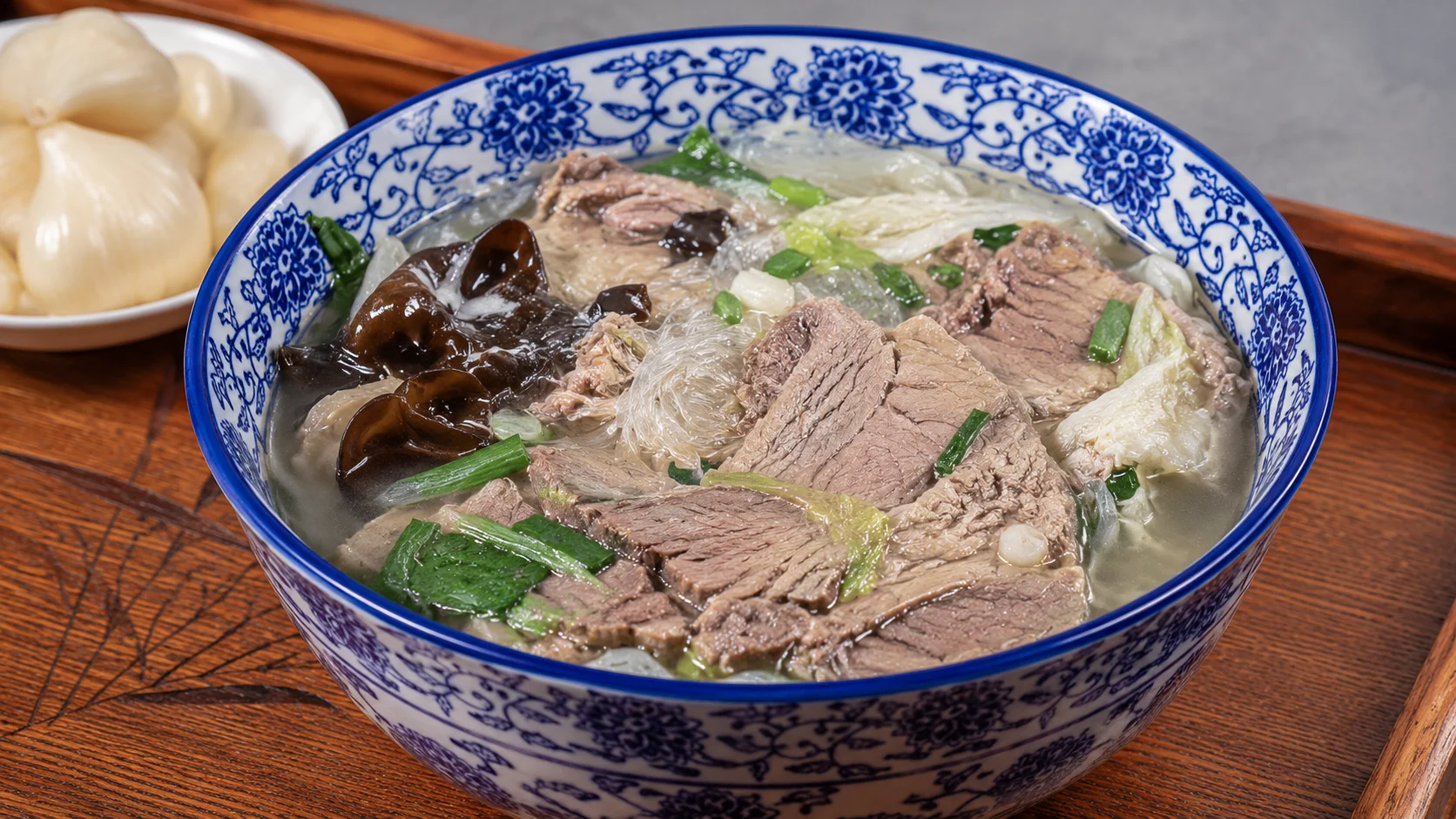
Beef noodles: The beef must be stewed until tender—not the sliced, blanched kind, but braised, fragrant with star anise and cinnamon. The broth is simmered from beef bones, with a layer of red oil floating on top. When eating beef noodles, you must drink the soup; that is the essence.
Pork intestine noodles: The intestines must be cleaned well, but not too well—leave a little fat for flavor. The braised intestines are cut into segments and piled on the noodles, soft and chewy. Those who love them are crazy about them; those who fear them turn pale at the smell.
Pickled pork noodles: The "light" choice for Chongqing locals. Shredded pickled mustard greens are stir-fried with shredded pork, sour and appetizing. Perfect for when your stomach has not woken up in the morning, or when you need a break after too much hot pot the night before.
Chicken giblet noodles: Chicken gizzards, liver, and hearts are stir-fried with pickled chilies and ginger, then piled on the noodles. The crunch of the giblets, the sour-spiciness of the pickled chilies, the springiness of the noodles—this combination creates an addictive texture. This is the heavy flavor among heavy flavors; beginners, be warned.
There is also pugai mian—quilt noodles," sheets as large as bedcovers, two or three per bowl, covering the entire surface; dao xiao mian—not the Shanxi kind, but Chongqing-style, sliced directly into the pot with a kitchen knife, uneven in thickness, varied in texture; and dan dan mian—strictly speaking from Sichuan, but it has taken root in Chongqing too, the combination of sesame paste and Sichuan pepper, fragrant and numbing.
Each type of noodle has a loyal group of regulars. They will go to the same shop on fixed days, sit in fixed seats, and eat fixed flavors. This is not habit; it is ritual.
A Bowl of Noodles from Dawn to Midnight
Chongqing noodle shops have astonishingly long hours.
At 4 a.m., the earliest shift of construction-waste haulers, vegetable-market porters, and nurses coming off the night shift are already sitting in the noodle shop. They want speed—from order to finish, no more than ten minutes. The noodles should be al dente, the chili oil generous, enough to keep them full until noon.
At 10 a.m., the second wave arrives. Retired elderly people, strolling their way to the noodle shop, sitting down for a bowl of xiaomian, eating slowly, chatting slowly. They are the "atmosphere group" of the noodle shop; without them, the place would feel cold.
At 3 p.m., this is the most unusual time. Not a mealtime, but there are always a few people with a "noodle craving" who run over specifically for a bowl. They do not care if it is time to eat; they only care if they want noodles right now. Chongqing locals call this "noodle worms taking over"—incurable, and no need to cure.
At 11 p.m., the last wave appears. Programmers just off work, young people done with karaoke, neighbors finished with mahjong, gathering at the 24-hour noodle shop. At this hour, the noodles are a hangover cure, a sleeping pill, a way to end the day. Eat, wipe your mouth, go home to sleep.
Chongqing's noodle shops are the city's clock. No matter what time it is, there is always a bowl of noodles waiting for you.
How to Eat Noodles Like a Chongqing Local
Coming to Chongqing for noodles, you do not need to do research in advance. Just remember a few local rules.
Find a shop by ducking into the alleys. Chain stores in shopping malls, no matter how bright their decor, do not have the right flavor. A real Chongqing noodle shop has a faded sign, a few plastic stools at the door, a yellowed menu taped to the wall, and a proprietress whose voice carries to the other side of the street. That kind of shop is reliable.
Do not hesitate when ordering. "Two liang" or "three liang" refers to the portion of noodles; women usually get two, men three. "Duo qing" means extra leafy greens (bok choy or pea shoots); "ti huang" means cook the noodles firmer, with a yellowish, al dente core. As for "shao hai jiao" (less chili)—unless you really cannot handle spice, I suggest you do not say it to the boss, or you will miss the original flavor of xiaomian.
Your eating posture matters. Sit down, stick your chopsticks to the bottom of the bowl, and fold the noodles from bottom to top, letting every strand coat itself in red oil. Listen for that "sizzle" as you fold—the sound of lard being awakened by the hot noodles. Then lift a chopstickful, blow on it, and slurp it into your mouth. The louder the sound, the more respect you show the boss. When the noodles are gone, a layer of seasoning remains at the bottom of the bowl—do not waste it. Call out to the boss to "add soup," turning it into a bowl of red broth, and drink it down.
Pair it with a drink. Soy milk cools the spice; liang xia—tiny rice-dough "shrimp" dropped into chilled brown-sugar water—is a slippery sweet treat that washes the heat away. One spicy, one sweet—that is the Chongqing way of balance. Some elderly people pair it with laoying tea—made from the leaves of the indigenous eagle tree—bitter but with a sweet aftertaste, a natural counterpoint to the noodles' mala heat.
Most importantly, leave your pretensions behind. Do not complain about the low plastic stools, the greasy table, or the loud slurping of the person next to you. In Chongqing, the dignity of the noodles is a hundred times more important than the dignity of the environment.
Chongqing locals love hot pot, but hot pot is an occasional carnival. Noodles are a daily necessity. Only after a bowl of xiaomian does the day truly begin.
So when you walk down the streets of Chongqing and catch that aroma mixed with lard, chili, and alkaline wheat noodles, do not hesitate. Find a plastic stool, sit down, and call out: "Boss, two liang of xiaomian."
Then listen for that "sizzle," watch that bowl of golden-red, and feel those six flavors explode on your tongue.
This is Chongqing. Not refined, not reserved, but passionate, real, and utterly addictive.