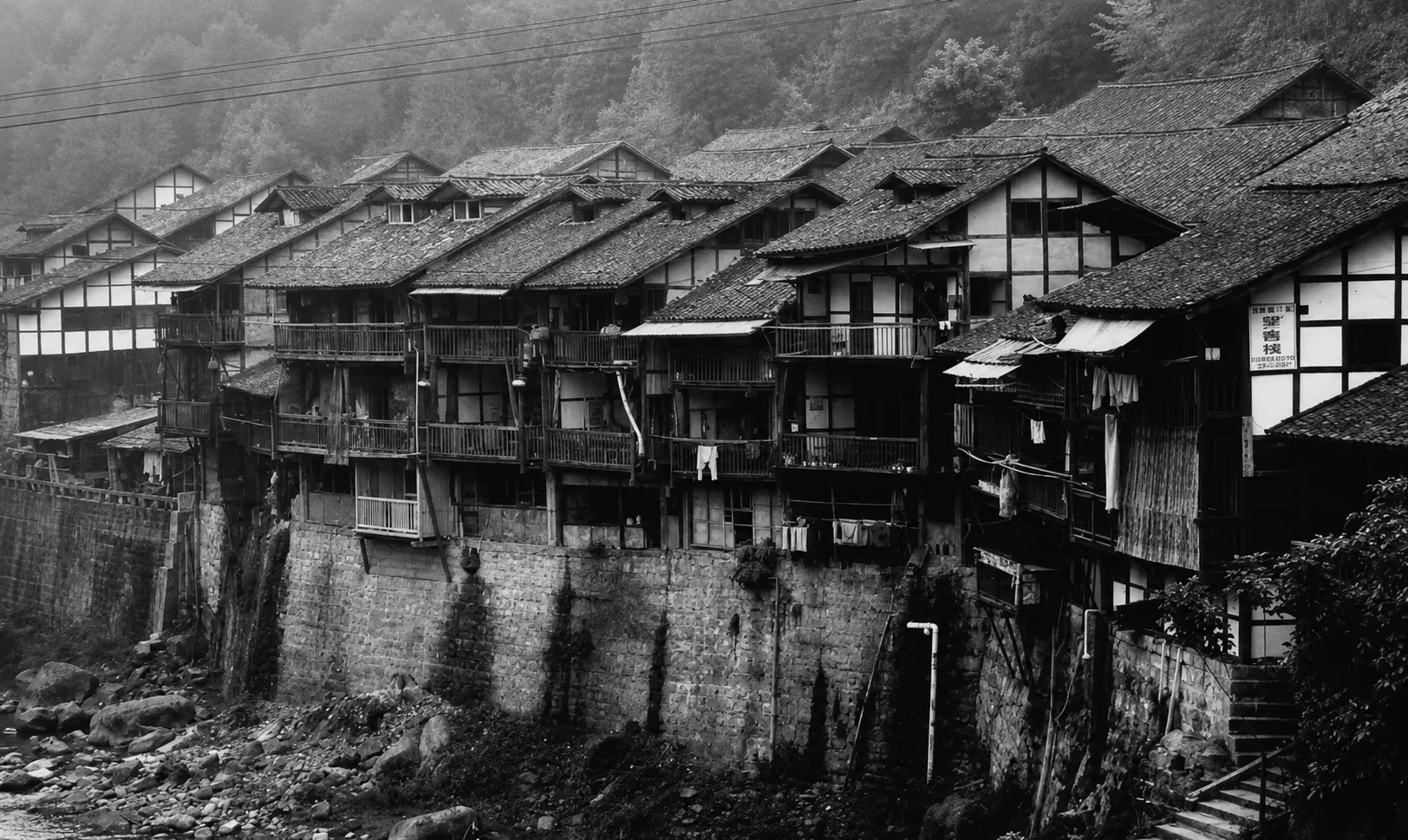
You stand by the Jialing River in Chongqing and look up. The cliff is almost vertical, yet it is densely covered with houses that seem to have "grown" out of the rock. Some have foundations wedged into stone crevices; others have no foundation at all—just a few bowl-thick wooden pillars slanting out from the cliff face like spider legs, gripping the mountain. Floorboards rest on these pillars, cantilevering far out into the air. When someone leans out the window, the rushing river and a dizzying drop of several dozen meters lie directly beneath their feet.
These are diaojiaolou, or "hanging-foot buildings," shaped by Chongqing's shortage of flat land. The rear of a traditional house rests against the slope while wooden posts lift the river-facing side above the drop, creating a level floor without flattening the mountain. Seen from below, the structure appears to float. Its logic is practical: build with the cliff instead of trying to remove it.
Wisdom Forced by the Mountains
Chongqing is a place of seven parts mountain, two parts water, and one part flat land. Level ground is as precious as an eyeball; the few gentle slopes were long ago claimed by docks, markets, and government offices. Common people who needed to live here could only squeeze their way up the hillsides.
But you cannot simply build on a steep slope. Too steep, and you cannot dig a foundation; too soft, and the house will slide into the river. The ancestors came up with a solution: stop digging, and just "hang" the house instead.
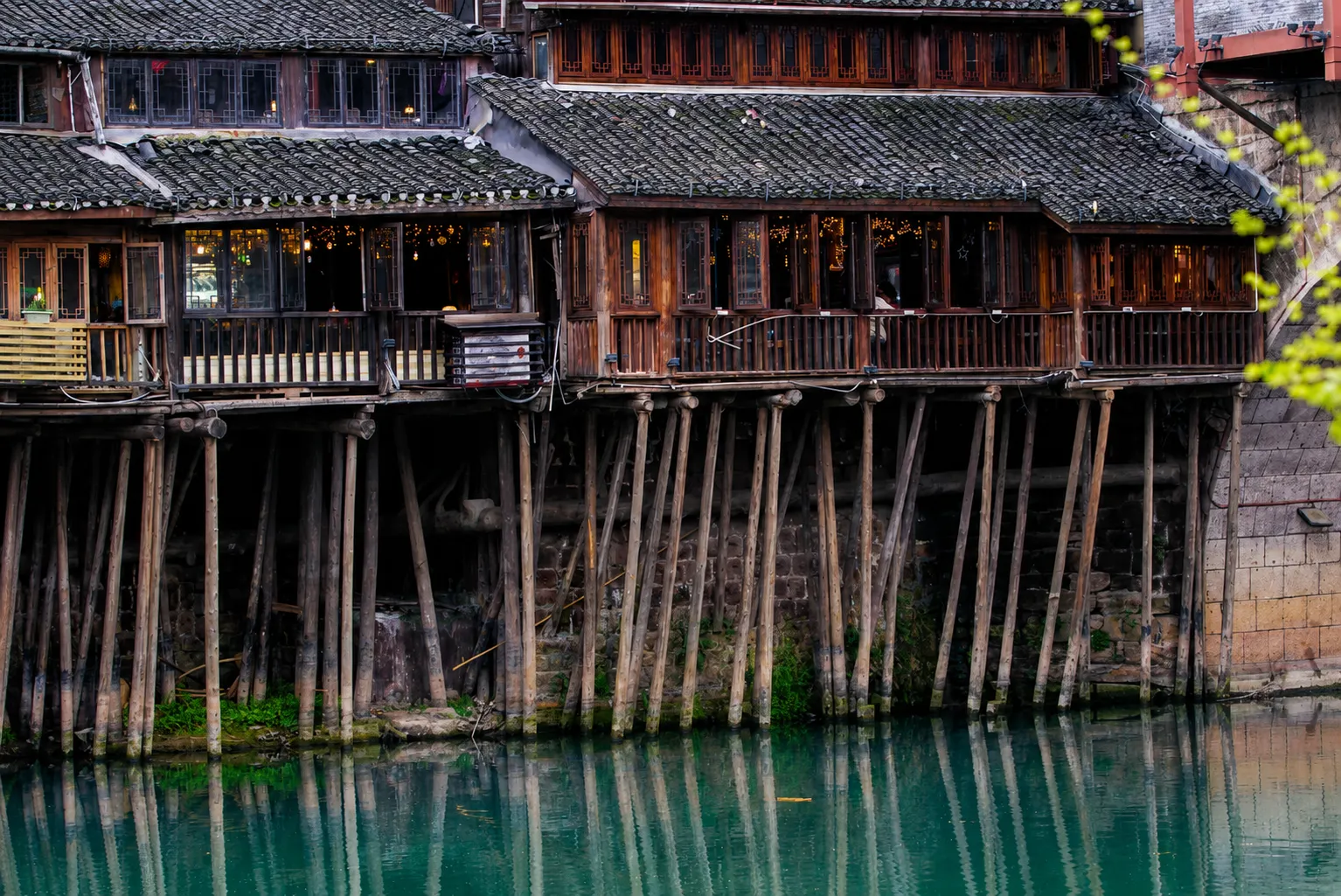
On the river-facing side, a low stone wall is built, or a few wooden piles are driven in to form a "foot." The front half of the house is then set on this "foot," while the rear half rests on the mountain slope. In this way, the house stands like a person—front foot dangling in the air, back foot pushing against the mountain—steady and secure. The open space underneath is perfect for stacking firewood, mooring small boats, or raising a few pigs.
The diaojiaolou is the temperament of a mountain city. The ground is uneven, but the people do not complain; with a few pillars propped up, life goes on as usual.
This structure can be traced back over two thousand years to the Ba people. Archaeological teams in the gorges near Chongqing have excavated stilt-house sites from the Warring States period—raised floors above the ground, keeping out moisture, snakes, and floods. The diaojiaolou is the descendant of these stilt houses, except that the descendants of the Ba people moved them onto even steeper cliffs, making them more dangerous, more stubborn, and more distinctly Chongqing.
The Art of a Single Pillar
Do not underestimate those few hanging wooden pillars. They are the lifeline of the entire house.
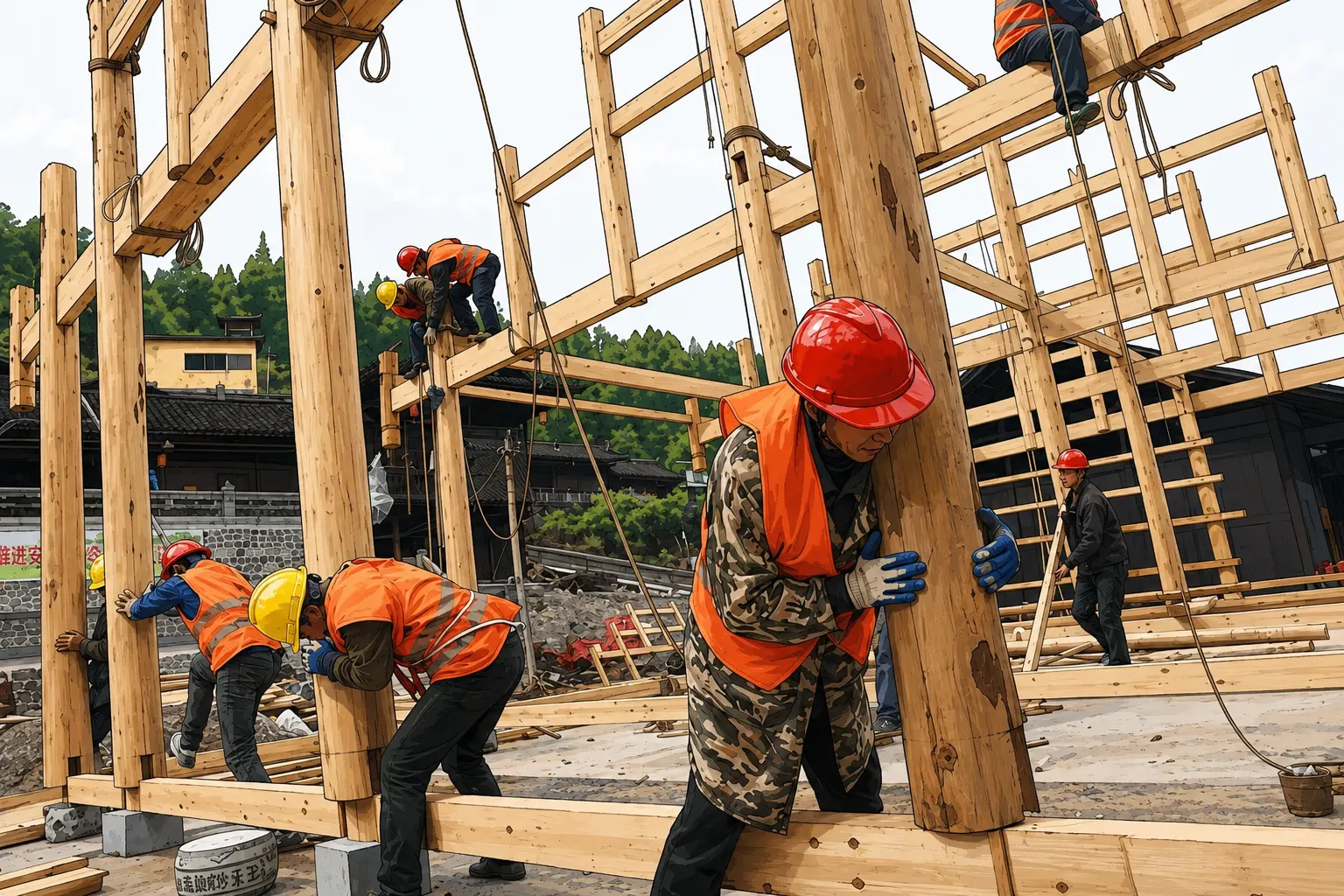
When old carpenters select timber, camphor wood or nanmu are the first choices. These woods resist rot and insects, and can withstand decades of river fog without decaying. The pillars must be straight, but not perfectly straight—a slight natural curve is best, like a fully drawn bow, distributing weight more evenly across the rock face. The base of each pillar is not simply placed on stone; it is carved into a tenon that fits into a pre-chiseled stone slot, then tightened with wooden wedges. Wind, rain, even earthquakes—the pillars may sway slightly, but the mortise-and-tenon joints lock tighter the more they move.
How far the floorboards cantilever outward is also a matter of calculation. Too little, and the space below is wasted; too much, and the pillars bear too much weight, making the floor tremble when people walk. The old rule is "one out, two in"—for every foot that juts out, at least two feet must rest on the mountain. This way, when you walk on the suspended floor, your heart stays steady.
The roof is covered with small blue-gray tiles, layered in a herringbone pattern. Rainwater runs down the tile channels to the eaves, then flings outward in tiny waterfalls. Grass grows in the gaps between tiles, blooming with small yellow flowers in spring. Chongqing locals take it in stride, saying the house has "grown hair."
Life Upstairs
Life inside a diaojiaolou is completely different from life in a flatland apartment.
The staircase is wooden, steep and narrow, creaking with every step. Water carriers, vegetable vendors, schoolchildren—day after day, they wear the steps smooth and shiny. The upper floor is usually divided into three rooms: the central hall, with its ancestral shrine and square "eight-immortal" table; bedrooms on either side, with small windows to block winter wind and summer mosquitoes. On the river-facing side, there is often an "outer corridor," a wooden deck with a knee-high railing. This is the family's living room—cooling off in summer, sunbathing in winter, watching boats come and go on the river at dusk.
The kitchen is usually downstairs, or built on the overhanging side. When stir-frying, cooking smoke drifts out through the gaps in the roof tiles, blending with the river mist. The fire downstairs warms the floorboards above. In winter, elderly women sit on the warm floor mending cloth shoes, feeling the gentle heat from the hearth below, as if the earth itself were breathing.
The liveliest time is the rainy season. When the river rises, the "feet" of the diaojiaolou are submerged, as if standing ankle-deep in the water. Lying in bed at night, you can hear the river slapping against the wooden pillars—thump, thump, thump—like someone knocking at the door downstairs. The children are not afraid; they are excited, leaning on the windowsill watching logs, watermelons, and the occasional flash of a fish drift past on the water.
People who live in diaojiaolou are not afraid of heights. Those afraid of heights cannot live in diaojiaolou.
Hongyadong: The Old Soul in an Internet-Famous Face
Today, the most famous diaojiaolou in Chongqing is Hongyadong.
It stands by the river, eleven stories high, layered in setback terraces climbing the cliff. At night, it is ablaze with lights; viewed from the Qiansimen Bridge across the river, it looks like a golden palace floating in mid-air. Tourists crowd the bridge to take photos, calling it the real-life version of *Spirited Away*.
But old Chongqing locals know that the roots of Hongyadong lie in an old street called Hongya Gate. During the Ming and Qing dynasties, this was one of Chongqing's seventeen city gates—nine open for daily traffic and eight closed for military defense, with the tunnel right at the base of the cliff. Riverboat sailors, trackers, and porters rested in the gate tunnel and drank, gambled, and watched Sichuan opera in the diaojiaolou above. When bodies floated downstream, there were people whose job was to retrieve them—corpse fishermen"—and their homes were also in the diaojiaolou.
In 2006, Hongyadong was rebuilt. The designers preserved the outward form of the diaojiaolou, replacing wooden pillars with reinforced concrete and wooden ladders with elevators. It is no longer a residence; it has become restaurants, bars, and souvenir shops. Some call it fake; others call it beautiful. But no matter what, whenever night falls and those layered upturned eaves light up, an old Chongqing native will still pause for a moment—as if catching a glimpse, through the window of their childhood diaojiaolou, of that hazy stretch of river.
The Disappearing "Feet"
Real wooden diaojiaolou are vanishing fast.
Demolition crews move into the old city, bulldozers crushing century-old houses. Young people move into elevator apartments; elderly people refuse to leave their leaky tile roofs. Occasionally, in Ciqikou, Xiahao Old Street, or some back alley that has not yet been scheduled for demolition, you can still see a few authentic diaojiaolou. The wooden pillars have blackened, the floorboards tilt, and weeds fill the gaps in the tiles. But they still stand, like a few stubborn old men, refusing to bow to flat ground.
There is an old carpenter, now in his seventies, who still does repair work on diaojiaolou. His toolbox holds chisels and an ink marker passed down from his grandfather. He says no one wants to learn this craft anymore. Young people find it hard, slow, and unprofitable. He took on one last apprentice—a forty-year-old electrician who wanted to repair his ancestral home.
"Diaojiaolou is not a technique; it is a way of living," the old carpenter said. "Do you know why the pillars are slanted? Not for convenience, but because the cliff does not tolerate things that go straight. You have to follow its temperament, or it will not let you live there."
How to See a Real Diaojiaolou
If you come to Chongqing and want to see real diaojiaolou, do not only go to Hongyadong.
Go to Xiahao Old Street, or Longmenhao. The old houses are still there. Although most are empty, the wooden pillars, stone walls, and blue-gray tiles remain. Stand below and look up, and you can see light seeping through cracks in the floorboards, and smell the mix of rotting wood and river water. That is the smell of time.
Go to Ciqikou Ancient Town, but do not stay on the main street—duck into the alleys. Around some corner, you will suddenly come upon a diaojiaolou, with a teahouse on the ground floor and residents upstairs. The owner sits on the threshold trimming vegetables, glances up at you without a word, and keeps trimming. That is Chongqing hospitality—not effusive, but never unwelcoming.
The best time is dusk. As the sun sets beyond Gele Mountain—the site of a wartime concentration camp turned memorial park—the river turns golden and the shadows of the diaojiaolou stretch long, like an ink-wash painting. In that moment, you will understand why Chongqing locals cannot leave the river, cannot leave the mountains, and cannot leave these houses suspended in mid-air.
Diaojiaolou grow old, pillars rot, people leave. But as long as the mountains remain and the river remains, there will always be someone who finds a few logs, props them against the cliff, and hangs life up again.
This is Chongqing. The ground is uneven, the sky is rarely clear, but the people always find a way to hang themselves steady between the mountains and the water.